


Dock
Description
This section is from "The American Cyclopaedia", by George Ripley And Charles A. Dana. Also available from Amazon: The New American Cyclopædia. 16 volumes complete..
Dock
Dock (Gr. Dutch dok, Ger. Dock, a receptacle), an artificial enclosure in connection with a harbor or river, used for the reception of vessels, and provided with gates for keeping in or shutting out the tide. There are two kinds of docks in general, wet and dry docks, the former so called because they retain their water for the purpose of keeping vessels afloat. In the United States wharves are popularly but erroneously called docks. Enclosed basins not closed by gates, in consequence of there being no necessity for it because of small tides, are called docks with better reason, as the Atlantic dock at Brooklyn, which will be described in this article, although according to the accepted definitions it should strictly be classed as a basin. The late English engineer Rankine calls a reservoir surrounded by quay walls, and having a single gate without a lock, a basin, restricting the term wet dock to a reservoir which is entered through a lock. Either kind of structure, however, is usually called a wet dock. A dry dock is one from which the water may be shut or pumped out so as to become dry, leaving a vessel in a position to be inspected or repaired.
Floating docks and screw docks are varieties of dry docks by means of which vessels are raised out of the water by the buoyancy of pontoons or the application of screw power. Vessels are also drawn out upon inclined railways which are called slips ; but these cannot properly be called docks, as they are not receptacles in the sense in which the word is understood. - Wet Docks are important structures in harbors where there is considerable rise and fall of tide, serving not only to keep ships afloat, but to maintain a convenient level. They are of comparatively recent date. The Mediterranean, upon which most of the commerce of the world till within a few centuries was conducted, has so little rise and fall of tide, and the vessels used by the ancients were of so small a size, that the necessity of maintaining a level equal to that of high tide did not exist. Liverpool was the first city to embark to any extent in their construction, and for a long time her docks were unrivalled in size and magnificence. In the harbor of New York, at Philadelphia, and at Baltimore and other ports in Chesapeake bay, the rise and fall of the tides are so inconsiderable as to render such docks as those upon the Mersey and the Thames not only unnecessary but inconvenient.
The Atlantic dock, therefore, has no gates. The maintaining of a level of 4 or 5 ft. above low water would doubtless often be an advantage, but the expense necessary to secure it would be greatly disproportionate. At Liverpool, however, where the difference between high and low tide is about 15 ft., and at London, where it is 18 ft., the case is different. Liverpool owes all her great commercial prosperity to the number and extent of her docks, which cover an area of over 200 acres. Without them the Mersey would never have afforded much more than an indifferent harbor for fishing and other small vessels. In the Clyde, where the tides are small, they have not been used, although the idea of providing them has been entertained. Wet docks are constructed with a wall of masonry, or of piling with concrete and tamped clay filling, and with a clay or concrete bottom. The enclosed area may vary from four or five acres, as at Leith, to 70 or more, as the Victoria dock at London. The higher the level of the water in the dock is kept above the low or mean tide of the harbor, the stronger and more impervious the walls require to be made.
When the area is not too great the water is sometimes maintained at the highest tide level by pumps, mainly to avoid the necessity of admitting too much sedimentary matter with the entrance of the tide when the water in the harbor is very turbid. In planning a dock, among other things to be considered is the proportion of the surface of water to the length of the quay walls, which should be as small as is consistent with convenience in manoeuvring the vessels. The docks of Great Britain are usually entered through locks having two gates similar to those on canals. The entrance locks to the docks of London vary in width from 40 to 80 ft., and in length from 100 to over 326, depending upon the class of vessels which it is intended to accommodate. The Victoria docks comprise a tidal basin of 16 acres at the entrance from the Thames, and a main dock of 74 acres. The earthy strata which occupied the site of the dock consisted of a top soil one foot deep, a layer of clay about 5 1/2 ft. thick, then one of peat from 5 to 12 ft., and beneath this a bed of gravel, lying upon the London clay. The dock and basin were excavated to a depth of 26 ft. below high-water mark, and its bottom puddled with clay to a depth of 2 ft., leaving the finished surface 24 ft. below Trinity high-water mark.
The entrance from the river into the basin is by a lock having two pairs of wrought-iron gates, revolving in hollow quoins, the walls of the lock being constructed of cast-iron piling, T-shaped in section, backed with hydraulic concrete. The gates are what are called cylindrical in form; that is, they are portions of a cylinder, with the convexity turned toward the basin. The lock chamber is 80 ft. wide at the bottom and 326 1/2 ft. long, including the upper and lower gate platforms upon which the gates are supported while turning upon a circular roller path. On the site of the lock the surface of the London clay was 37 ft. below high-water mark, and to this depth the excavation was carried at this point, and the foundations of the gate platforms were laid. Between the platforms the bottom of the lock was filled with clay puddle to a level of 28 ft. below high-water mark. The upper gate platform is 25 1/2 ft. below that mark, while the lower one is 28 ft., or at the same depth as the bottom of the lock; so that, the mean fall of tide being 18 ft., there will be 10 ft. depth of water in the dock below the upper platform at low tide.
The entrance from the tidal basin into the dock is by means of a single pair of gates, similar to those of the lock, placed between two dumb jetties or walls which separate the basin from the dock. (See fig. 1.) The basin and dock are 4,050 ft. in length and 1,050 ft. in width. There are six jetties - the two just mentioned, which are each 485 ft. long, and four others extending from the north wall into the dock a distance of 581 ft., including the pointed terminations. These with the sides of the dock and basin afford nearly three miles of quay room. The four interior jetties are each 140 ft. wide for 497 ft., and the surface of the quay varies from 6 to 9 ft. above high-water mark. The side walls are vertical and constructed of cast-iron piles 7 ft. apart from centre to centre, filled in between with brick set in Roman cement, the brickwork being arched toward the back to give strength. Behind the piles and brickwork there is a wall of concrete which was carried up from below the clay bottom, and behind this a filling of clay. The piles are T-shaped in section, and are 35 ft. long and 1 ft. wide on the face, averaging 1 1/2 in. in thickness, and weighing about l3/4 ton each. They are driven to a depth of 28 ft. below high-water mark, and therefore 4 ft. below the bottom of the dock.
The brickwork commences one foot above the bottom, and rests upon concrete 3 ft. thick. The wall is covered with a cast-iron plate bolted to the heads of the piles, and upon these lies a timber sill. The piles in the opposite jetty walls are connected by cross bars, 5 and 17 ft. below their heads. ' Upon each jetty there is a warehouse 500 ft. long and 80 wide, leaving wharf room 30 ft. wide; and it is also supplied with nine hydraulic cranes, one of five tons power at the pointed end, and eight others of two tons power each along the sides. Connected with the north side is a basin which opens into eight graving or dry docks. (For a more detailed description of this work, and also of the docks upon the Tyne, see Spon's " Dictionary of Engineering," London, 1871.) The West India docks, constructed in 1802 in a gorge in the Isle of Dogs, comprise an import dock of 30 acres, an export dock of 25 acres, communicating with the Thames at Blackwall, and a bonded timber dock of 19 acres. The gates are 45 ft. Wide, admitting vessels of 1,200 tons. The whole space occupied by docks and warehouses is 295 acres. The East India docks, also at Blackwall, completed in 1806, belong to the same company as the former.
They include an import basin of 18, an export basin of 9, and an entrance basin of 2 3/4 acres. The gates are 48 ft. wide, and the depth of water 23 ft. The Commercial docks, situated on the opposite side of the river, existed in 1660 under the name of the Rowland great wet dock, and subsequently of the Greenland docks, having been prepared for the accommodation of the Greenland whaling vessels. In 1807 they were greatly enlarged and received their present name, and are now used chiefly to receive vessels laden with corn, iron, lumber, guano, and other bulky articles. They cover an area of 120 acres, 70 of which are water. The granaries will contain 140,000 quarters of corn. The other principal docks here are the London and the St. Katherine docks, the latter situated between the former and the tower. The warehouses in the St. Katherine docks are built upon the water's edge, without a quay; but this plan has since been disapproved on account of interference with the ships' rigging. The docks at Liverpool were authorized by an act of parliament in 1708. There are numerous other mercantile wet docks in Great Britain, a list of which, including entrance basins provided with locks, at the principal ports, is appended :

Fig. 1. - Plan of the Victoria Docks at London.
PORTS. | No. | Area in acres. |
London......... | 23 | 350 |
Liverpool......... | 88 | 206 |
Birkenhead........ | 4 | 142 |
Bristol........ | 4 | 79 |
Hull, exclusive of timber pounds....... | 7 | 46 1/2 |
Freat Grimbsy..... | 2 | 51 |
Hartlepool........... | 1 | 20 |
West Hartlepool, exclusive of timber pounds.. | 3 | 32 |
River Wear......... | 2 | 41 |
River Type........... | 4 | 107 |
Leith..................................... | 3 | 154 |
Dundee......... | 4 | 34 |
Aberdeen............... | 1 | 35 |
- The docks at Cherbourg were commenced by Napoleon I., and the first basin was opened in August, 1813. (See Cherbourg; also for notices of other docks, see the articles on the places where they are situated.) - The Atlantic dock at Brooklyn, technically a tidal basin, was constructed by the Atlantic dock company, chartered by the state legislature in 1840. The work was commenced in 1841, and occupied several years. Over 200 acres of land were purchased at a point on the Long Island shore opposite Governor's island, and 60 acres of the low land and marsh were converted into a basin having 40 acres of water surface.

Fig. 2. - Plan of Atlantic Dock.
The enclosure on the water side was made with cribwork piers consisting of timber filled with stone, sunk in trenches 30 ft. below high-water mark. The cribs were 25 ft. thick at the base, and were placed with their external sides 150 ft. apart, that being the width of the pier, the top of which is 10 ft. above low-water mark. The space between them was filled with sand and gravel from the excavations in the basin. Piles were driven into the filling to a sufficient depth and sawn off 5 ft. below the surface; and upon the heads of the piles the stone foundations of the warehouses were placed. The entrance is between the north and south piers, and is 200 ft. wide. The excavation over the whole 40 acres was made principally with dredging machines working by means of an endless chain, and was carried to an average depth of 20 ft. below low-water mark, or 25 ft. below high-water mark. In the basin, reaching from either end, are wooden piers of sufficient width for the unloading of ships, built of piles covered with timber and planking. Upon the cribwork piers, one of 1,070 and the other of 1,000 feet in length, there are commodious stone warehouses, 100 ft. in depth and extending the length of the piers.
Upon the opposite or inland side of the basin is the commercial wharf, 2,000 ft. in length, and upon this there are three blocks of warehouses, each 460 ft. long and 180 ft. deep, besides an iron yard of the same dimensions. There are several grain elevators situated upon different parts of the wharves. A plan of the dock is given in fig. 2; for a further description and a perspective view, see Brooklyn. - Dry Docks, often called graving docks, because used for graving or cleaning the bottoms of ships, consist, as before stated, of those which are pumped dry and those which discharge the water by being raised. The former are usually built of masonry, but are sometimes constructed of piling, concrete, and clay puddling. Two of the latter kind were constructed at the Erie basin, near the Atlantic dock, which are 500 ft. in length by 90 in width at top and 480 by 50 ft. at bottom, and 30 ft. deep. The dry dock at the Brooklyn navy yard is the finest structure of the kind in the United States. It was commenced in August, 1841, and completed in August, 1851. The construction of the coffer dam and the excavation which initiated the work are described in the article Dam. The main chamber of the dock, fig. 3, a., is 286 ft. long and 30 ft. wide at the bottom, and 307 ft. long and 98 ft. wide at the top, this being the distance between the folding gates g g and the head of the dock e.
Behind the folding gates is what is called the lock chamber, c, 52 ft. long, which length may be added to the dock when it is required, a caisson, d, forming the external gate being sufficient to exclude the water. The bottom is 26 ft. below mean high tide, and 30 ft. 8 in. below the coping. The foundation had to be constructed in quicksand, and consisted of piling driven to great depth, covered with 18 in. of hydraulic concrete, this covered with cross timbers of yellow pine 12 in. square, and this again with 3 ft. granite blocks laid in hydraulic cement. A cross section is represented in fig. 4. The walls, composed of heavy granite blocks laid in hydraulic cement, are carrried up vertically from this foundation, and are 108 ft. from outside to outside, being 5 ft. thick at the coping and 39 ft. at the bottom or lower step, and varying in thickness between these two points in accordance with the curve, which is irregular and made to correspond with the general curve of the side of a ship. The distance between the quoins in which the folding gates revolve is 66 ft., and this is about the average width of the lock chamber, and also of the length of the deck of the caisson or outer gate, which has also a beam of 16 and a depth of 30 ft.
Two culverts, c, c, one on either side of the entrance and below the surface at low tide, admit water and carry it in a descending course to the bottom of the dock a few feet in front of the inner gates. These culverts have a calibre of 4 ft. 9 in. vertical by 2 ft. 5 in. horizontal. At the points where they enter the dock commence the discharge culverts, which are carried on either side to a point beyond the head, where they unite and empty into a well under the engine bouse. From this well the water is pumped into a culvert which descends to the river and discharges at a point near the entrance of the dock. The pumping engine can empty the dock in 2h. 10m., its capacity when filled by the tide being about 000,000 cubic feet. When a ship is docked, the filling culverts are closed, as well as the passages from the dock chamber to the draining culverts leading to the pump well, and the water is pumped from the latter; the ship is then admitted and placed over the keel block in the centre of the dock; the caisson is next floated to its place, over the recess or groove, and filled with water until it sinks down to the bottom of the masonry fitted to receive its keel; after which the turning gates are closed by men standing on the bridge, and working the four hand wheels that move the machinery.
The culvert gates in the dock chamber are next drawn and the water is allowed to flow into the draining culvert and well, by which means the water is lowered several inches in the | dock in a few minutes, thus hastening the shoring and producing an immediate pressure on the gates, so as to effectually prevent the admission of water and fix them steadily. A complete command of the level at the moment the gates are closed, or when a ship, especially a large one, is about to touch the blocks and requires the placing of shores, is important; and the above method gives a more perfect control of the operation for the first foot than could be obtained by the best regulated pumps and machinery for driving them. - There are also naval dry docks at the navy yards of Boston, Portsmouth, Norfolk, Pensacola, and San Francisco. The Boston dry dock, situated at Charlestown, is of granite, 256 ft. long and 86 ft. wide, with a depth at mean high tide of 25 ft. The length of the dock may be increased 53 ft., like the one at Brooklyn, by leaving open the turning gates and using the caisson alone. It was commenced in 1827 and finished in 1834. The dry dock at Norfolk, Va., built at the same time, is also of granite.
Before its completion the ship of the line Delaware was docked in it in 1833, on the anniversary of the battle of Bunker Hill (June 17), being the first national ship ever docked in a United States dry dock. Its dimensions and construction are like those of the Boston dock. - There are 11 dry docks at the Portsmouth navy yard, England; among them two (double locks), each 644 ft. long, with gates 80 and 88 ft. in width and a depth of water at highest tides of 25 and 27 ft.; and another 426 ft. long, with gates 70 ft. wide, and a depth of 25 ft. 9 in. at high tide. At Devonport there are five dry docks, one 437 ft. long, with an entrance 73 ft. wide, and a depth of water at high tide of 31 ft. There are 18 dry docks at Liverpool, some of them over 500 ft. long, the Canada graving dock having an entrance width of 100 ft. and a maximum depth of water of 26 ft. At Birkenhead there are six dry docks, two of them 750 ft. long at the bottom, with gates 85 and 50 ft. wide, and a depth of 29 ft. 9 in. at high water. There are numerous other magnificent structures in other parts of the kingdom. The number of floating basins in the English government dockyards is 11, comprising a total area of 35 acres, and having a lineal quay space of 13,500 ft.
The dry docks at Se-bastopol, which were mainly destroyed after the capture of the city, Sept. 8, 1855, were situated considerably above the level of the Black sea, and the expense of pumping was entirely avoided; ships were raised into a general dock basin by a series of three locks, each of which had a rise of 10 ft. The water for supplying the basin, for filling the docks, and for working the locks, was brought by a canal 12 m. long, which taps a mountain stream. Vessels, after being elevated into the general basin, wore floated into one of these dry docks, and, the gates being closed, the water was let off into the sea through a subterranean culvert. - A floating dry dock, called a balance dock, and which was patented by John S. Gilbert of New York, consists of a pontoon divided into compartments, which may be so filled with either air or water as to preserve a balance of position, and by its buoyancy to be capable of raising vessels. It may be built of timber and planking, or of wrought iron and planking. Those which are used in New York have the framework entirely of wood, and one of them has been in use for nearly 30 years. The pontoons may be from 8 to 12 ft. in depth, and 100 or more in breadth by 350 or more in length.
They are strongly girded and trussed, and have a strong bulkhead running through the middle for the whole length, upon which the keel of the vessel is supported by keel blocks. At either side the dock rises into walled chambers, which may be also filled with water or air, and upon the deck of which are placed steam engines for the purpose of pumping the water from the interior. The ends of the dock are left open, so that when the vessel is raised the water readily flows from the dock. Fig. 5 represents the larger of two docks owned by the New York balance dock company. It is 325 ft. long, 100 ft. wide, and 30 ft. from deck of pontoons to deck of side walls, or 40 ft. in all, the pontoons being 10 ft. deep. It has 8 gates on either side for admitting, and 8 others for discharging water, which is pumped out by steam engines, one upon either wall, of 40 horse power each. The pumps are 14 in number, 7 on either side, of 36 in. diameter and 35 in. stroke, capable of exhausting with sufficient rapidity to raise a vessel of 3,000 tons in an hour and a half. Its total lifting power is estimated at 8,000 tons.
In docking a vessel on the balance dock, the pumps are first set in motion by the steam engines on the deck above, and the discharge opening being closed by a gate for that purpose, the water rises in the chamber above the pumps until it is full to the deck of the dock. It is next allowed to flow into the upper chamber of the dock until its weight, acting as ballast, sinks the dock to the required depth. When the ship is floated into the dock, this ballast is drawn off by means of valves, causing the dock to rise by its own specific gravity until it touches the bottom of the ship, after which the vessel is lifted by pumping the water out of the side chambers and bottom tank; and as the dock rises, the water around the ship in the middle chamber ebbs out, so that the quantity of water to be exhausted in raising a vessel is in proportion to her weight and not to her bulk. - Fig. 6 represents a cross section of an iron floating dock, built mainly upon the same principle as the New York floating dock, differing however in having air chambers in the upper part of the walls, by means of which the depth of sinking is controlled. It was constructed by Mr. G. B. Rennie for the port of Ferrol on the 1ST. W. coast of Spain. It is 350 ft. long, 105 ft. wide, and 50 ft. high in extreme dimensions.
The depth of the pontoon is 12 1/2 ft., leaving a height of 37 1/2 ft. from the deck of the pontoon to the deck of the side walls, so that if the keel blocks occupy 5 ft. and the deck remains 4 1/2 ft. above water, there will be a clear depth of 28 ft. of water for the admission of ships. The total weight of the dock is about 5,000 tons, and the displacement by the pontoon is equal to 13,000 tons, leaving a lifting power of 8,000 tons. It is constructed of plate, angle, and T iron, riveted together in one structure. The pontoon is divided by a water-tight bulkhead running the whole length, each half being subdivided by 10 transverse bulkheads. The upper part of the side walls is composed of air-tight chambers having a capacity sufficient to prevent the dock from sinking below any desired level. The pontoon is strengthened by open lattice girders equal to it in depth, 34 of these being transverse, on either side. It is covered with three-inch teak plank, laid longitudinally, and upon this over every third transverse girder are transverse beams of teak 2 ft. square, for the support of the keel and bilge blocks. Keel blocks are also placed on the intermediate girders.
Four large sluices, two on either side, communicate by pipes 18 in. in diameter with the several compartments, the pipes having cocks to regulate the quantity of water in each compartment. There are four pumps on either side, of 2 ft. 9 in. stroke and 26 in. diameter, worked by steam. Four capstans are placed at each end for moving and mooring. - The New York sectional floating dock was patented by Phineas Burgess in 1838, and the first dock was begun by Burgess and Dodge in 1839. It consists of a number of floating pontoons, which form the dock by being placed side by side. At the end of each pontoon there is a framework of timber which supports machinery for pumping, being sufficiently high to remain out of water when the dock is submerged. This framework projects beyond the end of the pontoon, and its lower part contains what is called a balance tank, an air-tight chamber, which may be raised and lowered by means of a rack and pinion connected with the pumping machinery. These tanks have much the same use as the air chambers in the iron floating dock just described; by raising them the depth of the deck of the pontoons will be increased, and by lowering them the pontoons will be raised, independently of the amount of air or water the latter may contain.
Fig. 7 re] (resents the largest of these docks owned by the company. It consists of 10 sections, which when placed close together form a dock 350 ft. long and 110 ft. broad. These sections may be placed at some distance apart so as to increase the length of the dock when required, or if not of sufficient buoyancy other sections may be added. The advantage claimed for this dock is, that the buoyancy of each section may be so regulated as to bear with equal pressure against all parts of the ship's bottom, so that if she has been warped there will be no strain. On the other hand, it is stated that irregularities of pressure caused by swells from steamboat-- or otherwise more or less reduce this advantage. Advantage it certainly has in the facility with which it may be repaired, by taking up any section and placing it upon the dock formed by the remainder. - The arrangements for docking at the navy yard of Philadelphia consist of a Moating sectional dry dock, and a permanent stone basin with two marine railways. The sectional dock consists of nine sections, which may he increased in number, each section being 105 ft. long and 32 ft. wide, and the pontoons 11 ft; deep. There are three pumps at each end of each section, moved by two engines of 20 and two of 12 horse power.
The bottom of the basin is 350 ft. long and 226 ft. wide and will hold 10 ft. 9 in. of water at mean high tide. The dry dock at San Francisco is a sectional dock similar to the one at Philadelphia, but is a little larger. The dock at Portsmouth is a balance dry dock, 350 ft. long, 105 ft. wide, and 38 ft. deep. There is also a basin 350 ft. long and 120 ft. wide, with two marine railways. At Pensacola the docking arrangements are precisely the same as at Portsmouth. - There is in use at New York a so-called hydrostatic screw dock, in which vessels are raised by hydrostatic power applied to screws to which chains are attached, supporting strong platforms consisting of trusses of timber. The first dock of the kind was worked by screws alone, and was patented by Elisha Turner in 1825. The improvements by which hydrostatic power was applied were patented by Zebedee Ring in 1836. The screws which suspend the chains are fixed in a drawing frame which rests upon pins at either side. The drawing frames are propelled by horizontal hydrostatic cylinders.
The platform upon which the vessel rests may be adjusted to the bottom by raising or lowering each section or truss as may be required.
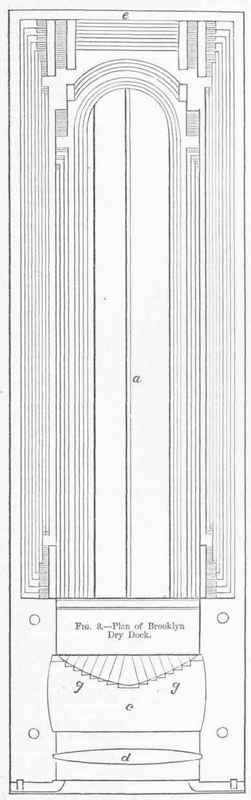
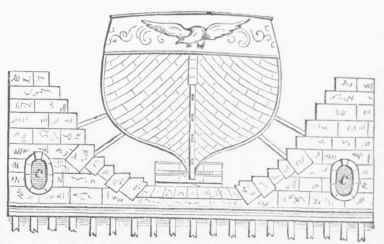
Fig. 4. - Transverse Section of Brooklyn Dry Dock.
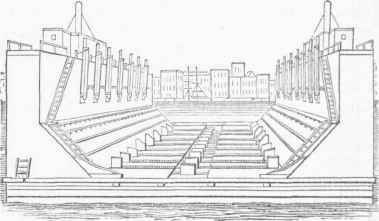
Fig. 5. - Balance Dock.

Fig. 6. - Transverse Section of Ronnie's Floating Dock.

Fig. 7. - New York Sectional Dock.
Continue to:


My Books

