


Hop
Description
This section is from "The American Cyclopaedia", by George Ripley And Charles A. Dana. Also available from Amazon: The New American Cyclopædia. 16 volumes complete..
Hop
Hop , (Ger. Hopfen), hamulus lupulus, a plant which with cannabis, the hemp, composes the order cannabineoe; this is by some botanists regarded as a suborder of the nettle family, the urticaceoe. The plant is dioecious; the flowers are apetalous; the staminate ones have five sepals and as many stamens; they are in loose axillary panicles; the fertile flowers are in short catkins of leafy scales, each of which has two flowers; calyx of a single sepal embracing the ovary, which has a style with two stigmas, and in ripening becomes a one-seeded fruit or acliene. In maturing, the scales of the catkin increase much in size and form a membranaceous cone or strobile; they are covered at their base with an aromatic resinous substance of yellowish color, known as lupuline. This constitutes about one sixth of the weight of the dried catkins, and contains the greater portion of their valuable qualities. The hop is a vine, with a perennial root from which spring up numerous annual shoots, forming slender flexible stems, angular and rough to the touch. These climb spirally upon trees or around poles to the height of 20 or 30 ft.
The leaves are opposite on long petioles, heart-shaped, and three- or five-lobed. The hop is found wild in America, Europe, and Asia. It has long been cultivated in Germany, where its use is traced back as far as the 9th century. In other countries it has become an important agricultural product, and in the United States is now largely cultivated; portions of New York and Wisconsin are the largest hop-growing sections, but considerable quantities are produced in other states; hops are an article of both export and import. The English, who have carried its culture to great perfection, first engaged in it in the reign of Henry VIII., about the year 1524, having learned from people of Artois its qualities of preserving beer from fermentation and imparting an agreeable bitter flavor to the liquor. Previous to the introduction of hops, various bitter herbs were used in beer, especially the alehoof or ground ivy, glechoma hederacea, and the use of hops was strongly protested against. The S. E. part of England is particularly favorable for the crop; and in the county of [Cent alone from 25,000 to 30,000 acres have long been appropriated to it.
Hop plantations are also found in other counties; but the production of Kent probably represents one half of the whole amount raised in England. In ordinary seasons this county supplies nearly enough hops for all the malt liquors brewed in England; but the crop is very fluctuating, and in seasons of scarcity hops are imported from Belgium and the United States. The Belgian hops have a good reputation; but those of Bavaria are the best of all, the aroma being more perfectly preserved by the method of preparation in practice there. The American hops are not so highly esteemed in England as those raised there, and bring a lower price. Several varieties are known to cultivators, such as the English cluster, grape, Pompey, and others, the first named being considered the best. The situations selected for hop yards are the sunny slopes of hills, or wherever there is a free circulation of air. Such soil as will produce a good crop of Indian corn is suited to hops, but it is essential that it be naturally or artificially drained, as success is impossible on a wet soil. The planting is done with "sets," which arc the underground stems of old vines cut into pieces of two or three joints. The plant being dioecious, 8 or 12 mole hills are equally distributed in each acre.
The hills are marked out from 7 to 10 ft. apart, and from three to five sets are planted in a hill. The plants are well cultivated the first year, the vines being allowed to spread upon the ground. The second spring, two poles 16 to 20 ft. long are set to each hill, and the vines as they grow are assisted, if need be, to twine upon the poles, the crop being kept clear of weeds. Hops are subject to blight of various kinds from mould or rust, and the devastation of an aphis or louse. This insect probably destroys more than half the crops, and much of the remainder is lost by unfavorable seasons and other causes. When the hops are mature, the poles are pulled up with the vines hanging to them, and women and children gather the strobiles, which are immediately carried to the kilns, called hop oasts, in which they are dried upon a floor of wire or hair cloth at a heat not exceeding 180° E. Fumes of burning sulphur are admitted to the hops while drying, by which they are partially bleached. They are then packed tightly in bags or pockets with the aid of a press, and the parcels are made so compact that they may be cut into blocks with a knife. The bales may be kept for years in a dry airy situation.
The Belgians follow the same practice; but the Bavarians, when the hops are ripe, cut off the plants close to the ground, and leave them upon the poles to dry in the sun. This is thought to preserve better the aroma, and the hops, though packed loosely in bags, have more strength and flavor than the English or Belgian. Several years ago a plan for training hops on strings or wires was patented under the name of the horizontal hop yard. One pole about 7 ft. high is placed at each hill, and the tops of the poles are connected by twine stretched across the yard in two directions; it is made fast to the end poles in each row and wound once around the tops of the others. When the hops are ripe for picking, the strings are loosened, and as many removed as may be convenient for the pickers. The quality of hops is judged of by the weight of the bags, the heavier samples having more of the lupuline or hop dust, 1 lb. of which is considered equal to 4 lbs. of the strobiles deprived of it. They should be of a clear bright color, free from greenish particles, but full of hard seeds and lupuline, and become sticky with the heat of the hand. Being greatly injured by dampness, the presence of a crust thereby produced should be particularly looked for.
The essential properties of the hop, its bitterness and fragrance, appear to reside in the lupuline; this was for a long time supposed to be the pollen of the hop, but it is found only on the pistillate catkins, and consists of peculiar glands attached to the base of the scales; their appearance when magnified is shown in the engraving. This substance was noticed by Sir J. E. Smith of England and M. Planche of France, and its properties were investigated by Dr. A. W. Ives of New York. When hops are shaken in a coarse bag a fine yellow powder passes through, which is shown to bo of a resinous character by its agglutinating under a moderate heat, and burning with a white flame. Dr. Ives call-ed this substance lupuline, but this name is more properly applicable to the bitter principle it contains. In 120 grains he found 5 of tannin, 10 of extractive, 11 of bitter principle, 12 of wax, 36 of resin, and 46 of lignine. A volatile oil also has been separated by Pa-yen and Chevallier, by distillation of the lupuline. This oil is yellowish, and has an acrid taste with the odor of hops. The oil and the bitter principle impart the virtues of the hops to water and alcohol.
The separation of the resinous powder and its use in commerco instead of the hops was strongly recommended by Dr. Ives, on the score of economy in saving transportation, handling of bulky materials, and absorption of wort. - Besides their use for preserving and flavoring malt liquors, hops have a reputation in medical practice as a tonic. Their efficacy depends both upon the bitter principle and, to a less degree, the volatile oil. The effect of the former is chiefly obtained from malt liquors, where it is of course much modified by the alcohol and other constituents. The tincture of hops and tincture of lupuline are preparations in which the alcohol they contain is more active than the hops. The narcotic and sedative effects of hops and lupuline are very slight, and to be obtained chiefly from large doses of the latter preparation. A hop pillow is however sometimes used to promote sleep, and hop poultices and fomentations are occasionally employed. It is very probable, however, that any supposed specific effect from the hops is largely due to the imagination. Pills of lupuline may be prepared by rubbing the powder in a warm mortar until it becomes plastic, and then working it into pills; these may be given in doses of 6 to 12 grains.
In hop-growing countries the young shoots are often blanched by covering with earth, and are highly esteemed as a table delicacy, being prepared like asparagus. The fibres of the vine are strong and flexible, and have been woven into coarse cloth, which served for the sacks in which the hops are carried to market. Hop vines are one of the many substances that have recently been proposed as a stock for paper makers. - The production of hops in the United States has increased from 3,497,029 lbs. in 1850 to 10,991,-996 lbs. in 1860, and 25,456,669 in 1870. Of the last amount, New York produced 17,558,-681 lbs., Wisconsin 4,630,155, Michigan 828,-269, California 625,064, and Vermont 527,927. In 1872 there were under cultivation in Great Britain and Ireland 61,927 acres of hops. The imports for that year amounted to 135,965 cwts., valued at £679,276, of which 66,930 cwts., worth £297,034, were from Belgium, and 36,612 cwts., valued at £221,617, from Germany.
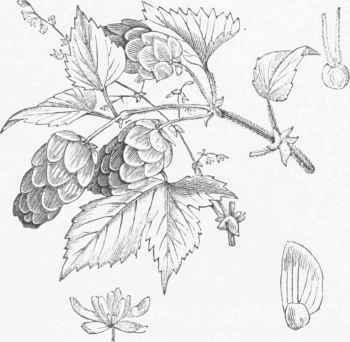
Hop (Humulus lupulus).

Lupuline Grains, highly magnified.
Continue to:


My Books

