


Churn
Description
This section is from "The Domestic Encyclopaedia Vol1", by A. F. M. Willich. Amazon: The Domestic Encyclopaedia.
Churn
Churn, a vessel in which butter, by long and violent agitation, is separated from the serous part of milk.
The inferiority of the churns in common use, has induced several ingenious mechanics to exert their skill in contriving others, that would render the process of making butter less tedious and expensive. Of these, we shall give a succinct account.
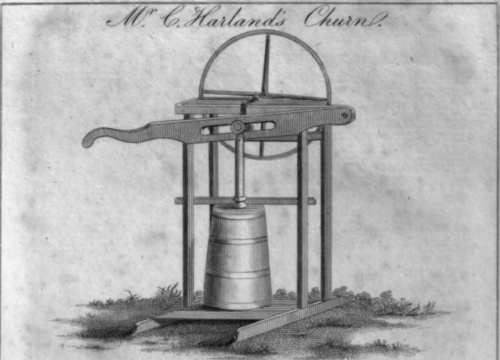
The first is an improved butter churn, constructed on a new principle, by the ingenious Mr. C. Harland Churn, London. The Barrel Churn, delineated in the Plate annexed, is moved by the intervention of a multiplying wheel, to moderate its too violent motion. The head of the crank in the mortise (in the handle) effects the rotatory motion of the barrel with great facility, And, if the barrel be fixed, and the axis (in the inside), to which the dashers are attached, be made to turn, the butter will be more speedilyformed. A fly-wheel is also affixed, by means of which the agitation of the cream is necessarily performed in a more uniform manner; and, consequently, the butter will be more perfectly separated from the whey.
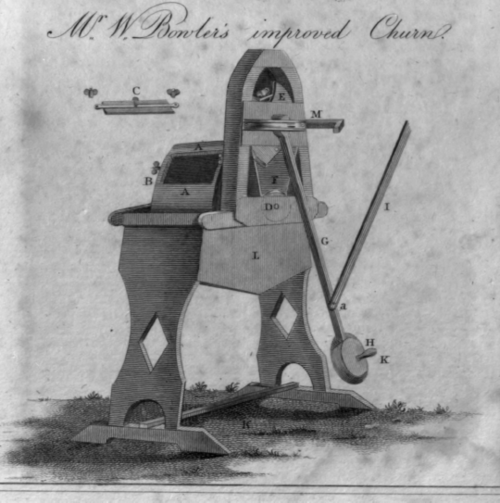
The second is Mr. WILLIAM BoW -ler's improved Churn*, for which the Society for the Encouragement of Arts, Manufactures, and Commerce, liberally gave him thirty guineas, in the year 1795.
This churn is of the barrel kind, being cylinder, 18 inches in dia-meter, and 9 wide ; the sides are of wood, and the rim a tin plate, which has two openings; one 81/2 inches in length, and 4 in width, through which the cream is poured into the churn, and the hand introduced for cleaning it; the other, a short pipe, one inch in diameter, by which the butter-milk runs out of the churn, when the operation is finished. The first of these openings has a wooden cover, fastened down by two screws ; and the other a cork fitted to it, while the butter is churning. There is- farther, near the larger opening, a small vent-hole with a peg, to admit the pa sage of any air that: may -be discharged from the cream, at the beginning of the operation. An axle also through the churn, terminating in two gudeons on which it hangs ; its . part being immersed in a trough, in order to to old occasionally either hot or cold water, according to the -season of the year. On the inside of the rim, are four projecting pieces of wood, with holes, serving to agitate the cream by the motion of the churn. This movement is car. by a pendulum 3 feet 6 inches long, has an iron bob, weighing l0 lbs. and at its end a turning inches in diamete rope goes twice round another about 3 inches in diameter, fixed on the axis of the churn, which it causes to make a partial revolution, by each vibration of the pendulum.
'1 here are likewise sliding covers to the machinery, and also another to the water trough ; hot water is used, to secure the steam, and keep the cream in a proper degree of warmth. The motion of the pendulum is given, andcontinued, by means of a wooden rod, about 3 feet 9 inches in ten which turns on a pin 3 inches above the bob of the pendulum.
Explanation of the Engraving which represents Mr. William Bowler's improved Churn.
A. A. The body of the churn.
B. An opening, by which cream is put in.
C. The cover of the large opening. The small hole on the 0; site side cannot be delineated in the print.
D. The axis, or gudgeon, on which the body of the churn is suspended.
E. The upper, or large pulley.
F. The smaller pulley fixed on the axis of the churn.
G. G. The rod of the pendulum, hanging; from the upper pulley E.
H. The bob of the pendulum.
1.1. The handle, moveable on the pin at a, by which the pendulum is. moved, making a traverse in the form of the dotted line K. K',
L. The trough for the hot or cold water.
M. A projecting piece of wood, with a shoulder, which supports the handle I. when the churn is not at work. -----------As butter is often made in small quantities, and the vertical motion of the common churn is extremely fatiguing, we consider those me-thods of applying the powers of mechanism, as valuable improvements. Hence we presume to re-Commend the preceding improved butter-churns to' be generally in-troduced ; for the facility and expedition, , with which butter is thus obtained, will amply compensate the additional expence.
Churing as we have already discussed the subject of butter and treated of the management of the dairy as connected with it, we shall only offer here a few suupplementary tary remarks.
If a pump-churn be employed, it may be plunged a foot deep in a tub of cold water, and remain there during the whole time • of churning; which will harden the butler in a considerable degree. This operation, as we have before observed (p. -103), may be much facilitated, by pouring into the churn a small quantity of distilled Vinegar, which will produce butter in the course of one hour. Those who make use of a pump-churn, should endeavour to keep up a regular motion of .the machine; and by no means admit any person to assist them, unless from absolute necessity: for, if the churning be irregularly performed, the butter will in winter go lack; and, if the agitation be more quick and violent in summer, it wiN cause the butter to ferment, and thus to acquire a very disagreeable flavour. - Where there are many cows, a barrel-churn is preferred; but unless it be kept very clean, the bad effects of it will be soon discovered in the butter. Particular care should also be taken, to place it in a proper temperature, according to the change of the season; that is, to fix it in a warmer situation in the winter; and, in the summer, to expose it to a free current of air.
Continue to:


My Books

