


More Common Kind Of Flat Gold - Lacquer Painting. Part 3
Description
This section is from the book "American Library Edition Of Workshop Receipts", by Ernest Spon. Also available from Amazon: American Library Edition Of Workshop Receipts.
More Common Kind Of Flat Gold - Lacquer Painting. Part 3
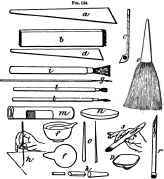
Objects in lacquered wood ornamented with paintings are termed in Japanese Makiye, a word which signifies powdered or lacquered painting. The material best adapted for the work is kiruki, the wood of a species of pine botanically termed Retinispora abtusa. The piece having received the desired form is plunged for an instant in boiling water, then wiped, and dried in the shade. It is next covered with lacquer - the word is here employed in the sense of varnish - and over this coating is sifted a layer of jisun, or unglazed pottery finely pulverized. Another powder is made of a, schistose stone (tonoko), which is is mixed with jisun to form kiriko. This is diluted with lac varnish by means of a wooden spatula termed urushi hera (a). When the mass is perfectly homogeneous, the spatula is employed to lay it on as a groundwork on the object, which is then enclosed in a case, probably to protect it from dust, etc., and left quiet for 1 1/2 days - in summer and somewhat longer in winter. Then with a piece of the schist the entire surface is rubbed smooth.
A new paste of powdered schist and seshime (a kind of lac) without jisun is now prepared and applied, dried, and polished as before. Then the whole is rubbed with a wad of cotton soaked with lac, and carefully wiped with very tine paper, softened by long crushing in the hands. The pbject is next again enclosed and left to rest for 1/2 day. Still another preparation is then made, composed of a different kind of lac - nuritate - urushi and shoyen, or soot produced by the burning of pine knots rich in rosin. This is intimately mixed and filtered through paper. Into the mixture a fiat brush, such as is shown in 6, is dipped, and with this implement the object is covered with a smooth coating; Another drying of 2 days' duration; succeeded...by polishing with Honoki chercoal, follows. _
These preliminary operations constitute the shita nuri or sub - lacquering. The intermediate stage (naka nuri) consists simply in repeating the preceding painting with the soot mixture. Then begins the uranuri, or surface lacquering.
The object is first covered with koero urushi a very fine and brilliant varnish, greenish black in hue and purified by filtration. When, dry, polishing by charcoal follows, and rubbing with schist is continued until not the least inequality on the surface is perceptible. At this point the schist powder is diluted with oil, and this is used as a polish until the surface becomes brilliant.
Now, on very thin closely made paper, the design which is to appear on the object is sketched. To transfer the marks to the work, a peculiar varnish called yaki - urushi, or burned lac, is employed, made as follows:- A band of paper is rolled in tube form c, an end being left unwound. A very small quantity of the seshime - urushi is placed on this end, and heated quickly to effervescence - Adding a very little red oxide of iron and camphor, the whole is carefully mixed and filtered. The varnish thus prepared warm does not become dry and friable. The paper, painted side up, is now attached to the object and - rubbed with a whalebone spatula d. This causes the lines to be transferred to the prepared surface. A bit of tow is then used to dust on tin in powder, and the excess of the latter is removed by a very soft pencil e.
Painting the design is done with a lac called shitamichi urushi.: This is a mixture of seshime - urushi 1/16 part, nashyi urushi 4/10 a small quantity of red oxide of iron of intensely red colour, and a little camphor. This is mixed and filtered 4 times; the more frequent the filtering the purer the material. The latter is then placed in a shallow cup /, and covered with a piece of permeable paper, which comes in contact with its surface and prevents its hardening by contact with the air.
The varnish thus prepared is "laid on by means of a very fine pencil g, which is composed of rats' hair. The little finger is placed on the side of the object, so that the brush is held vertically and only the tip used, A. When this work is terminated, the design is covered with a priming powder by means of the brush shown~in i, and the object is returned to its case to rest. This last powder consists of Honoki. charcoal, mixed with 3/10 sulphur. The whole is pulverized in a mortar and sifted through silk. On the next day, rubbing with seshime - urushi mixed with camphor, and another polishing with schist, follow.
" Rust finish " is the name given to the operation which produces the relief work for the figures. A mixture of seshime and schist powder is made pasty and applied with a spatula. The por tions not designed to stand in relief are removed with a brush. After drying, the low and raised portions are carefully polished with pieces of green schist, cut in forms either prismatic, conoidal, or cylindrical, k. The operation described at the end of the last paragraph is then repeated. On the next day, a soot varnish is made, and applied with a rats' - hair brush. After another 1 1/2 days, a charcoal polishing succeeds, the charcoal being first rubbed smoothly on pieces of schist, and then applied. More polishing with schist powder and a rubbing with oil precede the painting of the lowered parts, for which purpose the seshime varnish, mixed with oxide of iron and camphor, is again used.
The designs are next painted with a rats' - tail pencil l, dipped in filtered oxide of iron, seshime varnish. Then, if, for instance, a peony is to be represented, 2 kinds of gold powder and a gold scale (yasuriko) are used for branches and stem. To represent rocks and stones, pieces of metal flaked, and made of still another kind of gold powder (hanako), are employed. How these metallic preparations are made will be described farther on. Having thus ornamented the.work, 1 1/2 days' rest is allowed, at the end of which time the rats' - tail brush is used to apply to the more delicate shades yosheno - urushi varnish, camphorated and filtered. Polishing with Camellia japonica charcoal follows; and this is a most delicate operation, requiring the longest practice, for there is constant danger of rubbing off the thin layer of metal. A little schist powder is scraped from a tender piece of the stone mixed with oil, and applied to the painting with the finger - tip, to produce a polish. The operation of gilding, etc, is then repeated, and then with a wad of tow the appropriate metallic colours for the objects depicted are applied.
Next comes covering with yosheno - urushi varnish, wiping with cotton and paper, polishing with shikido (another schist) and oil, another application of camphorated varnish, then of the same mingled with water, another drying, and then a final polishing with powdered horn. The object is now uniformly brilliant, and the gold portions are finished.
To prepare the kirikane, or cut metal, a leaf of the same is spread upon a cylinder of bamboo m, and covered with paper. Then, by means of a razor, a number of fine equal bands are cut, a margin on each side being left intact. The leaf and paper are then turned so that the strips occupy a position perpendicular to that which they had at first. Carrying the razor in the former direction around the bamboo, the squares of metal leaf are detached and fall into a blackened saucer n. To pick up the pieces, a small stick of willow o is used, slightly moistened with saliva. Gold, copper, and silver are treated in this way.
The depolishing consists in removing the polish on certain parts of the object where portions of the design to be painted in colours fall. This is done by rubbing with Honoki charcoal powder, followed by retouching with the rats' - tail pencil. In the latter operation a cup of buffalo horn p is used, which is retained on the thumb by a cord. This cup contains a lacquer, seshime varnish, and iron oxide, filtered 5 times through paper. Then the proper powder to give the colour is placed in a goose - quill r, at the end of which is a very fine sieve, through which the powder is shaken in clouds over the wet lacquered part, the excess being removed with a soft brush. The object is then left to dry.
The powders and leaves of metal used are always in harmony with the subject. To paint a river, for example, the shores are boldly traced with the rats' - hair pencil, using the point to indicate the water. Then with the feather a certain coloured gold powder is sifted on, then a powder of different colour, and, finally, here and there fragments of gold - leaf are inserted. For a black ground a smoke - black varnish is used, and the gilded parts are covered with a transparent varnish. After 5 or 6 days' drying, the black parts are slowly polished with powdered Honoki char coal, then the gold is polished with camellia charcoal, then with horn powder, then rubbed with a wet cloth, then with a dry one. The piece thus prepared is covered with black varnish again, the design is rubbed and dried, and the piece is put away for the night. Next day schist powder and oil are applied, and more rubbing with paper is done. On the following day the finger is the rubbing instrument, and another polishing with horn powder finishes the operation.
A grey groundwork is applied after the sub and intermediate lacquering above described is finished, the parts being previously depolished by the goose - feather apparatus, held as shown in s, and rubbed gently on the surface, so as to scatter the metallic powder. The white flakes called shiroq - irshi are gently passed over the parts thus gilded. Nashyi - urushi varnish mixed with camphor is then laid thinly on; polishing with camellia charcoal follows, then drying, and then another coat of varnish; after another drying, a number of small prisms of camellia charcoal are polished on schist wrapped in paper, and are rubbed over the surface till the groundwork shows. Then follows a series of varnishing and horn - powder polishing similar to that already described.
Continue to:


My Books

