


American Freight Locomotives And The Engines Of The "Oceanic " - A Comparison Of Horsepower
Description
This section is from the book "Scientific American Reference Book. A Manual for the Office, Household and Shop", by Albert A. Hopkins, A. Russell Bond. Also available from Amazon: Scientific American Reference Book.
American Freight Locomotives And The Engines Of The "Oceanic " - A Comparison Of Horsepower
We are told that "Comparisons are odious," and the statement would seem to he based upon a fairly correct estimate of human nature; but as soon as we get outside of the range of human susceptibilities and apply our comparisons to insensate things, comparisons become not only extremely interesting, but at times a valuable means of increasing our general knowledge and our sense of the proper relative proportion of things.
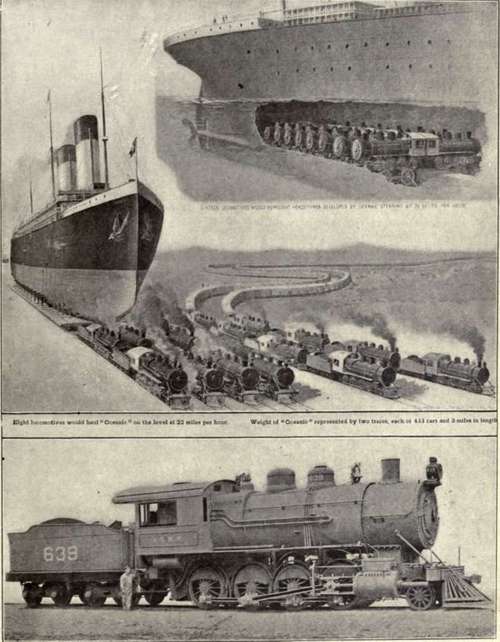
The pictorial comparison to be found here is based upon one of the mammoth freight, locomotives which are being turned out in considerable numbers just now by the leading locomotive works of the country. In addition to the usual information as to dimensions and construction, Mr. R. Wells, the superintendent of the Rogers Locomotive Works, has favored us with particulars of some novel experiments which he carried out to determine the exact location of the center of gravity of this locomotive above the rails. He has also given us particulars of its horsepower and freight-hauling capacity on a level road, and it occurs to us that a comparison of the relative power of one of these engines when working up to its maximum indicated horsepower with the maximum indicated horsepower of the "Oceanic," the second largest steamship in the world, will be attractive to that section of our readers that likes to have its facts enlivened occasionally with a touch of the fanciful and curious.
The locomotive shown is an extremely powerful Consolidation which was recently built by the Rogers Company for the Illinois Central Railroad for use on one of the divisions of their line where the grades are somewhat heavier than on the divisions connecting with it. It was designed to haul trains of a maximum weight of 2,000 tons over grades of 38 feet to the mile. The cylinders are 23 inches in diameter, by 30 inches stroke; the drivers are 57 inches in diameter and they carry 198,000 pounds weight of the locomotive out of a total weight of 218.000 pounds. The boiler, which is of the Belpaire type, is 80 inches in diameter at the smoke-box: the fire-box measures 42 inches by 132 inches, and there are 417 2-inch tubes which are 13 feet 8 inches in length. There are 252 square feet of heating surface in the fire-box, and 2,951 square feet in the tubes, making a total heating surface of 3,203 square feet. The tender is exceptionally large, the capacity of the tank being 5,000 gallons, while the coal space has a capacity of 10 tons.
The increase in the diameter of locomotive boilers which has taken place of late years has necessitated their being carried above the tops of the wheels, with the result that the center of the boiler is in some recent locomotives as much as 9 feet above the rails. To the uninitiated these immense machines have an exceedingly top-heavy appearance, and it looks as though their stability would be endangered, especially when they are running at high speed around a curve. Before sending this engine out of the shops, the Rogers Locomotive Company made an experimental test to determine the exact location of its center of gravity. The result is certainly surprising, for although the top of the boiler is fully 9 feet above the rails, the center of gravity was found to be only 50 1/2 inches above the top of the rails, that is to say, about 6 1/2 inches below the top of the driving wheels. As a matter of fact, the great bulk of the boiler is very deceptive to the eye, and one is liable to forget that the greatest concentration of weight lies in the heavy frame, the wheels, the axles, cranks and running gear, and the heavy saddle and cylinder castings. The test was made by suspending the engine on the upper surface of two 3-inch steel pins or journals as pivots, the one at the front being located 6 inches in front of the cylinder saddle, and the one at the rear 6 inches back of the boiler, both pivots being, of course, the same distance above the rails and on the vertical center line of the engine. After several trials, points of suspension were found which were in line with the center of gravity, which, as thus determined, was found to be 50 1/2 inches above the top of the rail. As the bearing points of the drivers on the rails are about 56 inches apart, the base on which the engine runs must be 1.1 times as wide as the height of the center of gravity of the engine above the rails. It is evident from this test that the center of gravity of such a locomotive could be raised still higher without endangering the stability of the engine under the ordinary conditions of service.
Copyright, 1900, by Munn & Co.
A Comparison Of Marine Engine And Locomotive Power.
A Comparison Of Marine Engine And Locomotive Horsepower.
In order to secure a basis for comparison of the power of. a modern freight locomotive with that of a modern steamship, we have chosen the "Oceanic." This truly gigantic ship, which exceeds the "Great Eastern" in length and in displacement, is 704 feet in length, and on a draft of 32 1/2 feet displaces 28,500 tons. As the depth of water in the entrance channels to New York Harbor will not accommodate a vessel drawing that amount, for the purpose of this comparison we will suppose that the "Oceanic" is drawing 30 feet, at which draft she would displace about 26,000 tons. On this displacement her engines will indicate about 28,000 horsepower when driving the vessel at a speed of 22 land miles an hour.
Now, it is estimated that the big Rogers Consolidation could haul about 3,250 tons weight of train at a speed of 22 miles an hour, on the level, and that while doing this work it would indicate about 1,7G0 horsepower. Here then we have a basis of comparison, and we may apply it in two ways. Either we may ask how many of these locomotives would have to be crowded into the hold of the "Oceanic," and coupled to her main shafts, in order to drive her through the water at 22 miles an hour, or we may determine how many or these locomotives it would take to haul the "Oceanic" if she were placed upon a movable cradle of the kind designed by Captain Eads for his Tehuantepec Ship Railway. In the first case, we know that when the main shafts of the "Oceanic" are making about 90 turns a minute, the engines are indicating about 28,000 horsepower, which is their maximum capacity. On the other hand, we know that when the drivers of one of these locomotives are making about 150 turns a minute, and the maximum tractive effort is being exerted at the periphery of the wheels, it is indicating about 1,760 horsepower, which represents its possible maximum indication at that speed. If now the sixteen necessary locomotives (the number being found by dividing the horsepower of the ship by the horsepower of the locomotive) were arranged in two lines, one above each main shaft, and the tractive effort of the drivers transmitted by means of friction wheels to the shafts, the speed of the rotation being reduced by intermediate gearing, in the ratio of 150 to 90, we should have the conditions shown in the engraving on the previous page, where the locomotives, in double phalanx, are shown grinding merrily away at their unwonted task of driving a modern transatlantic liner.
To determine how many Rogers Consolidations it would take to haul the "Oceanic" over a ship railway whose grade is perfectly level, we will neglect the weight of the cradle and assume that its rolling friction is the same as that of a weight of loaded freight cars, equal to that of the ship. The displacement (that is, the weight of the water which the ship displaces at a given draft) on a draft of 30 feet would be about 26,000 tons, and dividing this amount by 3,250 tons, which is the maximum weight of train Which one locomotive can haul at 22 miles an hour, we find that it would take just eight locomotives to haul the "Oceanic" by rail at a speed of 22 miles an hour. This result is particularly interesting as showing how quickly the resistance of the water to the motion of the ship increases with the speed. As a matter of fact it increases as the cube of the speed, with the result that, although the "Oceanic" could be moved at a canal-boat speed of 2 1/2 miles an hour by less locomotives than it would take to haul it at that speed on land, at a speed of 22 miles an hour it requires just twice the power on the water that it would on the land.
The "Oceanic," as she rests upon the ship railway cradle, represents both the dead and the live load; that is to say, the ship and the cargo. With a view to showing graphically what an enormous mass is represented by her 26,000 tons displacement, attention is drawn to the sketch showing an equivalent weight in loaded box cars of 40,000 pounds capacity, each of which with its load would weigh about thirty long tons. If this weight were made up into two separate trains each train would contain 433 cars and would be about three miles in length.
Between Brussels and Charleroi there is a length of nearly 30 miles of canal served by overhead wires. The motor "tractors" run on the rough canal towpath, with plain wheels of hard steel. In another style on the Finow and the Tetlow Canals, the "tractor" runs on a single rail by the pair of wheels on one side, and on the towpath by a plain pair of wheels on the other side.
Copyright, 1901, by Munn & Co.
Continue to:


My Books

