


How To Place The Pattern On The Material
Description
This section is from the book "A Manual Of Home-Making", by Martha Van Rensselaer. Also available from Amazon: A Manual of Home-Making.
How To Place The Pattern On The Material
After the pattern has been altered and tested, or after it has been cut in inexpensive material and modeled to the figure, it is ready to be placed for cutting on the material. A few general rules are here given but there are many exceptions to them.

Fig. 65. - Method of cutting and opening a shirt-waist pattern to throw in fullness. This method of putting more fullness into a shirt-waist pattern also increases the length of the shoulder. The line of opening should extend through about the center of the shoulder. It is often necessary to increase the size of the arm-hole to make it correspondingly larger. The sleeve may be opened along the center.
1. Observe on the outside of the pattern envelope or on the guide chart contained in the envelope, the allowance for seams. In the case of the modeled pattern allow for seams, since the pattern has been cut apart exactly on the line of basting. In case the seam allowances have not been made, allow at least 3/8 inch on material which does not fray, and more on material that frays badly. If the pattern has not been used before, it is a wise precaution to make an allowance of at least 1 inch on all fitting seams, such as the shoulder seam and the under-arm seam of the waist, and the seams of the skirt which fall over the fullest part of the body. In making the extra allowance on the skirt seams, begin at the waist-line and taper down to the original allowance at a point from 12 to 14 inches below the hip-line.

Plate XIII
Left, draping a simple waist; center, draping a simple skirt with cascade effect on sides; right, dress form used in draping, padded "with tissue paper to fill out fitted lining.
2. Spread the material out as much as possible, and place the entire pattern on it, in order to determine the most economical way of cutting. This is always advisable for economy in cutting, and if it is necessary to piece the garment, the piecing may be planned to come in the least conspicuous place.
3. If the material is easily cut and does not slip when several thicknesses are cut at one time, it may be folded end to end and most of the pieces may be cut double. Care must always be taken not to cut two pieces for the same side. This difficulty may be obviated by placing the two right sides or the two wrong sides of the material together when cutting it. Then, when the two pieces of material are taken apart, one is for the right side and the other for the left. Folding the material together is not always the most economical scheme, for often the parts of the pattern may be fitted into irregular places if cut singly.
4. Always place the largest pieces of the pattern first with the largest end of the pattern toward the cut end of the goods. This is economical because it leaves the irregularly shaped pieces attached to the large piece of the goods. Often the smaller pieces of the pattern may then be fitted into these irregular pieces, which would be useless if detached.
5. Observe carefully the nap or design of the material, placing the pattern so that the design runs in the same direction, on all the pieces. The nap generally runs down, but velvet and velveteen are exceptions to this rule. Different color effects are produced if the surface of the material does not reflect the light in the same way.
6. A conspicuous design in the material, such as a plaid, must be identical on the two sides of the garment to prevent destroying the balance or introducing undesirable lines. Most important of all is keeping the grain of the material identical on both sides of the garment; otherwise the set of the garment will not be bi-symmetric.
7. After the pattern has been placed in the most economical manner, pin it carefully, trying not to lift the material and the pattern from the table when pinning them. Do not use too many pins; they not only take time to place, but they often make noticeable holes in the material, especially in silks.

Fig. 66. - Method of increasing or decreasing the bust measure of a shirt-waist pattern without increasing the length of the shoulder. The opening should extend from the bottom of the waist in a straight line to the deepest curve of the armhole. In the front it is often better to make two slashes than to spread one slash too far. This method of adjustment necessitates lowering the armhole and, if the second slash is made, slightly lowering the tip of the shoulder near the armhole.
8. The actual position of the pattern on the goods depends largely on the pattern. When using a commercial pattern, read the directions carefully, and then locate the indicating marks which show the lengthwise, the crosswise, and the fold of the material. These indicating marks should be followed carefully.
For using a modeled pattern, or a pattern without indicating marks, the following guides are offered:
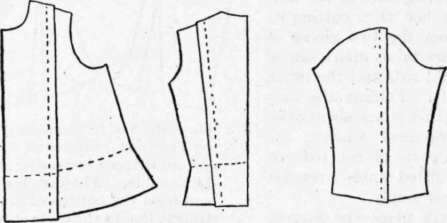
Fig. 67. - Method of decreasing the size of a shirt-waist pattern. Instead of cutting and spreading a pattern as in Fig. 65, the size should be decreased by making a fold in the pattern.
1. Lines of a simple pattern generally placed on the straight lengthwise grain, or the lengthwise fold, of the material: In a waist: a. Center front b. Center back In a sleeve:
Along the outer fold when the seam edges are brought together. Any sleeve after being basted should lie perfectly flat when folded. In a yoke or collar: a. Center front or center back of yoke or collar. The center back of a waist yoke or collar is generally cut on the lengthwise fold, although often the lower front edges are cut on the straight grain, causing a bias seam in the center back.
b. In a skirt yoke there may be all sorts of combinations in cutting. Probably the most successful way is to cut the material with the straight grain in the center back and the center front, giving a bias seam over the hip. Sagging may be disguised by making the yoke longer over the hip, if this gives a becoming line. The bottom line of a skirt yoke must be carefully considered with reference to the figure. Avoid allowing the lower edge to fall in a straight line around the fullest part of the body. Either an irregular yoke-line or the line joining a front or back panel is generally more becoming.
In a cuff:
The direction of the grain of the material in the cuff depends greatly on the design of the waist and of the material. For beauty of design, the cuff is generally cut with the lengthwise grain running with the depth of the cuff; for greater strength, however, the cuff is cut with the lengthwise grain running from fastening to fastening.
In a skirt: a. Center of front panel. Generally the front edge of each succeeding gore, in order that a straight edge may be sewed to a bias edge. This method will help to keep a skirt from sagging. In skirts of two gores the center of each gore is often placed on the straight lengthwise fold.
b. If a rounding or tubelike effect is desired in a skirt of many gores, the center of each gore is placed on the straight lengthwise grain of the material.
When great strength is desired, the lengthwise grain of the material is always used. Skirt-bands, apron-bands, neck-bands, bands in all undergarments, and cuffs, are cut with their longest measurement on the lengthwise grain of the material.
2. Lines of a simple pattern placed on the straight crosswise grain of the material:
In a shirt-waist: a. Width of the chest b. Width of the back c. Waist-line of the under-arm piece of a tight-fitting waist In a sleeve:
Generally around the fullest part of the arm.

Fig. 68. - Method of lengthening a waist pattern for a very full bust or round shoulders. This method may be used on a shirtwaist, also, with slight alteration of the under-arm seam.
In cuffs:
Depth of the cuff, when,the design of the waist requires it.
In yokes:
Depth of the yoke, when the design of the waist requires it.
In skirts:
Skirts are seldom made with a construction line falling on the crosswise grain of the material. For children's dresses and for fancy silk dresses, a skirt is occasionally made on the crosswise grain of the material. Chiffons, georgette crepe, net, or voile, on which there is a beautiful selvage edge, is often draped on the crosswise grain, and thus the making of a hem finish, which is often cumbersome on very light-weight materials, is avoided.
Continue to:


My Books

