


Golden Hamburgh Grape
Description
This section is from "The Horticulturist, And Journal Of Rural Art And Rural Taste", by P. Barry, A. J. Downing, J. Jay Smith, Peter B. Mead, F. W. Woodward, Henry T. Williams. Also available from Amazon: Horticulturist and Journal of Rural Art and Rural Taste.
Golden Hamburgh Grape
If this grape is as good as its mother, the Black Hamburgh, it is an acquisition to the grapery - for its color is a high attainment in such a grape. If I were to stock a vinery with a dozen grapes, ten of them should be Black Hamburgh, and the other two Golden Chasselas. These two varieties are easily grown, sure bearers, and possess the aggregated virtues of all the others. Only prove the Golden Hamburgh what it is described, and I will add it to the others, making three reliable grapes.
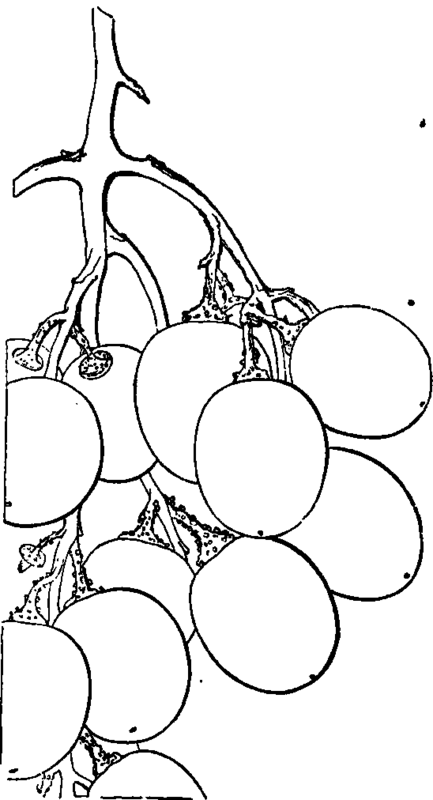
The Golden Hamburgh Grape #1
Frequent applications to know more of this grape are made by American correspondents. It has been distributed to some extent among our grape growers, and very probably some may already have fruit coming forward, of which we shall have report in due season. Meantime, we reproduce the cut inserted in 1856, for the information of those who may not have seen it.
At a meeting of the British Pomological Society soon after this superb grape was brought forward, it was resolved unanimously that " the Golden Hamburgh is the finest of all white grapes, the Muscats only excepted." The Trentham Black also received a premium. Later accounts agree as to the value of the former in a remarkable manner. This and the Muscat Hamburgh, the one a fine, yellowish, transparent grape, and in shape the very counterpart of the Black, and the other a black grape with a Muscat flavor, are, most probably, destined to be among the greatest favorites of our graper-ieB, a Muscat flavor in a black fruit being very valuable.
GOLDEN HAMBURG GRAPE.
The bunches of the Golden Hamburgh are large, loose, branching, and shouldered, varying from six to nine inches in length, and the foot stalks are short and stout. Berries large, and hang loosely on the bunches, an inch long, and seven-eighths of an inch wide, and of a uniform oval shape, skin thin and tender, of a pale yellow color, but when highly ripened, of a pale amber. Flesh delicate and melting, very juicy, and remarkably rich, sugary, and vinous, leaving on the palate a full and luscious flavor. Each berry contains from two to three seeds.
Golden Hamburgh Grape #2
We have now in hand an engraving of this superb grape from a specimen fruited by C. P. Bissell & Salter, of Rochester, N. Y., who are taking a lead in the cultivation of grapes. The vine is young, and produced but the one bunch; the Golden Hamburgh is to be one of the choicest fruits in even the smallest selection of sorts, going along with the inevitable Black Hamburgh, so universally known.
The same growers favored us with a sample of Childs' Superb, grown under glass. We scarcely think it worthy of a place in the grapery, but where it is a hardy grape, it will take a high rank. See answers to correspondents.
Golden Hamburgh Grape #1
The grapes which I sent to you in April were the fruit of a new variety, called the Golden Hamburg, which I imported with some others from England in the spring of 1858. The plant was not a very large one, being only a guinea vine, and I planted it in a 1x9 glass box, in which it stood during the summer in the cold grapery. Being somewhat impatient to see its fruit, I placed it in the propagating house during the winter of 1858-9, without allowing it any rest after it had ripened and shed its leaves, and on the 24th of January the vine was in flower. It set admirably, although in midwinter, and by the 1st of April the grapes were fully ripe - thus being, as I believe, the first of this variety fruited in this country. The vine produced several bunches, which all set well, as I said before; but 1st, because of its very small root room; 2d, the size of the vine; 3d, the fact that it had had no rest; and 4th, the season of the year, - only three of the bunches were allowed to come to maturity; but these ripened perfectly.
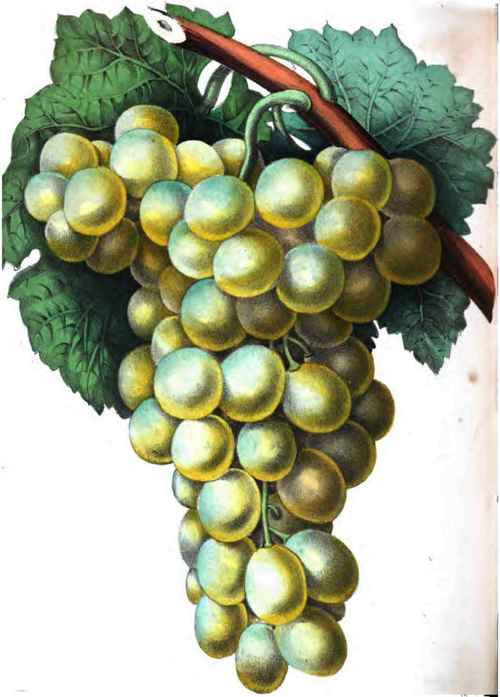
Golden Hamburgh Grape
The one which was drawn for the Horticulturist was the best shouldered bunch of the three; but the berries were not the largest, nor were they as fine as of the other two. Had there been but one bunch, as erroneously stated on page 284 of this year's Horticulturist, it probably would have been finer and its berries much larger. Many of our Rochester gardeners and amateur grape-growers came to see and to taste the fruit, and all pronounced it "truly excellent" "first-rate," "the best of white grapes," etc, etc. The skin is thin and tender, the flesh is tender and delicate, very juicy and luscious, and I think its flavor superior to that of the Black Hamburgh.
The Golden Hamburgh is a new and perfectly distinct variety, originated at Stockwood Park from the Black Hamburgh, impregnated with the Sweetwater. The first premiums were awarded to it in 1853, and it has since then maintained its high character, and steadily received premiums, certificates, medals and diplomas, each year it has been shown. Its habit of growth is somewhat between that of both its parents, its wood being round and firm, short-jointed, and of a whitish green color. Its foliage is large, like the Hamburgh, but of a lighter and brighter green, sometimes lobed, and its veins and midrib tinged with bright red or crimson. The bunches are well shouldered, and the berries hang loosely on the bunch; it is a good setter, and requires good thinning. The berries are large, many of them being an inch long and seven-eighths of an inch in diameter, of an oval form, and of a pale yellow color.
If a young vine will do as well as this has done without any "rest," and with every circumstance unfavorable, a mature vine will assuredly do a great deal better in summer, after its seasonable rest, with its roots in a vinery border, and its branches trained to the rafters. This Golden Hamburgh is destined to become among white grapes what the Black Hamburgh is among black grapes - ttie best of white grapes for a cold vinery and also for pot culture.
[The above is a correct statement: the figures we have on hand of this grape as grown in England on mature vines, represent the berries as considerably larger than our plate, and of a deeper golden color; in fact, the picture of the bunches was too large for our pages, and we waited for some time to get an American representation such as we could endorse, and it is now presented to our readers. The flavor of this fine acquisition is delicious. It has also been fruited in Philadelphia, and probably elsewhere, and has excited a very lively interest with grape-growers wherever exhibited. - Ed. H].
Golden Hamburgh Grape #1
We are glad to find that this admirable grape, of which we gave a figure and description, still maintains the high character we orginally formed of it. Numerous reports have been in circulation tending to depreciate it in public estimation; but from what we saw recently at the meeting of the Fruit Committee of the Horticultural Society tends fully to remove any such misconception, and to confirm us in the opinion we formerly expressed.
At this meeting meeting Mr. James Veitch, of the Exotic Nursery, Chelsea, offered a premium of five guineas for the best three bunches, fur which there were three competitors - Mr. Tasker, of Brighton; Mr. Allport, of Doddington Park, Nantwich; and Mr. Crambe, of Tort-worth Park. Mr. Talker's were large and handsome bunches, eight to nine inches long and heavily shouldered: the berries very large and oval, and of a greenish-yellow color. Mr. Crambe's were very large, being a foot long and seven inches across the shoulders, but looser than Mr. Talker's; the berries large, and pale green, but with rather more flavor than Mr. Tasker's. Both of these exhibitions were not sufficiently ripened. Mr. Allport's were smaller bunches than either of the others; the berries of good size, and more approaching the amber color of the variety when properly ripened; they were also rich in flavor. After making a careful comparison of the merits of the various exhibitions, the Committee unanimously decided on awarding the premium to Mr. Tasker. - Cottage Gardener.
Continue to:


My Books

