


Soil Pipes. Part 5
Description
This section is from the book "Plumbing Practice", by J. Wright Clarke. Also available from Amazon: Modern plumbing practice.
Soil Pipes. Part 5
Referring again to Figure 371, it will be noticed that the short pipes branched into the horizontal soil pipe have the connections made in such a way as to reduce to a minimum the liability of the discharges from the water-closets running back up the main soil pipe. The branch-joints, when made in this way, require to be carefully fitted, or little spurs of solder will be found inside when finished. They also require about half as much more solder, and a thin cloth to be used, so that as much solder can be wiped out of the throat of the acute angles, W, W, as possible.
Some little time ago the writer was acting as foreman on a large job, and instructed the plumbers to make the branch-joints of a soil pipe for a range of water-closets in the same manner as shown at Figure 371. Unfortunately, he fell sick, and was away for some few days, and when he came back, found part of the work done and fixed, the joints being made as shown at Figure 378. It was very difficult to make the men understand that the object sought was entirely lost by bending the end of the branch soil pipe in such a way that it entered the horizontal pipe at right angles, and that the work would have answered just as well, and the labour to the bend saved, if the pipe had been branched, as shown by dotted lines at V. It is scarcely necessary to add that the joints were intended to be made as shown by dotted lines at U.
A case of faulty construction occurred where complaints were made of an abominable stench issuing from a water-closet near a bedroom. An examination was made for the cause, when it was found that the waste pipe from the slop-sink - shown in sectional elevation at A, Figure 379 - was connected to the side of the water-closet trap, on the floor below, in such a way that whatever was thrown into the sink rushed down the waste pipe, through the water-closet trap, up the safe waste pipe, and lay in the lead safe at B.
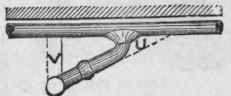
Figure 378.
Another sink was fixed beneath the stairs, as shown at C, and sometimes when the water-closet was used liquid matter would wash back up the waste pipe, and could be seen to knock up against the grating which is soldered over the end of the waste pipe in the sink.
Figure 380 is a sectional elevation of a wing of a large building in London which is occupied as offices. The vertical stack of soil pipe is fixed inside the building and is 4 1/2-inch diameter lead pipe. The water-closets are of the valve description, and fixed over lead D-traps. In the lobby outside each water-closet is a wash-hand basin, a urinal-basin, and a lead sink on the floor for drawing water into pails for cleansing purposes. A 1 1/4-inch lead ventilating pipe is carried from the top end of the soil pipe to the roof. It transpired that for years there had always been complaints of smells escaping from somewhere, but hitherto no one had been able to discover where. Sometimes the smells were found on one floor, and at other times on another, and sometimes in a water-closet, and sometimes in the adjoining lobbies, or in the offices behind. Chemical and smoke tests failed to prove any defects in the soil or waste pipes, or that the seals of any of the traps were broken. It was found impossible to break the seals of the traps by syphonage, for the reason that the branch waste and soil pipes had not sufficient fall, and in spite of violent tests the D-traps always retained sufficient water to seal the ends of the dip pipes, but in some cases only to the extent of 1/8 to 1/4 of an inch. The examiner having called in two other persons to assist him, it was found that when two water-closets on the upper floors were used at the same instant of time, the air in the lower portion of the soil pipe would become sufficiently compressed as to burst through the traps fixed on the floor below. After the air had escaped, the water would fall back into the traps, thus leaving them sealed again. It was also found that another reason the water was not syphoned out of the traps sufficiently to break the seals was, that so many traps were connected to the same soil pipe, that each would allow a small quantity of air to pass, which, in the aggregate, was sufficient, when added to the air entering through the 1 1/4-inch vent pipe, to fill the soil pipe, and thus prevent the vacuum being sufficient to start a syphonic action in the other traps. Air currents up the pipe-casings would sometimes carry a smell from one floor to another at a higher level. This is often very troublesome when making examinations, and the engineer is sometimes misled by this means as to the source of smells. In the case under consideration the walls were found defective, so that smells could sometimes pass through to the annoyance of the people in the offices. It is proposed to ventilate all the traps and enlarge the vent pipe at the top of the soil pipes, also to take precautions to prevent smells from passing from one place to another.

Figure 380.

Figure 379.
At a large building near the Bank of England, a difficult case came under the writer's notice. Several experts had been called in at various times to discover the cause of an abominable smell that was intermittent. The fact of the smells not being continuous added to the difficulty, as no vapour test would betray the cause in the same manner as if the smells were constant. Each sanitary man had taken away the water-closets and fixed others that he had a preference for. The one who preceded the writer had the syphon-traps taken out and D-traps placed beneath each water-closet, but did not succeed in his object.
Figure 381 is a sketch diagram, showing the water-closets and soil pipes which were continued to the roof full size, and the first floor was the place where the smells were complained of. After applying vapour tests and finding nothing defective in the materials or appliances, the water-closets were taken up, and also the flooring, so as to be able to make a closer examination of the traps and pipes. Nothing being discovered to account for the smells, men were sent to the upper floors. The handles of the closets, A and B, being simultaneously pulled up, and the writer stooping over the trap of the water-closet, C, to watch the result, was anything but agreeably surprised to have the contents of the trap blow up into his face. This solved the mystery at once. On discharging the contents of these two water-closets, air was driven downward in each soil pipe. The two columns oft air meeting at the first-floor level burst through the traps of the water-closets at that point. Several other fittings, such as urinals and wash-hand basins, were attached to the same soil pipes, but they are omitted for the sake of clearness. The remedy applied was to take two ventilation pipes from the traps of the first-floor water-closets and continue them to the roof. On using any one water-closet on the upper floors no evil resulted, as the air driven down the soil pipe by the falling water, etc, could freely escape up the other one. The above evils have frequently been found in smaller houses. Figure 382 is a sketch of the back of a very common description of house. This kind of house has been referred to in an earlier chapter, where was pointed out the evils of connecting the rain-water leader to the soil pipe. In great numbers of cases a trap is fixed at the foot of the soil pipe to prevent any bad air from the drains passing out at the top of the soil pipe, etc, and into any open window. This trap seals the bottom of the pipe, with the result that the air cannot freely escape when driven downward by discharges from the water-closets. On using the top water-closet, the air in the soil pipe is driven downward, and will frequently burst through the trap of the lower water-closet. Innumerable cases could be given of defective arrangements of soil pipes. Those that have been illustrated were simply those out of several that came first to the writer's mind, and which were given as typical examples to show that even with good materials and skilled labour, the whole affair may be rendered a failure for want of technical knowledge as to what will be the results when completed.
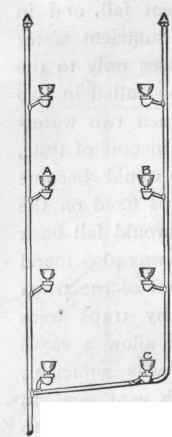
Figure 381.

Figure 382.
The water-carriage system of conveying sewage matter from the dwelling is one that requires a great deal of thought and study. The most elaborate water-closet apparatus is perfectly useless without the necessary water to cleanse it, and float the matter deposited in it away to a suitable place. The best kind of traps are of no value if they have no water in them. Drains or soil pipes may be made of the very best materials and yet be sources of serious evils unless the joints are both air and watertight when in or near the dwelling. All the above evils may be guarded against, and, at the same time, an error of judgment in the arrangement or setting out of the work may be committed with dire results. In olden times the plumber was simply a manipulator of lead, but now he is called upon and expected to be a highly-trained scientist. There is not the least doubt he will rise to the occasion, and that in the future he will not commit the same mistakes as were made by his predecessors in the craft.
Continue to:


My Books

