


First Type Of Cane Chairs. Continued
Description
This section is from the book "Colonial Furniture In America", by Luke Vincent Lockwood. Also available from Amazon: Colonial Furniture In America.
First Type Of Cane Chairs. Continued
Figure 457 shows a side chair of later date. The cresting is carved in the design of C scrolls, and at the centre was an inlaid star the inlay of which is missing. The finials are in the form of acorns. The front stretcher is carved in a scroll design suggesting the Flemish scroll. The legs are in the form of a Flemish scroll with an additional out-turning scroll above. The two last-mentioned chairs belong to the writer.
Figure 458 illustrates a late form of the chair shown in Figure 451. The only carving is on the cresting and is in the familiar design of the Flemish scroll. The frame for the cane is perfectly plain and a turned-front stretcher takes the place of the carved one. The legs are turned in a simple design. This chair belongs to Mr. H. W. Erving.
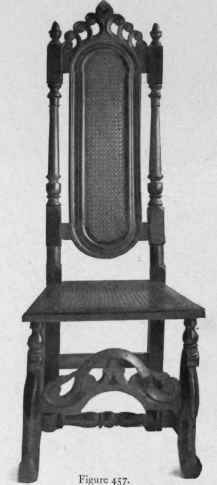
Cane Chair, Flemish legs, last quarter seventeenth century.
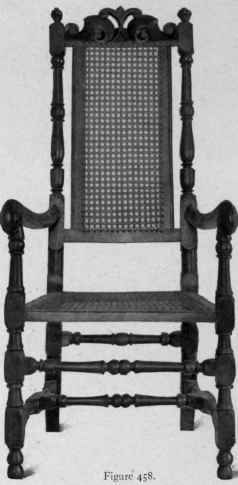
Cane Chair, turned legs, first quarter eighteenth century.
Figure 459, the property of the writer, illustrates a further differing type from those under discussion. The only carving is on the cresting and front brace. The design differs from that shown in the preceding figure in that it is composed of two C scrolls instead of Flemish scrolls, separated by the conventional fleur-de-lis. The design is similar to that shown on the front brace of Figure 452.
The back and seat were intended for upholstering, as the frame is heavy and unpierced.
Figure 460 shows a later variation of this type. The carved cresting has disappeared as well as the cane, and yet it clearly suggests the preceding design.

Figure 459. Upholstered Chair, turned legs, about 1700.
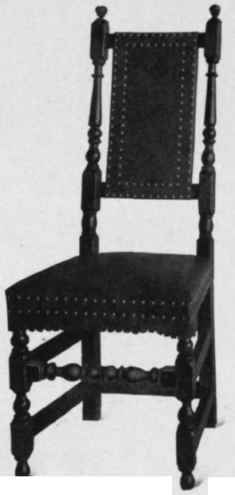
Figure 460. Upholstered Chair, turned legs. about 1700.
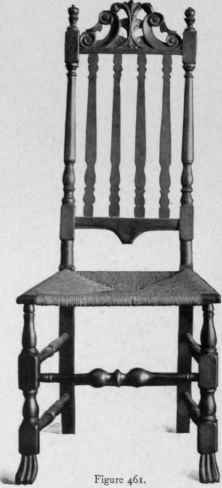
Figure 461 is in the style known as banister-back, which is one of the late variations of the type under discussion. Split balusters take the place of cane or upholstery and the seat is made of rush. The carved cresting is in the design of two C scrolls separated by conventional fleur-de-lis, and the legs terminate in the Spanish scroll foot. Such chairs undoubtedly were made by local cabinet-makers in imitation of the cane models, but without proper material. This is the only form of the first type which has Spanish feet.
Figure 462 shows an arm-chair of this type. The cresting is unusually well carved, in the same design as in the last figure. The front legs, which extend to hold the arms, are turned in the vase, ring, and bulb pattern and terminate in Spanish feet. The stretchers, including the back one, are also well turned. This chair is in the Bolles Collection.
Banister-Back Chair, first quarter eighteenth century.
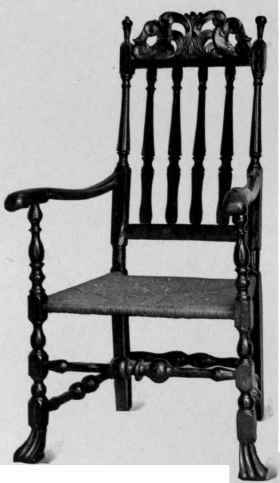
Figure 462. Banister-Back Chair, first quarter eighteenth century.
Figure 463 shows an arm-chair in the same style as the preceding. The cresting of C scrolls separated by a fleur-de-lis is the same, and the front stretcher is in the same design, which is rather unusual, as banister-back chairs usually have the turned stretcher. The legs terminate in the ball feet which appear on six-legged high-boys and desks of the period. Another unusual feature is that it has five instead of four split balusters, one of them missing. This chair is also in the Bolles Collection.
Figure 464 shows another variation of the style. The cresting is almost invariably in the form shown in the two preceding figures, but it will be seen that this is an exception to the rule, for in this chair there are two foliated scrolls, really portions of the Flemish scroll, the two sections joining at the centre to make a C scroll with foliations below. The legs terminate in unusually good Spanish feet, and the side stretchers are vase-and-ring-turned the same as the front one. This chair is the property of Mr. G. W. Walker, of New York.
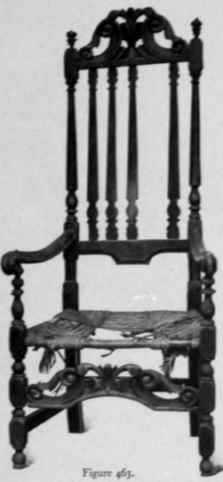
Banister-Back Chair, first quarter eighteenth century.
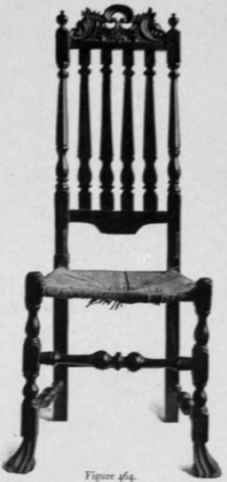
Banister-Back Chair, first quarter eighteenth century.
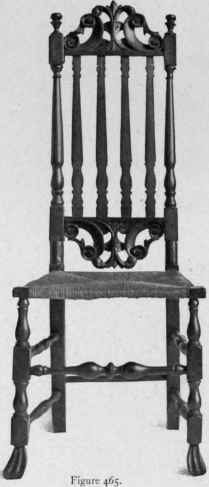
Another chair of this same general type, the property of Mr. Dwight M. Prouty, of Boston, is shown in Figure 465. The carved cresting is repeated reversed at the base of the back, otherwise the chair is very similar to that shown in Figure 461.
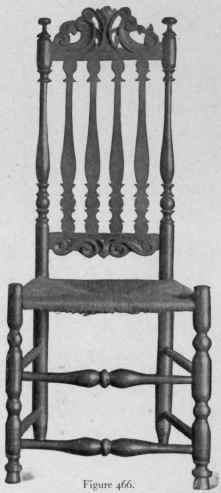
Another and later variation of the banister-back chair is shown in Figure 466. Not only the cresting is carved but also the lower rail holding the balusters. It is a little unusual to find two turned-front braces. The balusters are usually in the same designs as the stiles of the back, as in this example.
Banister-Back Chair, first quarter eighteenth century.
Banister-Back Chair, first quarter eighteenth century.
A very unusual form of the banister-back chair from the Bolles Collection is shown in Figure 467. The cresting consists of a pierced circle with a C scroll on either side, and below are two circular openings. The finials of the stiles are acorns, and three small acorns are attached to the cresting. There are but three split banisters, and the lower rail of the back is cut in curves. The front legs, at the point where the front stretcher joins them, are bulb-shaped, and the legs terminate in what were probably a form of Spanish feet but which are now considerably worn off. The legs of this chair quite closely resemble those on Figure 471.
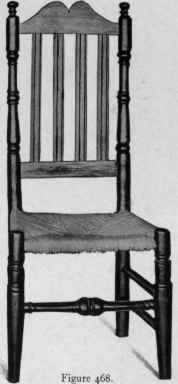
A little later variety of banister-back chairs in which is but a slight suggestion of the type under discussion is shown in Figure 468. The cresting is cut in a curve as though the maker had a carved piece in mind. The balusters do not follow the general rule but are straight-grooved strips instead of being turned and split. The chair belongs to Mrs. L. A. Lockwood, of Riverside, Connecticut.
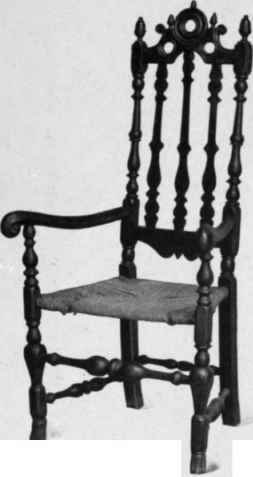
Figure 467. Banister-Back Chair, first quarter eighteenth century.
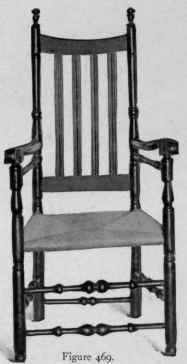
Figure 469 shows one of the latest developments of the banister chair back. No suggestion of carving is anywhere to be seen and the balusters are plain grooved slats. This chair belongs to Mr. Albert H. Pitkin, of Hartford.
We have now traced the development of the first type of cane chairs to the point where they disappeared, and we have shown practically every style of leg in which it is found except the unilateral Flemish scroll, of which the writer has been unable to find an example in this country although he has seen a few in England.
We now take up the second type of cane chairs in the same manner.
Banister-Back Chair, 1730-40.
Banister-Back Chair, 1740-50.
Continue to:


My Books

