


IV. Cupboards And Sideboards. Part 8
Description
This section is from the book "Colonial Furniture In America", by Luke Vincent Lockwood. Also available from Amazon: Colonial Furniture In America.
IV. Cupboards And Sideboards. Part 8
Figure 185 shows a side cupboard built into the Robinson house, at Saun-derstown, Rhode Island. Inside are two fluted pilasters supporting the shell arch on each of which is carved a rosette. At the centre of the shell is also carved a large rosette. The interior of the cupboard is painted a greenish blue and seems to be in its original condition. The edges of the shell are gilt and the top of the arch and rosette are red. In the spandrels of the cupboard outside are cupids painted in gilt.

Figure 185. Side Cupboard, 1725-50.
Figure 186 shows a side cupboard and a portion of the panelling of a room which is the property of Mr. George S. Palmer, of New London. The upper door is of glass and the lower one is panelled. The top of the cupboard is carved in the scallop shell pattern. The method of doing this was to place a number of planks, one on the other, to the desired height and then carve out the shell. The cupboard, as is usual, is of pine and has never been painted. It is said to have come from a house built in 1785. The style of panelling, however, is earlier than that date, and one would expect to find such panelling about 1750.
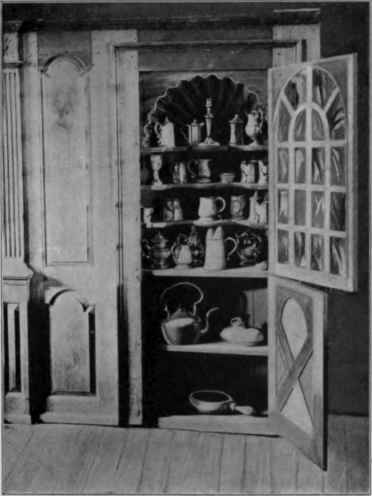
Figure 186. Side Cupboard with panelling, style of about 1750.
A corner cupboard with panelled doors top and bottom is shown in Figure 187. The cupboard part sets back from the outside several inches, and fluted pilasters support the top, which is carved in the scallop shell pattern, the edges of which and the pilasters do not show in this picture. The outer case of the cupboard is panelled, and large fluted pilasters run from the floor to the cornice. The cornice is in the familiar form already shown, a fillet, a large cyma recta, a fillet, and a small cyma reversa. This cupboard is the property of the writer.

Figure 188. Corner Cupboard, 1725-50.
Figure 188 shows a corner cupboard similar to the foregoing, except that it has two glass doors covering the upper cupboard. The edge of the scallop shell shows very distinctly. The sides and front of the outer case are well panelled. This cupboard is the property of Mr. Albert H. Pitkin, of Hartford.
The corner cupboard shown in Figure 189 differs in some respects from those already described. The cupboard is flush with the outside edge of the case, instead of being recessed, as in the preceding cupboards, and is covered by a single large glass door. The closed cupboard below is very short and there is no panelling except on the doors. The inside is very beautiful; engaged fluted shafts standing on very high bases support the shell top, which is boldly carved, but its edges are left flat, probably because the frame of the door covers the edge when closed. At the centre of the shell is carved an urn with foliations. This cupboard is the property of Mr. George M. Curtis, of Meriden, Connecticut.


Figure 187. Corner Cupboard, 1725-50.
Figure 189. Corner Cupboard, 1725-50.
Cupboards like those shown in the preceding figures were commonly called "Beaufatts," "beaufets," or "beaufats," and a village in the vicinity of Northampton, Massachusetts, has acquired the name "Beaufat" from the fact that one of these cupboards, which was considered quite remarkable, was built into a house there.

Corner Cupboard, 1750-75.

Corner Cupboard, 1750-75.
Figure 190 shows a corner cupboard, in Chippendale style, which is the property of the Metropolitan Museum of Art. The cornice, which is scrolled, consists of a fillet, a cyma recta, a fillet, a dentil moulding, a cyma recta, a fillet, an astragal, and a fillet. The sides are chamfered in the usual manner, and the cornice projects, giving the appearance of a pilaster. Across the top and at the sides are carved fret designs. The glass door is broken up into an oval and C scrolls in a very charming manner. Across the top of the base is a fret design suggestive of the Gothic, and the chamfered edges arc fluted. The moulding about the panel of the cupboard is carved in an acanthus-leaf design.
Figure 191 shows a corner cupboard which is the property of Mr. G. W . Walker. The scroll of the cornice is composed of a quarter-round, a fillet, and a cove, below which is a narrow reel and bead moulding which carries partly down the sides. The ends are chamfered. A simple panel moulding follows the lines of the door. There are two flush drawers in the lower part and below is a cupboard with two panelled doors. The feet are of the ogee bracket type.

Corner Cupboard, 1750-75.
Figure 192 shows a cupboard with a flat top, the property of Mr. Hollis French, of Boston. The sides are chamfered and there is a fluted pilaster, top and bottom, on each side. The glass in the doors is plain, except that the upper series is domed. The panelled door below is perfectly plain.
A well-made mahogany inlaid corner cupboard is shown in Figure 193 and is the property of Mr. Robert H. Schutz, of Hartford. The moulding at the top is very simple, consisting of a fillet and a cyma reversa. The top is scrolled and the inside ends are finished with rosettes inlaid in a star pattern. At the centre, above the doors, is an inlaid fleur-de-lis in a medallion, and about the doors is a delicate waving line of inlay. On the chamfered sides is inlaid a guilloche. There are three drawers in the lower part and two cupboard doors. In the centre of the latter are inlaid medallions.

Figure 193. Inlaid Corner Cupboard, 1790-1800.

Figure 194. Corner Cupboard, 1800-10.
Figure 194 shows another corner cupboard, the property of Mr. H. W. Erving, of Hartford. The cornice consists of a fillet, a cyma recta, a fillet, and a cove. A carved rosette finishes the inner ends of the scrolls. On either side of the upper and lower sections are spiral turned columns with capitals suggestive of the Ionic order, and the same capital finishes the front of the centre acroterium.

Figure 195. Carved Corner Cupboard, about 1800.
Figure 195 shows a corner cupboard of pine very elaborately carved in Sheraton designs. The cornice is very similar to the mirrors of the period with pendent balls. Below this is a frieze of half-rosettes and rosettes, and below that is a raised lozenge-shaped border bordered by astragals. The stiles and chamfered ends are fluted, broken at the centre by rosettes, and across the base is a border Composed of lozengea separated by two vertical pellets. The skirt is ornamented with three rosettes. The front is convex and the glass is made on the curve. There are two doors at top and bottom, the centre glass and panel being stationary. At the centre is a drawer. The three panels in the lower part are ornamented with a border of reeding set at right angles to the stiles and rails. This piece is the property of the writer.
Continue to:


My Books

