


IX. Tables. Part 12
Description
This section is from the book "Colonial Furniture In America", by Luke Vincent Lockwood. Also available from Amazon: Colonial Furniture In America.
IX. Tables. Part 12
After the adoption of the Hepplewhite and Sheraton styles, between the years 1780 and 1800, the cabriole leg was dropped and the straight square leg or the slender fluted leg took its place on furniture of every kind, and carving was superseded by inlay or marquetry. The wood continued to be principally mahogany.
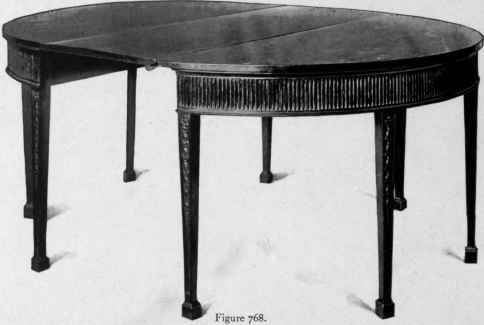
Dining-Table, last quarter eighteenth century.

Figure 769. Dining-Tablc, 1800-10.
Figure 768 shows a dining-table composed of two half-round tables, to one of which is attached a leaf which raises and attaches to the other. The frame is fluted and the eight legs are tapering and terminate in spade feet and are ornamented with carved pendent flowers. This table is the property of the Tiffany Studios.
A form of dining-table quite popular in the early nineteenth century is shown in Figure 769. There are three bases, each with four columns carved in the acanthus-leaf design, and four legs the upper surfaces of which are composed of a convex and a concave curve terminating in brass claw feet. On the convex surface of the legs are carved acanthus leaves. The centre standard has no leaves, but each of the ends has one on the inside which, when open, locks into the centre section. This form of table was popular with the cabinet-makers of the period, of whom Duncan Phyfe, of New York, is the best known. This table is the property of the Metropolitan Museum of Art.
Figure 770 shows another dining-table of the same period, closed, which was the property of the late Mrs. Frank H. Bosworth, of New York. There are four lyre-shaped standards. The outer ones have three cyma curved legs and the inner ones have but two legs, and all terminate in brass claw feet. The inner standards are attached to the frame, and when the table is opened they separate, supporting the leaves at proper intervals.

Figure 770. Dining-Table, 1800-20.

Figure 771. Dining-Table, about 1810.
The extension top in this form was invented by Robert Gillow, of London, in 1800 and is the same as that found on the modern tables.
Another form of extension dining-tablc is shown in Figure 771. When closed the legs fold up and it forms .a square table. When open the legs spread, as are shown, and tour leaves can be inserted. The legs are turned and the only ornaments are rosette bosses at the ends. This table is the property of the Tiffany Studios.

Figure 772. Dining-Table, about 1820.

Figure 773. Part of Dining-Table, about 1820.
A still later form of dining-table is shown in Figure 772. It has three pedestals, circular in form, with four carved claw feet in Empire style. The ends have no leaves but the centre section has two which raise and fasten to the ends. This table is the property of Mr. Charles R. Morson, of Brooklyn.
Figure 773 shows an end of a table similar to that shown in the last figure. The base is well carved in the characteristic coarse Empire carving in acanthus-leaf and pineapple designs. The legs have the usual shoulders and claw feet. This table is the property of Mr. Merle Forman, of Brooklyn.
During the last quarter of the eighteenth century card-tables were very common, and large numbers of them have survived in Hepplewhite and Sheraton styles.
A very beautiful inlaid card-table, in Hepplewhite style, is shown in Figure 774 and is the property of Mr. John J. Gilbert, of Baltimore. The top is a half-round and is divided into five panels. A wide border of inlay finishes the outer edge of the top and a half circle of inlay is at the back. A satin-wood border forms panels on the frame and at the top of each leg is an inlaid medallion. The legs are tapering and have a pendent flower design inlaid on their surfaces.

Card-Table, 1775-1800.
Another Hepplewhite card-table, the property of the Misses Andrews, is shown in Figure 775. The corners are cut in the recessed quarter-round design which was very popular during the last ten years of the eighteenth century. The inlay consists of a narrow border of holly on the frame and forming panels on the legs, and at the centre of the skirt and above the leg are lozenge-shaped panels formed with the same wood. When the top is opened it is supported by one of the rear legs which swings out in the usual manner.
Figure 776 shows a card-table in Sheraton style, the property of Miss Manning, of Hartford. The front of the frame is swelled and the sides are formed in cyma curves. The top follows the outline of the frame. The table, when open, therefore, has a serpentine curve on the long sides. At the centre of the frame and above the legs are inlaid shells. The legs are tapering and reeded.

Figure 775. Card-Table, 1790-1800.

Figure 776. Card-Table, 1790-1800.
A form of card-table of the Sheraton period, which is very graceful and of which many examples are found, is shown in Figure 777. The front is slightly swelled and the top curves out over the round top of the legs. The front and sides have inner panels of satin-wood and a narrow border finishes the edge of the top and skirt. The legs are turned and reeded in the form common on Sheraton pieces. This table is from the Bolles Collection.

Figure 777. Card-Table, 1790-1800.
Continue to:


My Books

