


V. Desks And Scrutoires. Part 3
Description
This section is from the book "Colonial Furniture In America", by Luke Vincent Lockwood. Also available from Amazon: Colonial Furniture In America.
V. Desks And Scrutoires. Part 3
From about the year 1660, or possibly a little earlier, a new style of furniture for writing purposes seems to have come into use called "scrutore," or " scriptoire," as some of the inventories call them. It may be assumed that the influence of Charles I and Charles II, with their French ideas and fancies, had something to do with the change.
One is instantly impressed, on reading the early inventories, with the fact that up to the end of the first quarter of the eighteenth century scrutoires are inventoried at much higher figures than desks, it being very seldom that they are placed at a lower valuation than £1, while the average is easily from £6 to £7. A good illustration of the above appears in a Boston inventory of 1709: "a desk 3s," "1 scriptore £6." Among the various inventories we find the following: At Boston, 1669, "scritoire and desk £10"; in 1683, "a scriptore £2," "a small scriptore 10s"; in 1704, "a black walnut scrutoire"; in 1717, "a scriptore £8"; and in 1723 one for £12; at Salem, in 1684, "a large scriptoire £5"; at New York, in 1691, "a scrutore without a lock 20s"; and in 1704, "2 schrutoors £13," the last a spelling which none but a Dutchman could have executed; at Philadelphia, in 1687, "1 screwtor £1"; in 1705, "a scrutor & large Bible £2 5s"; and in 1720, "1 black pine screwtor £4."
There are three types of early scrutoires found in this country, those having a falling front on which to write, and those having a slant top and ball feet, and those having a slant top resting on turned legs.
Figure 238 shows an example of the first type in the Bolles Collection. It is made in two carcasses; the lower one contains three drawers with the early single-arch moulding on the frame about them. About the bottom is a heavy moulding, and the piece stands on ball feet. The upper carcass consists of a solid front concealing drawers and pigeon-holes. The cornice is heavy and consists of a quarter-round, a fillet, a cyma recta, a wide fillet, a quarter-round, a torus or cushion frieze which contains a shallow drawer, an astragal, a fillet, and a cove. The wood is walnut veneered and the handles are of the early drop variety. This piece has many of the characteristics of the six-legged variety of high chests of drawers which belongs to the same period.
Very few scrutoires of this type have been found in this country, but they were fairly common in Holland and England. In an inventory of a store-keeper in New York in 1692 appears "4 Pr. Scrutore Chains with two dozen bolts." These chains must have been used to hold the front which lets down to write upon; and as all slant-top desks are supported with two frames which pull out to hold the front, such chains were probably intended for the style of scrutoire above shown.
The next type of scrutoire, and the one most commonly found of the early varieties, is shown in Figure 239. The characteristics of this type are the arrangement of the interior, with the pigeon-holes and drawers at each end advanced; the slide opening into the well which lies above the two drawers; the four drawers, two long ones and two side by side; the mouldings about the bottom, and the lull feet The scrutoire here shown has all these characteristics. The moulding about the drawers is of the single-arch type and the handles are in the early drop form. These scrutoires are found made of maple, walnut, and of white-wood, and sometimes with veneered panels of bird's-eye maple or walnut on the face of the slant top and drawers.
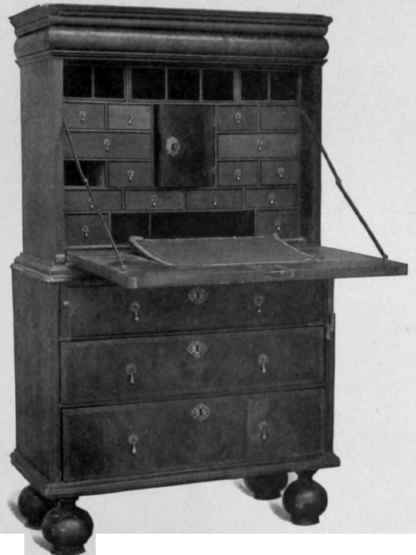
Figure 238. Scrutoire, fall front, about 1700.
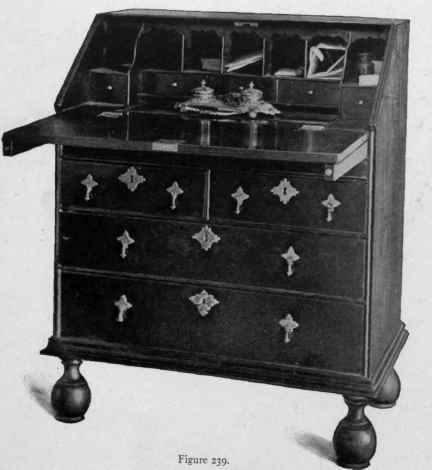
Ball-Foot Scrutoire, 1700.
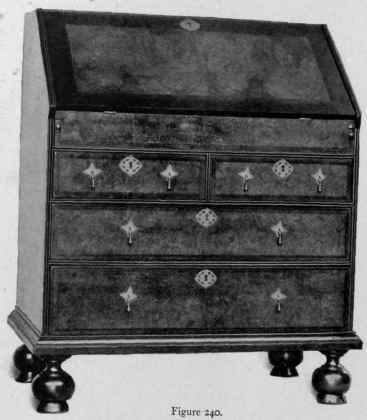
Ball-Foot Scrutoire, about 1700-10.
Figure 240 shows another scrutoire of the same type which is in the Bolles Collection. The outer wall of the well above referred to can be seen just above the two drawers. This piece has all of the characteristics above mentioned and differs from the preceding only in that it has the double-arch instead of the single-arch moulding about the drawers, and also a variation in the ball feet, those shown in this piece being in the usual form with the flaring shoe below the ball. The surfaces of the drawers and lid are beautifully veneered with burl walnut with a herring-bone border in the manner found on some of the high chests of drawers.
Figure 241 shows the earliest form of scrutoire with a top. The lower part has all the characteristics above mentioned as belonging to this type. The upper section is composed of two doors with rounded tops. In each is inserted a bevelled panel, the upper outline composed of a half-round and a cyma reversa on each side, a characteristic design of the period and identically like the mirror shown in Figure 315. The cornice is composed of two arches on the front and one at each side, and the mouldings are all cut on the circle and are as follows: a quarter-round, a fillet, a cyma recta, a fillet, and a cove, which is the same moulding as that shown on the high-boy (Figure 65). About the drawers and the doors are double-arch mouldings. The brasses are engraved and the bails are held with wires. Behind the doors are pigeon-holes, each tier having a different style of fret across the top. There are two slides below the doors to hold candle-sticks. These scrutoires are also found with flat tops and with the panels in the upper section planted instead of sunken. There is one of this description in the Philadelphia Library, which is said to have belonged to William Penn. This piece was found in Maine and is the property of the writer.
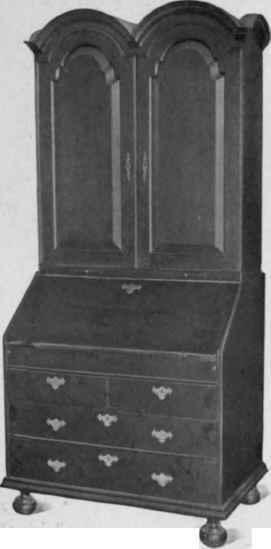
Figure 241. Ball-Foot Scrutoire with cabinet top, 1700-10.
Continue to:


My Books

