


X. Bedsteads. Part 3
Description
This section is from the book "Colonial Furniture In America", by Luke Vincent Lockwood. Also available from Amazon: Colonial Furniture In America.
X. Bedsteads. Part 3
In New England, where practically all the examples of seventeenth-century furniture now known have been found, the less extravagant habits of the people caused them to be more conservative; but, notwithstanding this, most of the fine chests, cupboards, etc., recently unearthed have been found in attics, woodsheds, or barns, partly destroyed and nearly always painted and maltreated in every way. Cupboards, tables, and chairs could for a while serve their useful purposes in kitchen or woodshed, but a bedstead, when discarded, could not be utilised for any useful purpose and was consequently destroyed.
Miss Helen Evertson Smith, author of "Colonial Days and Ways," informs us that she remembers, many years ago, going to the home of the widow of Peter G. Stuyvesant, at the corner of Eleventh Street and Second Avenue, New York City, and seeing there a state bedstead with elegant hangings which was said to have belonged to Governor Stuyvesant, and on the third floor a bedstead which she describes as follows:
"Another bedstead, not so beautiful as this one, but more plentifully (if not so finely) carved, stood dismantled in a rear third-story room, and had, apparently, been intended to fit into an alcove, as all the carving was on one side. A pair of carved and panelled doors opened beneath the high bed-place. The closet thus formed may have been used for bedding. The place for the beds was a sort of box deep enough to have held three or four mattresses or feather-beds, laid, without the intervention of anything to answer the purpose of springs, directly upon the age-darkened boards. At each corner rose a carved post from six to seven inches in diameter, as I now guess. The two front posts were square as far as they formed the ends of the closet beneath the bed, and round as they rose above this till they merged into a carved cornice of over a foot in depth. The two rear posts were halves laid flat against a heavily panelled rear wall."
This would seem to have been a handsome cupboard-bedstead, but the writer has been unable to locate it or to find whether it is still in existence. These cupboard-bedsteads we find frequently mentioned throughout the inventories, which would indicate that they were popular, probably because, being built into an alcove, they took up but little room; and this would also account for the fact that they have so entirely disappeared, for, being built for a particular room, they would have been of little use elsewhere, and when families moved or remodelled their houses these bedsteads would have been destroyed.
Couch-bedsteads are mentioned occasionally in the Northern inventories, and very frequently in the South; in fact, there is hardly a Southern inventory of .any size during the first hundred years which does not mention at least one much-bedstead. These were, as their name indicates, couches which could be Utilised for sleeping purposes.
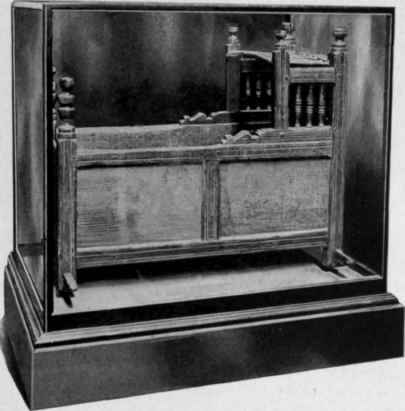
Figure 799. Oak Cradle, sixteenth century.
As several cradles dating before 1700 have been found in this country, we will briefly describe them here before proceeding further with the discussion of bedsteads.
There were apparently two styles of cradles, one swinging between uprights which stood firm on the floor, the other swinging on short rockers; but, so far as this country is concerned, the former style, though antedating the latter in Europe, does not seem to have appeared here until much later.
Figure 799 is an example of one of the latter style made of oak, the top and side of the hood made with turned spindles, much after the fashion of Elder Brewster's chair, shown in Figure 415. This turned style is extremely old, and we have found such pieces illustrated as early as the fifteenth century. This particular cradle is the finest that has come under our observation in this country, and is probably late sixteenth or early seventeenth century. It is now at Pilgrim Hall, Plymouth.
Another cradle at the same place is shown in Figure 800. This piece, it will be seen, is made of wicker, and tradition says that it came over in the Mayflower and was used for Peregrine White. The fact that it is made of wicker can easily be explained by the fact that the Pilgrims came from Holland, which at that time was engaged in the India trade, and this piece was undoubtedly of Eastern origin.
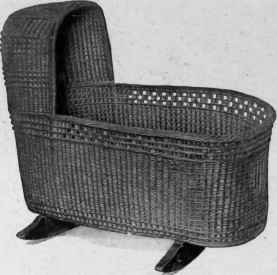
Figure 800. Wicker Cradle, early seventeenth century.
After about 1700, in England, the fashion of high ceilings having been introduced, the bedposts were correspondingly lengthened, and some were twenty feet tall. These, as formerly, were heavily draped, the bedsteads being plain or covered with fabric. In this country the ceilings continued to be made low, and simple slender posts were used which were either round, octagonal, or fluted.
We find at Philadelphia, in 1709, "a black walnut bedstead £1"; at Providence, in 1726, "2 bedsteads 10s," and in the same inventory, "1 bedstead and bedding £13"; and in 1734, "14 new bedsteads £14." Occasionally a will throws a little light on the subject, as in the case of the will of Thomas Meriwether, of South Farnham Parish, Essex County, Virginia, February 10, 1708: "I give my dear and loving wife Susanna my best new bed and furniture and the set of chairs belonging to it. The whole sute of Japan." At Providence, in an inventory of 1730, appears, "a feather bed & pannoled bedstead £10," which was probably an oak bedstead of an earlier date.
The bedsteads in this country were probably heavily draped, as they were in England, and an example of this heavy drapery will be seen in Figure 801, which is an enlargement of the second-floor bed-room of the doll house shown In Figure 1.
Figure 802 shows a simple walnut bedstead dating rather early in the eighteenth century. The lower posts are simply fluted and the base is square. The head-posts have chamfered edges and the head-board is plain. Such a bedstead as this was intended to be fully draped either in stuffs or crewel-work. The back would be covered with the fabric, and head-curtains which would slide on rods were on either side. The tester was finished with a valance and the top was often covered. The foot-posts were covered with curtains, which were likewise on rods and could be so drawn as to enclose the entire bedstead. A bedspread would be made of the same material and a valance would finish the bottom under the bed frame.
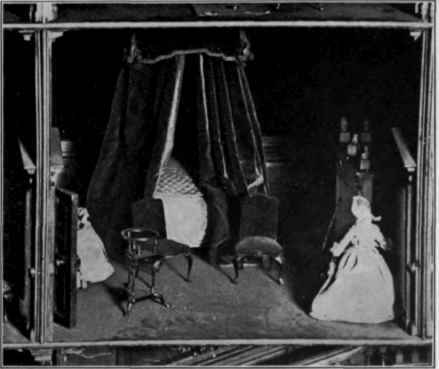
Figure 801. Miniature Bed-Room showing draperies, first quarter eighteenth century.
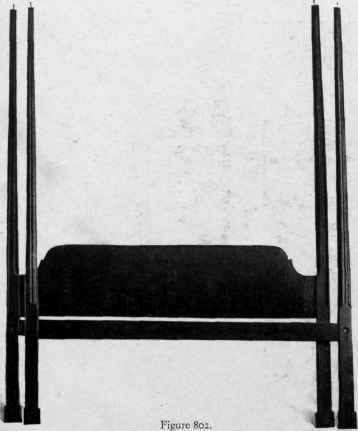
Walnut Bedstead, about 1725.
Continue to:


My Books

