


X. Bedsteads. Part 4
Description
This section is from the book "Colonial Furniture In America", by Luke Vincent Lockwood. Also available from Amazon: Colonial Furniture In America.
X. Bedsteads. Part 4
Another early bedstead is shown in Figure 803. The foot-posts are round and terminate in crude bandy legs. The head-posts are chamfered and the headboard plain, as in the preceding figure.
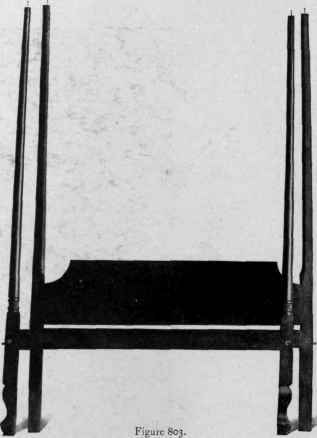
Bedstead, about 1725.
An unusually beautiful set of bed-hangings, made of crewel-work, is shown in Figure 804 and is the property of the museum at the gaol at York, Maine. It It was made by Mrs. Mary Bulman, whose husband, Dr. Alexander Bulman, died at the siege of Louisburg in 1745, and in a letter to a friend, dated October, 1745, she mentions beginning the work to occupy her mind. The hangings consist of the head and foot curtains embroidered in a flowing design of flowers and leaves, an upper valance showing trees and verses from hymns, a curtain across the head of the bed embroidered in trees, flowers, baskets of flowers, and birds, and a bedspread to which is fastened the valance embroidered in the same design as the back. Very few of the early bed-hangings have survived, which makes this set doubly interesting.
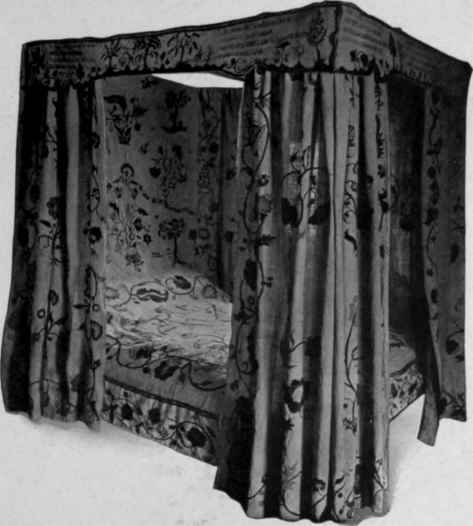
Figure 804. Bedstead draped in crewel-work, 1745.
About 1720, bedsteads became more ornate and the better ones had claw and ball feet.
A very beautiful example of the bedstead of the period is shown in Figure 805. It is the property of Mr. Richard A. Canfield. The foot-posts are carved in a leaf design about one-third the distance up from the bed frame, and above are fluted.

Figure 805. Mahogany Bedstead, about 1725.
The feet are well-carved animals' claws on balls, but the legs are straight and not cabriole. The head-posts are plain except for a Muting. The bed frame is hidden behind panels of wood on which are carved the meander pattern with a rope edge. The tester-top is unusually well carved in a guilloche design alternating a large and small circle, and in the centre of each large circle is carvcd a rosette. This design is carried out on the inside as well, and hidden between the two mouldings are the rods upon which the curtains run. Above is a nulled edge, and at each corner is a bold, well-carved acanthus leaf and at the centre of each side and the lower end is carved a cartouche with scrolls and acanthus leaves. No such bedstead has been found in America, but it is shown to emphasise the difference between the elaborate English bedsteads and the simpler ones found here.

Figure 806. Cabriole-Legged Bedstead, 1725-50.
A typical example of the simpler bedsteads found in the American colonies is shown in Figure 806 and is in the Pendleton Collection, owned by the Rhode Island School of Design. The foot-posts are fluted and reeded, the fluting being broken about two-thirds of the way up the post by a ring. There is a rounded capital with a plain shaft above. The legs are cabriole and terminate in bird's claw and ball feet. The head-posts are plain with chamfered edges. This bedstead had a plain, straight tester-top over which the valance was fastened. Bedsteads of this type are also found with posts a little shorter, with a field top; that is, the tester was cut in a serpentine curve from head to foot.
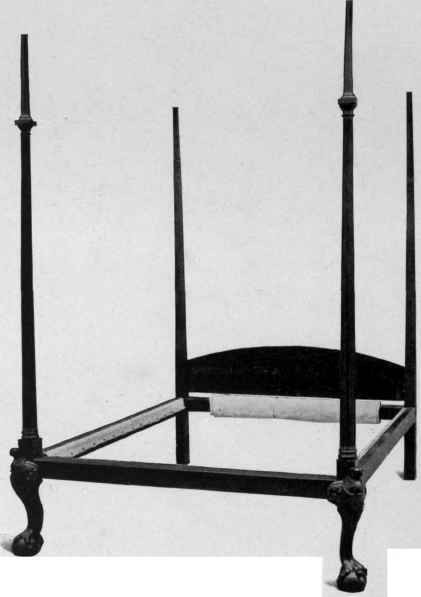
Figure 807. Cabriole-Legged Bedstead, 1725-50.
Figure 807 shows a more elaborate bedstead from the Bolles Collection. The foot-posts are slender and fluted. At the top is a square block above which the posts are plain. The legs are cabriole and terminate in bird's claw and ball feet.
The bolts locking the frames are covered by blocks which accentuate the curves of the legs. These blocks are fastened to the posts by screws which fit into key-hole plates. The surface of the blocks is carved with acanthus leaves and flowers and a scroll at the top standing out beyond the plane of the posts.
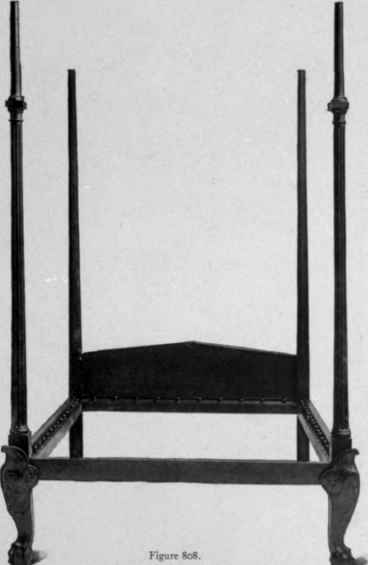
Cabriole-Legged Bedstead, about 1750.
Figure 808 shows another bedstead of the same general type which is the property of the writer. The foot-posts are the same as shown in the preceding figure and blocks of the same style hide the bolts. The blocks in this piece are carved in two-headed pheasants so designed that a head, wing, and tail appear on each side and a rosette finishes the outer edges. The head-posts are plain with chamfered edges. The inner edges of the frame are cut in a recessed square, and knobs of wood are dowelled in, the heads of which come a little below the top surface of the frame. These were intended to hold the cording upon which the mattress was originally placed.
It is probable that this form of bedstead continued to be used in this country until the introduction of the Sheraton style, for we find very few of the Chippendale period.
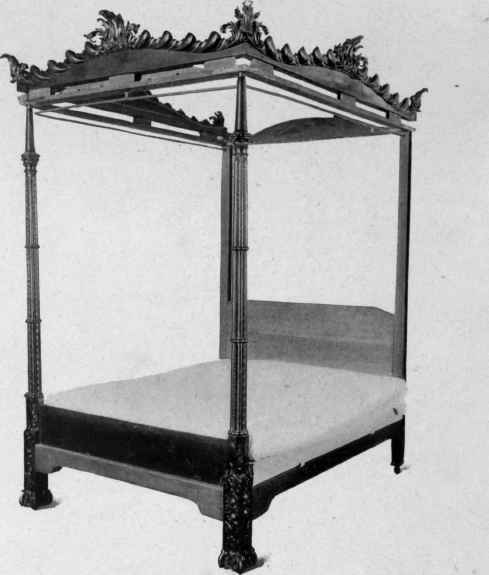
Figure 809. Bedstead in Chippendale style, about 1760.
Figure 809 shows an English bedstead of the Chippendale period, the property of Mr. Marsden J. Perry, of Providence. The foot-posts are in cluster form with the surface carved in a pendent-flower design, and above is a capital carved with acanthus leaves above which is an egg-and-dart moulding. The legs are partly chamfered and partly square, and on the surfaces are carved designs of foliated scrolls and rosettes. The legs swell slightly at the corners of the bottom with carved scrolls, thus forming the feet. The head-posts are perfectly plain.
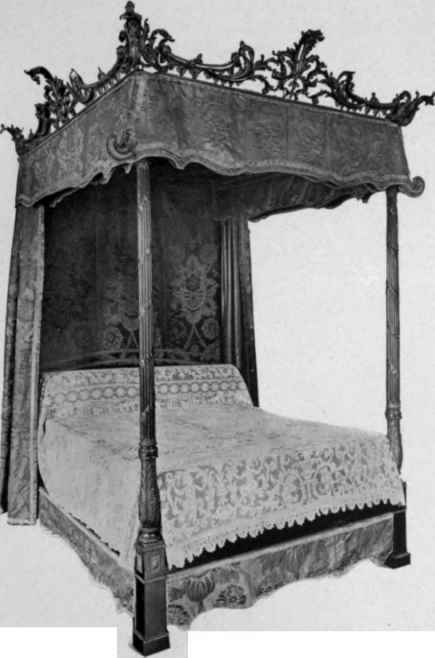
Figure 810. Bedstead in Chippendale style, 1750-60.
The tester-top is crested with a bold nulling, and at the corners and centre of the sides and foot are carved acanthus-leaf scrolls.
A very beautiful bedstead of the Chippendale period, with its original draperies, is shown in Figure 810 and is the property of Mr. Marsden J. Perry.
Each foot-post has cluster columns bound by ribbons and a capital carved in an acanthus-leaf design. At the base of each column are carved an acanthus-leaf edge and a bead moulding. Around each post below this is carved a flower pattern, and on the surface of the vase-turning below are well-carved acanthus leaves. The small turnings below are ornamented with a bead and an egg-and-dart moulding. The legs are square, with three mouldings, the upper and lower ones carved in an acanthus-leaf pattern and the centre one in a reel-and-bead pattern. The tester-top is delicately carved in foliated scrolls and acanthus leaves which overhang at the centres and ends. The edges of the valance at the top and bottom are cut in cyma and simple curves, and at the corners of the top are stuffed scrolls of the fabric standing out from the corners of the foot-posts.
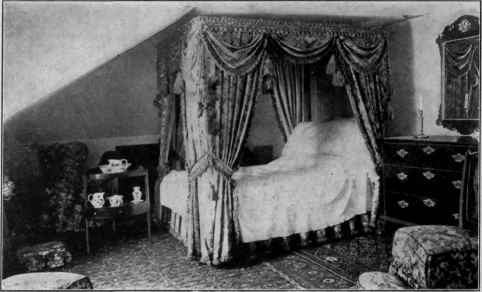
Figure 811. Draped Bedstead, late eighteenth century.
Figure 811 shows one of the bedsteads now preserved at Mount Vernon which illustrates admirably how completely the drapery covered the frame and the bedposts of the simpler sort, thus making any ornamentation of the posts quite unnecessary, the elegant appearance of the bed being made entirely to depend upon the draperies.
One of the features of the style following the Chippendale is that the posts, instead of being plain, fluted, or with a slight vase-shaped turning above the bed frame, are turned in forms which are not architectural, and this turning became more elaborate as time went on.
Figure 812 shows a bedstead in Sheraton style, the property of Mr. Marsden J. Perry, of Providence. The posts are in the form and decoration quite commonly found here, but seldom do we find so elaborate a tester. The foot-posts have .a carving of drapery and leaves on the bulbs, and above, the post is cut in hexagonal shape, and at the base of this portion, on each surface, is carved a laurel leaf. Below the bulb are narrow medallions, and the square legs terminate in spade feet. The head-posts are plain. The tester-top is domed, and on the edges are gilded rosettes strung on a gilded rod and at the centre is a panel on which is gilded drapery. At the corners and centre of the sides are carved and gilded urns.

Figure 812. Bedstead, Sheraton style, about 1790.
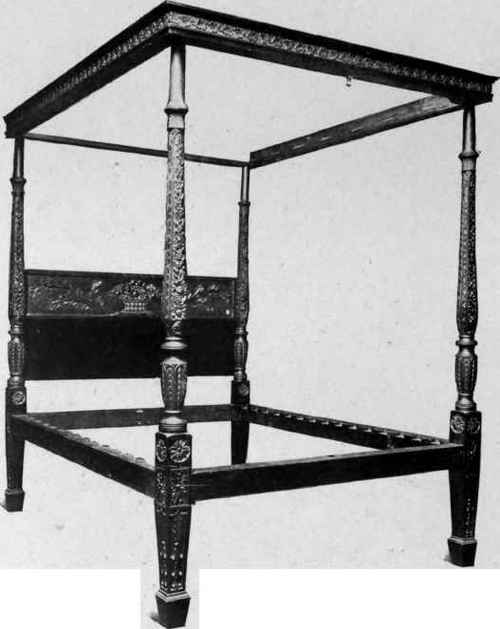
Figure 813. Bedstead in late Sheraton style, about 1800.
A very ornately carved bedstead of this period is shown in Figure 813, the property of Mr. Richard W. Lehne, of Baltimore. The four posts are carved with rosettes just above the rails, and above that is a vase-turning divided into panels within which are carved pendent flowers. Above, the rounded posts are squared. on the two outside surfaces are carved a cornucopia, leaves, flowers, fruits, and acorns extending all the way up the post The other two sides of the posts are carved in a long, narrow leaf, and above these panels is a slight acanthusleaf carved capital. There is a high head-hoard upon the upper panel of which is a basket Idled with fruits, and from either side are streamers of leaves. The legs are square, ornamented with carved leaves and pendent flowers, and terminate in spade feet. The tester-top is simple with a border of oak leaves carved on the surface.
Continue to:


My Books

