


Jacobean Period. 1603-1688. Part 8
Description
This section is from the book "The Practical Book Of Period Furniture", by Harold Donaldson Eberlein And Abbot McClure. Also available from Amazon: The Practical Book Of Period Furniture.
Jacobean Period. 1603-1688. Part 8
Decorative Processes
Jacobean furniture, of the Jacobean period properly so called, was replete with ornament. It was frequently weighted to excess with a riotous profusion of decoration that echoed the exuberance of the popular fancy and sprang from an involved wealth and ingenuity of invention or, perhaps, one might more truly say ingenuity of adaptation. Of tasteful moderation and becoming sense of restraint there was little, if any, till the severity of Cromwellian days banished the "sinfully frivolous" intricacies of ornament in which cabinet makers of former regimes had freely indulged. In considering early Jacobean furniture we must always remember that the background for all this varied richness of decoration, the parent stock from which it all grew by logical process of evolution, was the furniture of Queen Elizabeth's day, and, furthermore, that that same Elizabethan furniture in turn had only just broken away from ecclesiastical tradition which had till then dominated all mobiliary forms.
The guiding inspiration was the spirit of the Renaissance, filtered through various media and sufficiently modified by English conceptions to make its expression a thing of living interest and indicative of the national temperament in that Golden Age when family life began in good earnest to assume both the guise and reality of comfort and when little amenities and elegancies were somewhat heeded, when chimneys and glazed windows became common and domestic cleanliness, however short of modern demands for sanitation, was more than a mere name. The average reader is not likely to have frequent occasion to identify Elizabethan furniture, however, and it is not necessary therefore to dwell further upon it.

Fig. 10. Jacobean Oak Chest with Drawers, c. 1670. Height, 3 feet 8 inches; length, 3 feet; depth, 19 inches. By Courtesy of Mr. R. W. Lehne, Philadelphia.
Notwithstanding the break from ecclesiastical tradition in Queen Elizabeth's time and the farther departure from its domination in the reign of James I, traces of it, nevertheless, are discernible in early Jacobean furniture, showing more clearly in severity of form or contour than in other respects. As to the sundry types of decoration bestowed on furniture, it is safe to say that until the Cromwellian era they may almost without exception be attributed to "the Renaissance and its evolution from the Gothic" through a channel of British craftsmanship.
In the early days of the Commonwealth overmuch embellishment was taboo, uncompromising plainness was esteemed and also certain Dutch tendencies became noticeable. Indeed, under Charles I and even under James, Continental influence had cropped out from time to time and affected both the contour and ornamentation of furniture.
From 1660 onward all the Restoration influences, Dutch, Flemish, French, Spanish, Portuguese and Italian, modified somewhat, it is true, by native British tastes but nevertheless essentially foreign, came into play and wrought a vast change in the fashion and form of English furniture. At this time, of course, the furniture of the American Colonies, except New York where the Dutch influence was unadulterated, faithfully and exactly reflected many of the styles in the Mother Country.
During the early Jacobean portion of the Stuart period, even more perhaps than in preceding times, ornamental design was largely dependent on architectural inspiration. In fact the architectural character of much of the furniture reminds us that it may, in a sense, be called the offspring of architecture and that its manufacture and decoration is one of the most closely allied arts.
The processes of decoration ordinarily employed within the Jacobean, Cromwellian and Carolean periods were carving, inlay or marqueterie, turning, painting, gilding, lacquering, upholstering, panelling, applied ornament and veneering - surely an ample list of resources.
Carving was the traditional, favourite and hence most common method of decorative expression in the furniture of the Jacobean portion of the Stuart period, that is to say from 1603 to 1649. During Cromwellian days it enjoyed less ample vogue, thanks to Puritan austerity. At the Restoration, Carolean influences renewed the popularity of carved ornamentation but in a quite different form, however, that reached its height in the Baroque extravagances of the final years of the period. In Restoration or Stuart work we find a free flowing treatment of roses and acanthus, and sometimes human figures, along with the conventional Baroque scrolls. Sundry methods of carving were practised in early Jacobean times and were capable of yielding considerable variety of effect in the hands of a skilful craftsman. The most usual were (1) the "Modelled" type of carving where the design stands out in well moulded relief, the surrounding background being lowered by gouge and chisel. (Fig. 13, and Key I, 4.) Such carving is usually sunk well into panels so that the part in highest relief does not project above the surfaces of the object. (2) "Flat" carving was also popular.
In this sort flat surfaces predominated and were thrown into relief by the groundwork being "sunk" or sharply gouged out (Fig. 11). (3) "Scratch carving" was easy of execution and inexpensive and hence widely practised. It was just the reverse of ordinary carving in that the design, usually of simple foliage, was vigorously and sharply incised (Fig. 14, 6).
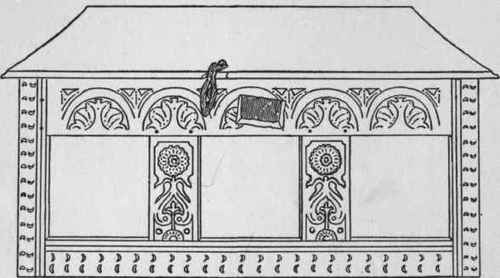
Fig. 11. Jacobean Oak Chest, c. 1640, in Collection of Pennsylvania Historical Society. Length, 52 inches; height, 22 inches; width, 23 inches. Shows gouged ornament in bottom rail and stiles and incised carving elsewhere.
All these methods were sometimes used in ornamenting the same piece of furniture.
Inlay or Marqueterie. These two terms have properly the same significance. In practical use, however, marqueterie is usually understood to connote greater elaboration of design and deftness of craftsmanship while the term inlay is applied, generally, to simpler operations. A further difference of usage seems to be that "inlay" is used to denote other materials as well as wood, while "marqueterie" is used to designate wood only. In the furniture of the Stuart period every variety of inlay or marqueterie was extensively employed. In the more expensive furniture, especially in the Carolean part of the period, large portions of the surface of various objects were completely covered with intricate and flowing patterns of foliage (Fig. 13, 3), fruit, flowers, birds and beasts. In the earlier work, though some elaborate pieces are met with, we generally find stiff little panels and isolated sections adorned with bits of simple floral inlay, often in bog oak and holly without any of the artificially stained woods afterwards used to obtain richness and variety of colour.
Lacquer. Although specimens of lacquer from the Orient were known in England in Tudor times and pieces were imported with growing frequency during the early and middle seventeenth century, the art of lacquering or Japanning does not seem to have been extensively practised by English craftsmen in imitation of the Oriental process till nearly the end of the century's third quarter. Its popularity grew so rapidly that in 1688 was published a treatise on Japanning evidently written for the use of amateurs among whom it became an immensely fashionable hobby and continued so for a considerable period.
Veneer. Some early examples of veneer, or a process approaching veneering, have been found but the practise did not obtain conspicuously till the middle or end of the Carolean epoch when the whorled or "oystered" veneer made from the transverse slices of small boughs came into vogue. There was an earlier veneer of walnut on oak while the former wood was still regarded as semi-precious.
Applied Ornament and Panelling. From the end of the Cromwellian epoch onward, when Dutch and Flemish influences were gaining more and more power, it was a common fashion to apply ornament to cabinet work in the form of panels (Fig. 14; 4, 9, 10 and 11, also Fig. 6) of various geometrical shapes made from mouldings mitred and glued on to the groundwork, pendants, bosses and the like (Fig. 1, frieze and stiles; Fig. 8, stiles).
Painting. From mediaeval times in England, as on the Continent, paint had been used for the embellishment of furniture. Throughout the Stuart period paint was employed to some extent for decorative purposes. Armorial bearings were blazoned in their proper tinctures on the panels of bed heads or chests. Other subjects of freer design were occasionally depicted in similar places. Sometimes arabesques in two or three colours were painted on a solid ground of another hue. Cornices, also, were occasionally picked out in two or three colours. Frames of chairs and other pieces of furniture, too, made of cheaper wood were not infrequently painted black or some dark hue and enriched by gilding. In the Carolean epoch a wider use was made of paint than formerly.
Gilding, though not employed as extensively as in France, was nevertheless one of the stock resources of embellishment for the furniture of the wealthy during the reign of the Merry Monarch.
Upholstery. In early Jacobean times upholstered chairs, settees or stools in small numbers were to be found in some of the great houses of the nobility but it was not till Cromwellian days, when chairs were made in greater numbers, that padded seats and backs (Key I, 2), covered with leather, were of common occurrence. After the Restoration many of these chair seats and backs were brightened up with a covering of Turkey work. From Carolean times onward upholstery was fashionable. Chairs, settees and stools were covered with elaborate needlework wrought by the ladies (Key II, 8), or with the gorgeous velvets and brocades of Continental or English manufacture. In the latter part of Charles II 's reign wonderful fabrics were made in England by foreign refugee textile workers, as many remnants of their handiwork fully attest.
Turning (Fig. 7; Fig. 13; 12,14,15 and 16; Key I, 2 and 5, and II, 7) was a favourite and inexpensive decorative process from early times and was wrought in every variety. Spiral turning, although early instances are known, did not become general till after the Restoration. The sundry types of turning are often valuable aids in determining dates.

A

B

C
Fig. 12. Typical Jacobean legs; A, pear baluster; B, melon bulb; C, ringed baluster.
Continue to:


My Books

