


Louis Quatorze And Louis Quinze. Part 2
Description
This section is from the book "The Practical Book Of Period Furniture", by Harold Donaldson Eberlein And Abbot McClure. Also available from Amazon: The Practical Book Of Period Furniture.
Louis Quatorze And Louis Quinze. Part 2
Articles
Space forbids and there is no necessity that we should enter into a detailed catalogue of all the articles of furniture used in the reigns of Louis XIV and Louis XV. It will serve the present purpose and sufficiently amplify the principal characteristics of style - particularly the characteristics that visibly influenced English furniture - if we enumerate the chief objects.
The list includes chairs, stools, or tabourets, canapes or sofas, bedsteads, tables, consoles, cabinets, commodes, armoires, bureaux or escritoires, torcheres, mirrors and clocks. Besides these there were all kinds of meubles de luxe.
Contour
The kernel of the whole matter is reached by saying that in Louis Quatorze furniture the structural lines were almost invariably perpendicular or horizontal - in other words, rectilinear - while in furniture of the Louis Quinze period the cabinet-makers apparently preferred to curve their structural lines.
There were, to be sure, the usual overlappings between the latter years of one regime and the former years of the other. We find furniture with cabriole legs and curving lines appearing before the end of Louis the Fourteenth's reign and we also find cabinet work of rectilinear structure made long after the beginning of his successor's.
The bombe or swelling fronts of commodes and garderobes, however, the cabrioled legs and serpentine tops of tables and consoles and the general scrolled treatment that went with the Rococo phase of ornamentation, which flourished exuberantly in this period, were unmistakably characteristic of the Louis Quinze style and more strongly than aught else bespake the constructional change from the methods of the Louis Quatorze epoch, when cabinet work frequently had a tall, perpendicular aspect.
Chairs
Louis XIV. All the chairs of this period were instinct with dignity. In the earlier part they were often pompous and stiff as well, while in later years grace and comfort were characteristics more in evidence.
Legs at first were often straight, carved and moulded and joined by straight X or saltire stretchers, likewise elaborately carved and moulded (Plate XII, p. 136). About the end of the seventeenth century a graceful cabriole form appears, sometimes with a more pronounced curve than at others. The proportions were well moulded and the foot was not seldom either a scroll resembling a dolphin's head or cloven hoof or pied de biche (Plate XII, p. 136). Some of the chairs were made without stretchers while many, on the other hand, had flat serpentine stretchers of the same general type we have seen in William and Mary chairs and settees. The knee of the cabriole was ordinarily adorned with some sort of shell, leaf or cabochon motif and sometimes pendent husks extended part way down the leg. Seat rails were both shaped and carved or straight, in which latter case the upholstery frequently came to the lower edge of the rail so that it was not seen. Seats, backs and arms were both caned and upholstered. Seats were broad and approximately square with a slight taper towards the back. Backs had considerable rake. Arms were long and nearly horizontal, followed the straight line of the seat side, and flared only slightly at the ends.
Upholstered backs were broad and square, or slightly flared at the crest; and the tops were straight; carved or moulded tops were curved and arched a little in the middle.

Fig. 1. Louis Quinze Arm Chair. By Courtesy of Mr. R. W. Lehne, Philadelphia.
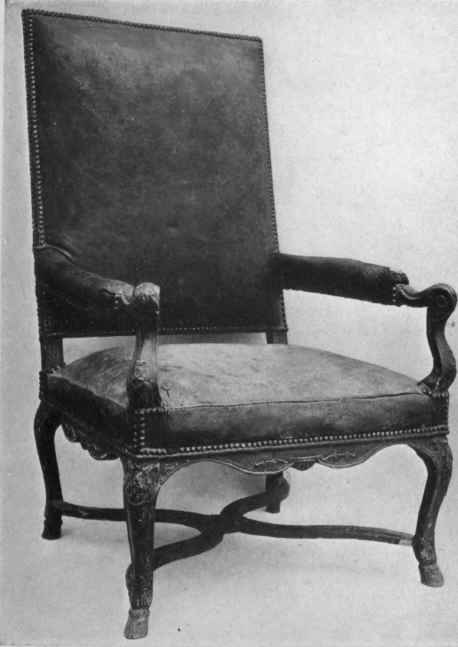
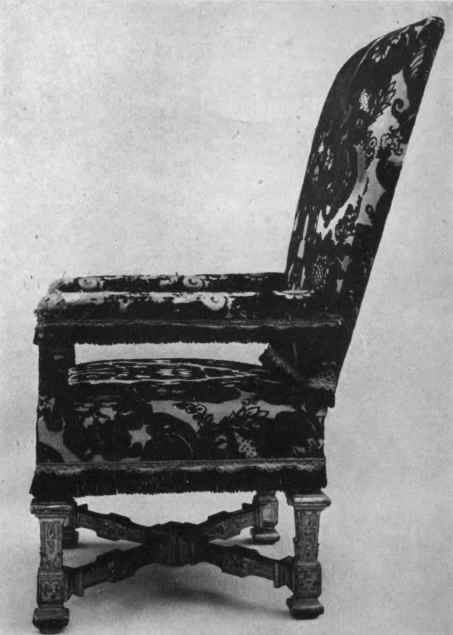
LOUIS QUATORZE ARM-CHAIR WITH CABRIOLE LEGS, LOUIS QUATORZE ARM-CHAIR WITH STRAIGHT CARVED GOATS' FEET AND SHAPED STRETCHERS LEGS AND STRAIGHT SALTIRE STRETCHERS.
By Courtesy of Metropolitan Museum of Art, New York City.
PLATE XII.
Louis XV. We first have the Regence chairs with an agreeable combination of straight lines and curves and tasteful but restrained ornament. Then as the years advance the Rococo influence increases. Cabriole legs assume stronger curves, scrolled leaf or dolphin-head feet in endless variety take the place of the pied de biche, stretchers disappear. Seat rails are shaped and waved in many curves and elaborately carved as well as the legs, arms and framing of the back. Seats are broad and approximately square tapering toward the back. Arms are short, flaring, and the supports, which are sharply curved, join the seat rail well back from the front legs. Backs are broad, and the framing, much carved, is broken into many curves and slightly arched at the top (Fig. 1; Plate XIII, p. 142).
Continue to:


My Books

