


Birmingham
Description
This section is from "The American Cyclopaedia", by George Ripley And Charles A. Dana. Also available from Amazon: The New American Cyclopædia. 16 volumes complete..
Birmingham
Birmingham, a manufacturing and market town, municipal and parliamentary borough of Warwickshire, England, 17 m. N. W. of Warwick and 100 m. N. W. of London; pop. in 1851, 232,841; 1861, 296,076; 1871,343,696. It is situated in the N. W. portion of the county, and stands on undulating ground sloping down to the river Rea. The railway lines centring here are the London and Northwestern, the Great Western, the Midland, the Birmingham and Oxford, the Birmingham, Dudley, and Wolverhampton, and the Birmingham, Wolverhampton, and Shrewsbury. Several canals, radiating from Birmingham, communicate with other towns and with the mines in the vicinity. The town is divided into 13 wards, and its government is administered by a mayor, recorder, 15 aldermen, and 48 common-councilmen. There are three public parks, viz.: Adderley park, triangular in shape and prettily laid out, which was opened in 1856; Calthorpe park, near the Rea, opened in 1857; and Aston People's park, dedicated in 1858, which contains 43 acres and is covered with fine trees. The older portion of the town is on low ground, and exhibits some good specimens of ancient domestic architecture, while the modern portion, on high ground, contains many fine and costly buildings, principally of brick, and spacious streets.
The town hall, of brick, faced with Anglesea marble, 160 ft. long, 100 ft. wide, and 83 ft. high, is built on the model of the temple of Jupiter Stator at Rome; and the public hall, 145 ft. long. 65 ft. wide, and 65 ft. high, contains one of the most powerful organs in England, with 4,000 pipes and 78 stops. The free grammar school was founded by Edward VI. Its present building, a beautiful structure, erected in 1834 at a cost of £50,000, is 174 ft. in front, 125 ft, deep, and 60 ft. high. The school contains a classical and a commercial department, and has an income of £12,000 a year. There are about 470 pupils in the main establishment, and 1,000 in the four branches that have been established for the children of artisans, etc. The parish church of St. Martin, a very ancient edifice, with a massive tower and handsome spire 210 ft. high, recently rebuilt, contains some curious monuments of the De Berminghams, the ancient lords of the place.
St. Philip's church, erected in 1715, but lately repaired, is a fine structure in the Italian style, with a tower surmounted by a dome and cupola. There may also be mentioned St. George's church, in the decorated English style; St. Thomas's, a Doric structure; the Roman Catholic cathedral, erected at a cost of £60,000; the London and Northwestern railway station; Queen's college, which confers degrees in arts, law, and medicine; the Midland institute, a philosophical institution; the exchange buildings, the masonic and odd fellows' halls, etc. Besides the free grammar school and Queen's college, the most noteworthy educational institutions are the blue-coat school, giving elementary instruction to 140 boys and 60 girls; the Protestant dissenters' charity school, educating 40 girls; St. Philip's industrial free school, admitting 220 children; Springhill college, a theological institution of the Independents; Sydenham medical college; and the government school of design. In the vicinity of Birmingham are the Roman Catholic seminary of Oscott, and a diocesan training institution at Saltley. There is a public subscription library in the town, containing 30,000 or 40,000 volumes, a society of arts, an odd fellows' literary institute, free libraries erected by the corporation, and two reformatory institutions.
Of the charitable institutions, the most important are the general hospital, Queen's hospital, the deaf and dumb asylum, the institution for the blind, and various dispensaries and infirmaries. . There are 34 churches belonging to the establishment, a Roman Catholic cathedral and three or four chapels, and numerous places of worship for dissenters. There are two theatres, three music halls, an art gallery, and three cemeteries. Birmingham has a branch of the bank of England and six other banks, on the joint stock principle. The savings bank, which was one of the largest in England, has been merged in the post office system. - The town owes its rapid growth and great prosperity to the extent and variety of its manufactures. Situated near the centre of England, on the border of a great coal and iron district, with an admirable canal and railway system, it has enjoyed unrivalled advantages. Birmingham has been known for centuries for its iron and steel manufactures, but it has attained its present preeminence within this century. While there are many extensive establishments, employing a large capital, yet a great proportion of the manufacturing is carried on by men of small means, who generally employ their workmen by the piece.
The latter frequently work at home, and when they require the aid of machinery hire one or more rooms, furnished with steam power, in buildings which are kept for that purpose. In 1865 the number of steam engines in the town was 724, with 9,910 horse power, consuming 600 tons of coal daily. There were 1,013 smelting and casting furnaces at work, and 20,000 families were engaged in manufactories. The value of hardware and cutlery exported in 1864 was over £4,000,000. At the same time the exports of firearms, glass, leather, machinery, iron and steel wire, plate, copper, brass, zinc, tin, and coal amounted to over £37,000,000. Of firearms 5,000,000 were furnished during the Napoleonic wars, and during two years of the American civil war 1,027,-336 were exported to the United States. Besides glass manufacturing, glass painting or staining is an important branch of industry.
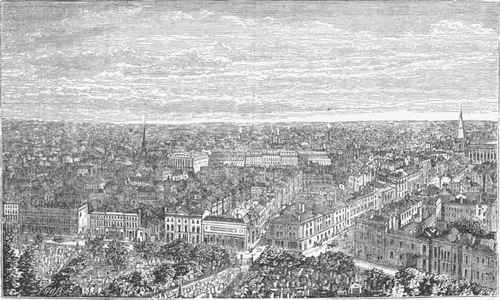
Birmingham, England.
The quantity of gold ware assayed and marked at the assay office averages 30,000 ounces annually; of silver ware, 100,000. Large quantities are also manufactured and sold without being marked. Large numbers of gold rings are produced, nearly 30,000 wedding rings having in some years been assayed and marked at the assay office. About 300,000 ounces of silver-plating are consumed yearly. The manufacture of steel pens is very important. The establishment of the late Mr. Gillott employs 600 workmen and manufactures 1,000,000 gross annually. The whole number of steel pens made yearly in Birmingham is estimated at 91)0,000,000, consuming 500 tons of steel. Pins and buttons are also made in vast quantities, and several hundred tons of mother-of-pearl are annually consumed in the latter manufacture. The manufacture of swords and bayonets is also extensively carried on. At Smeth-wick in the vicinity of Birmingham steam engines are largely made. Many hands are employed in japanning and electro-plating. An important branch is the manufacture of fancy seals, brooches, clasps, and other trinkets, of what is known as Birmingham gold, as well as of polished steel.
There may be mentioned in addition, among the industries of Birmingham, wire-drawing, scale making, railway carriage building, brass founding, iron casting, works in bronze, and manufactures of lamps, metallic bedsteads, gas fittings, leather and wood cases, nails, articles of papier mache, tools, percussion caps, and sewing machines. The machinery employed in the various manufactures is remarkable for the combination of power with delicacy and precision of movement. There are two annual fairs, each lasting three days, one in the spring, the other in autumn. - Birmingham is first mentioned in Doomsday Book, under the name of Bermingeham. It remained an obscure village for centuries. The first great impetus was given to its growth toward the close of the last century by the introduction of the steam engine and the demand for muskets created by the American revolution and the French wars. A still greater accession of strength and prosperity has been received in the last 40 years from the railway system.
Birmingham was constituted a borough by the reform act of 1832, with the privilege of sending two members to parliament; an additional member was given by the act of 1867. The municipal charter was granted in 1838.
Continue to:


My Books

