


Tea
Description
This section is from "The American Cyclopaedia", by George Ripley And Charles A. Dana. Also available from Amazon: The New American Cyclopædia. 16 volumes complete..
Tea
Tea (Chinese, tcha, cha, or tha), a substance used in making a beverage by infusion, consisting of the dried leaves of one or more species of plants of the old genus thea. Bentham and Hooker, who have thoroughly revised the genera, say (Genera Plantarum, vol. i., p. 187) that they can find no good characters by which to separate thea as a genus distinct from camellia; as botanists were mostly agreed that there was but one species of thea, the botanical name of the tea plant under this arrangement will be camellia thea. The genus is well known from the very general cultivation of G Japonica and other species, especially their double forms, in greenhouses in the northern states, and in the open air in the southern. The tea species differs from any of these in having longer, narrower, thinner, more serrate, and less shiny leaves; its flowers are axillary and nodding, and, though only about an inch across, closely resemble those of a single camellia.
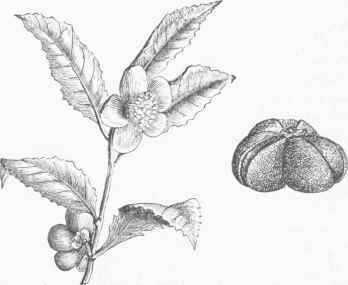
Tea riant (Camellia thea).
The sepals and petals are usually five, the stamens numerous, a portion forming by their united bases a cup within which are numerous separate stamens; the fruit or pod is usually three-celled, with a single large seed in each cell. The plant in the wild state is a bushy shrub, and sometimes a small tree, but in cultivation is kept dwarf by pruning. Like other plants long in cultivation, tea has produced several marked varieties, which,have been described as distinct species. The original country of tea is not known; it has been found in a truly wild state in Assam. In the East it may be cultivated through a wide range, from India to Japan. In this country the plant barely survives the winter at Washington, but a little south of that city it succeeds, and in North Carolina and Georgia bears fruit abundantly. On the Pacific coast, where the climate is especially favorable for broad-leaved evergreens, both native and exotic, the tea plant flourishes much further north than at the east. The time of its first cultivation in China is not known.
That its use in the Indies is comparatively recent is inferred from the fact that there is no name for the plant or its product in the Sans-krit. The Portuguese are said to have been the first to import tea into Europe, and were acquainted with it early in the 16th century; early in the 17th it was introduced by the Dutch. Previous "to that time it was the custom among European nations to make use of hot infusions of various leaves, notably those of the sage (salvia), which at one time had a high reputation, and was regarded as a sort of panacea; its dried leaves were taken to China by the Dutch East India company, to be exchanged for the tea leaf. About the middle of the 17th century a Russian embassy to China brought back to Moscow packages of tea, which were received with much favor; and in 1664 it is recorded that the English East India company made the queen of England what was considered the brilliant present of two pounds of tea. "When first introduced into England, tea sold by the pound at £6 to £10; it was known there previous to its direct introduction, having been brought from Holland, but was only used on rare occasions.
The first considerable importation was in 1667, when the East India company brought in 4,713 lbs., which was a supply for several years. - Teas are classed as black and green, distinctions not due to their production by different species, but to the age of the leaf when gathered and the methods of preparation; each of these has several subvarieties named from the provinces producing them or the points of exportation, or some peculiarity in the article itself. The Chinese districts which supply the export demand lie between lat. 25° and 31° X. Tea has long been in cultivation in Japan, and since the opening of that country to commerce a large trade in it has grown up. Various parts of India are eminently favorable to the culture; the government of British India has encouraged the introduction of the Chinese plant, and also the cultivation of that found wild in Assam, and large supplies are sent from India to England. In Java and Penang the culture has been established with favorable results. About 1850 the plant was introduced into Brazil, and by the aid of Chinese laborers some tea was produced; but little mention has been made of the results in later years.
The experiments in cultivating tea in the United States have been numerous; the most noted was that of Dr. Junius Smith of Greenville, S. C, who gave in the reports of the United States patent office from 1848 to 1859 full accounts of his results; his labors and those of others show that there are localities in the southern states well adapted to the production of excellent tea, and that its success in this country is only a question of the price of labor. In California, where the plant flourishes admirably, an experiment in tea culture has recently been undertaken by a colony of Japanese. - While the many varieties of tea arc no doubt produced by the same species, the quality of the product being largely determined by the preparation given to the leaves, it is also much influenced by the soils and situations in which the plants grow. The tea of the hills is different from that of the low lands, and that which receives but little care gives a product inferior to the highly cultivated. The slopes of the hills are preferred, at an elevation depending upon the climate; almost any good arable soil, free from stagnant moisture, will serve for the culture.
In China the plant blooms in November, and the seeds are ripe by the next autumn; these, kept in sand till the following spring, are sown in a seed bed, or in rows where the plants are to grow; the plants stand 4 or 5 ft. apart each way, and when about 18 in. high have the leading shoots pinched to induce them to become bushy. The plants yield a small picking in their third year, and attain their maximum yield in the eighth or tenth, after which they deteriorate and give way to young plants; in some localities the land is enriched with litter, sewage, or other fertilizers; the plant, which would naturally form a tree, is, for the convenience of picking, kept pruned down to 5 ft. The quality of the tea depends largely upon the age of the leaves at the time of picking; the younger the leaves the more delicate their flavor, and of course the smaller the yield. The earliest picking, the first of April, consists of the buds and the very youngest leaves; a second gathering, at the end of April or early in May, consists of more developed leaves, and is the most important crop; an inferior quality of leaf is gathered in July, and in some localities another picking of old and poor leaves is made still later.
The picker has a basket slung by a cord around his neck, to leave both hands at liberty; he holds the shoot with one hand, and breaks off the blade of the leaf with the other, for, except in the earliest picking of the very young leaves, no portion of the petiole or leaf stalk must be gathered with the liner kinds of tea. If left in large masses, so that heating or natural fermentation takes place, the leaves are greatly injured. The manipulations to which they are subjected vary greatly, and are often prolonged and repeated in various ways. As each locality has its traditional treatment, supposed to be necessary, the accounts of the process vary greatly; in all, however, the first step is to prevent the fermentation of the leaves, by exposing them in shallow baskets to the sun and air, which withers and slightly dries them. They are then placed in small quantities in a shallow copper or iron pan heated by charcoal or other fuel, and rapidly stirred; at the proper moment they are swept out into other vessels or upon a table, where other workmen rub the leaves between their hands in order to roll them into the form which they finally retain; exposure to the air and a final heating complete the process with some teas, while with others there are several heatings, alternated with airings; the choicer teas are spread out upon a table to be assorted before packing, all imperfectly rolled leaves being removed and the dust and fine fragments sifted out.
The chest with its leaden lining being ready, one bare-footed laborer gets into it, and another gradually pours in the leaves, which the first treads down firmly, and as soon as the case is full the leaden cover is soldered down. If the process of drying is completed as rapidly as possible after picking, the tea remains green; but for black tea the process is prolonged, and repeated with long intervals of exposure, some-times for a whole night, in order that a kind of fermentation may take place. Sometimes two qualities are made from the same picking by sifting the finer leaves from the coarser after they are dried. Apart from the tedious labor of picking the crop leaf by leaf, the necessity for these many small operations before the tea is ready for use will prevent its successful culture in this country, where the cost of labor is already a serious problem in the cultivation of the ordinary farm crops. It requires about 4 lbs. of fresh leaves to make 1 lb. of dried tea, and the yield per acre is from 300 to 400 lbs. Certain districts in China produce either green or black tea exclusively. A third sort, the scented teas, is recognized in commerce.
The scenting is generally due to the admixture of certain flowers, and while it is sometimes practised upon choice kinds, it is more frequently employed to give inferior kinds a better flavor; the principal flowers used are those of tea-olive, olea (or osmanthus) fragrans (see Olive), and the chulan (chloranthus incon-spicus); but those of the cape jasmine (Gardenia) are sometimes employed. The flowers are laid with the leaves under pressure, or are dried with them and afterward sifted out. The classes of tea are subdivided, and names, not always permanent, are given to subvarie-ties founded upon the size and age at which the leaf is picked. Of the Chinese teas, the principal black sorts are bohea, congou, souchong, caper, oolong, pekoe, and others. Bohea is the coarsest of these, and its importation has greatly fallen off of late years. The highest quality of black tea is pekoe, which consists of the very youngest leaves of the first picking; these, when so young that they are still clothed with down, constitute the flowery pekoe. Among the green teas are twankay, hyson skin, young hyson, hyson, imperial, and gunpowder.
The gunpowder in green tea corresponds with the pekoe in black, and like that is from the first gatherings; imperial, hyson, and young hyson are grades made from the second and third pickings, while the inferior light leaves, winnowed from the hysons, make the hyson skin, the chief market for which is found in this country. The brick tea of Thibet is probably the poorest of all; it gets its name from the shape of the blocks into which refuse tea and tea sweepings are made by mixing them with bullock's blood and drying by fire heat; the bricks are wrapped in paper or sewed up in sheep skins, and are rarely exported except as a curiosity. The teas from India have a separate nomenclature. The finer teas, both black and green, are rarely seen in this country; if packed in large parcels, or conveyed in the hold of a. ship, a fermentation or change takes place which destroys their quality; a large share of the crop is consumed by the wealthy Chinese, and a portion of it finds its way by overland conveyance to Russia. - Teas are subject to various adulterations in China, and in the countries where they are sold, including the mixing of different qualities, and the coloring and other treatment to improve the looks of inferior kinds.
The manipulation of poor teas to give them a finer appearance is carried on in China, and there are establishments in both England and America engaged in the business. The glazing or facing of teas is done with plumbago or black lead, added in fine powder to the tea in a revolving cylinder where the mutual attrition imparts to the leaves a peculiarly smooth and glossy appearance. Green teas, being in this country especially popular (their higher price conveying the idea that they are of better quality), are produced to meet the demand by coloring cheaper black kinds. The principal materials used in coloring are "China clay," or terra alba (largely found in this country and exported), Prussian blue, and turmeric; sometimes gypsum and indigo are used; the coloring matters, mixed in proportions to produce the desired shade, are added to the slightly moistened tea, and the whole agitated until the color becomes evenly distributed and the leaves by rubbing together become glazed. This treatment, with variations in the manipulation, is so general that but very little uncolored green tea is offered for sale.
The coloring and facing are readily detected by examining the leaves under the microscope as an opaque object, when the particles of coloring matter are easily seen; if it is desired to make a further examination as to the materials used, the leaves must be treated with water, and the washings subjected to chemical tests, or be burned, and an analysis made of the ash. The adulteration by mixing a finer tea with a portion of an inferior grade is common; besides this the Chinese prepare what is called "lie tea" for this express use, consisting of the dust which accumulates in the manufacture of tea, and the dust of other leaves, rice husks, etc., made up by the aid of gum into little pellets and colored to resemble tea. Some years ago the annual importation of this stuff into England was half a million pounds annually, all of which was used to mix with teas. The adulteration is readily detected by soaking a portion of tea and examining it with a lens; the true leaf may be unrolled and spread out, while the factitious article will separate into its component fragments.
Another adulteration is with exhausted tea leaves; at the Chinese tea houses, which are open day and night, the tea is usually made in a cup, covered with a saucer, and then poured into another cup; large jars stand about the saloons into which the dregs are emptied; these are carefully made over and find their way into commerce. The detection of these when colored is not difficult, but when they are rerolled without coloring, a chemical analysis must be made; it is generally only necessary to test for the amount of tannic acid, which in genuine teas ranges from 20 to 40 per cent., while in exhausted teas it is from 7 to less than 1 per cent., and sometimes completely extracted. The adulteration with other leaves is practised in China, and was formerly to a large extent in England; willow leaves and those of camellia sasanqua are much used in China, while in England those of the sloe or wild plum, the hawthorn, elder, plane tree, poplar, and others have been employed. These adulterations and others with false leaves may be readily detected by soaking out and unrolling them; those of the true tea being well known as to their shape, the character of the margin, and especially the serration (the looping together of the principal veins just within the margin being very characteristic), they may be readily picked out from any foreign admixture by the aid of a hand glass. - Tea has been analyzed by different chemists, whose results show much discrepancy, doubtless due to the variable character of the product.
The average composition is, in 100 parts: carbohydrates (gum and sugar), 21; fatty matters, 4; albuminoids, 15; tannin, 26'23; vege-table fibre, 20; theine, 2 or 3; mineral substances, 5; water, 5; and an aromatic oil, less than 1. The most important constituent is theine, or, as it is identical with the active principle in coffee, caffeine, a crystallizable substance, soluble in water and having a bitter taste (see Caffeine); acting as a feeble base, it is classed among the alkaloids, with the formula C16H10N4O2+H2O. Some give the proportion as high as 6 per cent, in the finer green teas, but the average is 2 to 3 per cent. The constituent next in importance is the aromatic oil, as upon this depends the aroma and a large share of the flavor of the tea. The tannin gives the tea its astringency; in the proper making or infusing of tea the object is to extract as much of the theine and aromatic oil and as little of the tannin as possible; when tea is infused too long, or is boiled, the amount of tannin in the infusion is perceived by its marked astringency; more or less of the other constituents are taken up by the water, and give what is called "body" to the tea. - The wealthy Chinese make their tea in the cup.
The proper quantity of leaves is placed in the cup, boiling water poured over them, and the cup covered for a time with the saucer; to prevent the leaves from rising to the surface, a perforated bit of silver, or silver filigree work, is placed over them. The poorer Chinese make their tea in a tea pot. In Japan some teas are reduced to a fine powder, which is infused in the cup and stirred before taking, that both the infusion and powder may be swallowed; it is also the custom in Tartary to take the leaves with the liquid. In other countries it is customary to make some addition to the tea: in England and America, sugar and milk or cream; in Russia, lemon juice; and on the continent of Europe it is very common to add a little brandy or other spirit. The quality of the tea (the infusion) is greatly affected by the manner of making it. Those who think that color indicates strength boil the tea, either putting the leaves directly into boiling water, or placing them in cold water and setting the pot upon the fire until the water boils; some practise prolonged infusion, with the same result, a dark-colored liquid, in which the proper flavor is concealed by the amount of tannin extracted; and some add a fragment of soda to increase the color.
Connoisseurs in tea usually make it on the table, a caddy containing several kinds of tea and an urn of boiling water being at hand; a portion of boiling water is poured into the tea pot, and when that is thoroughly warmed the water is distributed among the tea cups; then the leaves of one sort (or a mixture of two or three sorts) are placed in the pot, boiling water poured on, and in a few minutes, the cups being emptied of the water put in to warm them, it is served. The character of the water greatly influences the quality of the tea, it being impossible to make really good tea with hard water. Excess of lime in the water may be corrected by the judicious use of carbonate of soda. - The effects of the habitual use of tea have been much discussed, some regarding them as highly deleterious, while others, on account of the large proportion of nitrogen in theine, have maintained that tea is nutritious, and serves as a substitute for food. The elaborate experiments of Dr. Edward Smith ("Foods," in the "International Scientific Series," New York, 1873) are worthy of study; his results in brief are : that while the amount of nutriment contained in the quantity of tea one consumes is not sufficient to be of use in building up the system or in supplying heat, it has a marked effect upon the vital functions, and particularly stimulates respiration, as shown by the increased amount of carbonic acid thrown off by the lungs after taking it; and that it powerfully promotes the assimilation and transformation of other foods.
Excessive use of tea produces wakefulness and increased mental and bodily activity, which is followed by a reaction that brings exhaustion and a corresponding depression. Most of the unpleasant effects of tea are ascribed to the volatile oil; the long-continued breathing of air impregnated with this produces illness in the packers of tea, and the tea tasters at the tea marts in China, who are even careful not to swallow the infusion, are obliged in a few years to give up their lucrative positions with shattered constitutions. The Chinese, who drink tea at all times, are careful to use none less than a year old, as in time the oil either evaporates or is so modified that it ceases to be injurious. - There are numerous substitutes for tea in different countries, and widely separated peoples have in use some plant the active principle of which is closely analogous to, if not identical with, that in tea. Besides coffee and chocolate, one of the most important of these beverages is the Paraguay tea. (See Mate.) The Mat of Arabia and Abyssinia, introduced into the Mohammedan parts of Africa, is catha edulis, the leaves and small twigs of which possess the properties of tea in an eminent degree.
The coca of Peru and Bolivia, though generally chewed, has similar properties, and is sometimes used like tea. (See Coca.) Other plants might be cited. (See also New Jersey Tea.) - The official records of importation into England begin in 1725, in which year there was imported 370,323 lbs.; in the first year of the present century the quantity entered for home consumption was 23,730,150 lbs. Until 1834 the East India company had a monopoly of tea, which paid a heavy duty; but in that year the duty was reduced, and the trade thrown open to all. The imports of tea into Great Britain and Ireland for five years, ending Dec. 31, entered for home consumption only, were: 1809, 998,995 cwt.; 1870, 1,050,202; 1871, 1,102,943; 1872, 1,141,003; 1873, 1,178,760. The value of the total import for the same years, of which one fourth was reexported, was £10,311,465, £10,097,619, £11,635,644, £12,933,143, and £11,372,595. The imports into the United States for five years, ending June 30, for home consumption, were: 1869-'70, 423,293 cwt.; 1870-'7l, 458,615; 1871-2, 569,741; 1872-'3, 578,707; 1873-'4, 498,318. The total values (in gold) for the respective years were 813,871,546, $17,254,617, $22,943,-575, $24,466,170, and $21,212,334.
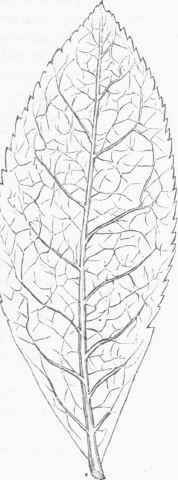
Tea Leaf.
Continue to:


My Books

