


Examination Questions
Description
This section is from the book "Questions And Answers On The Practice And Theory Of Sanitary Plumbing", by R. M. Starbuck. Also available from Amazon: Questions and Answers on the Practice and Theory of Sanitary Plumbing.
Examination Questions
1. Why is a trap placed under each fixture?
2. What is a trap?
3. Name some of the principal traps in use.
4. What is meant by the trap seal?
5. What is the ordinary depth of a trap seal?
6. What advantage does the main or intercepting trap possess?
7. What are the objections to the use of the main or intercepting trap?
8. What are the comparative merits of the S and drum traps?
9. What precautions should be taken with traps in unoccupied houses during cold weather?
10. What effect might the pressure of sewer gas on the trap seal have?
11. How may the pressure of sewer gas on the trap seal be relieved?
12. With a sink properly trapped below, what should be done with the bell on the sink strainer?
13. How should the cellar drainage trap be protected from evaporation?
14. What qualities should a trap possess?
15. Name different ways in which the seal of a trap may be broken?
16. Why are internal partitions in traps dangerous?
17. Why should, traps with mechanical seals be prohibited?
18. Where may back vent pipes be connected together?
19. What is the difference between local venting and back venting?
20. What are the two principal traps on which nearly all other traps are based?
21. What style of trap should be used under a hotel or restaurant sink?
22. What is the result of double trapping?
23. Describe some grease trap.
24. What style of trap do you consider best for a bath tub, and why?
25. Why should traps be back vented?
26. Is it the amount of water or depth of seal that offers most resistance to sewer gas?
27. What are the advantages of a ventilated system of plumbing?
28. From which side of the trap should the back vent be taken?
29. What would be the result if the back vent were taken from the wrong side of the trap?
30. Is it the amount of water or depth of seal that offers the most resistance to syphonage?
31. Where should the back vent from a trap be carried?
32. Why should a back vent pipe enter the main vent above its fixture?
33. What should be the relative size of waste and back air pipes?
34. What material may be used for back venting?
35. What objection is there to black wrought iron pipe for back venting?
36. What fixture does not use the same size of pipe for both waste and back vent?
37. In what ways may water closets be back vented?
38. What is the distinction between soil and waste pipes?
39. What are the proper weights of soil pipe, standard and extra heavy?
40. How does back venting effect evaporation of trap seal?
41. Why should rubber vent couplings be prohibited?
42. Why is it wrong to vent from the water closet bowl?
43. How should the top and bottom connections of main vent with main stack be made?
44. What is the advantage of returning the main vent into the stack?
45. Where should the main vent be carried?
46. Why should the main vent enter the stack above the highest fixture?
47. Why should a stack be carried through the roof?
48. Why is it wrong to run a back air pipe into a chimney?
49. Why is a water closet at a long distance from the stack liable to syphonage?
50. What is understood by back pressure ?
51. What causes sewer pressure?
52. How should a fixture eight or more feet from the stack be vented?
53. With long runs of vent pipe, what should be the increase in size?
54. What sizes of waste pipes should be used on the several fixtures?
55. What materials should waste pipes be made of?
56. What is the least fall allowed for waste and soil pipes?
57. Why should fixture wastes enter the stack independently?
58. What causes the gurgling sounds often heard in waste pipes?
59. Where should the drip pipe from a safe be run?
60. What is a safe, and what is its use?
61. What are the proper weights for lead pipe of the several sizes?
62. How should connections be made between waste pipes and stack?
63. How should connections be made between lead and wrought iron pipes?
64. How should horizontal and vertical soil pipes be supported?
65. What sizes of rod should be used for hangers?
66. How far apart should hangers be placed on horizontal soil pipe?
67. Why is it wrong to use a T on soil pipe?
68. How should a branch enter horizontal soil pipe?
69. How should a right angle turn in soil pipe be made?
70. Where should cleanouts be placed?
71. How deep should the lead be poured in a soil pipe hub?
72. What is the result if too much lead is used on a caulked joint?
73. Describe the process of making a caulked joint
74. How is a horizontal caulked joint made?
76. How far should cast iron soil pipe be carried outside the foundation wall?
77. Why is it necessary to run the soil pipe beyond the foundation before entering drain tile?
78. What should be done when the stack passes through the roof near a window?
79. Why should caps or screens be prohibited at the top of a stack?
80. What benefit is derived from carrying the stack through the roof?
81. How and where would you connect rain leaders into a main drain?
82. In what way does climate enter into the question of increasing the stack through the roof?
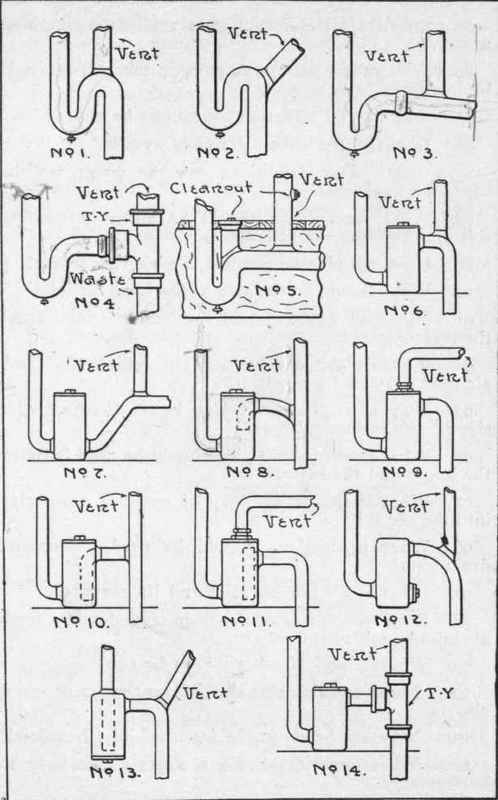
connections for s and drum traps..
83. Describe the different tests applied to plumbing work.
84. Why should all stacks passing through the roof be increased to 4 inches?
85. Why should all lead connections be wiped?
86. Describe the cellar drainage system.
87. Under what conditions can the water test be used as a final test?
88. What precautions should be taken in running soil pipe through the cellar wall?
89. How can pipe be caulked in a narrow recess?
90. What should be the size of the fresh air inlet?
91. How and where should the fresh air inlet enter the main drain?
92. What is the disadvantage of taking the fresh air inlet from the main trap?
93. Why is a 4-inch soil pipe better than a larger size in any ordinary house?
94. What kind of drain pipe should be used between the house and the sewer?
95. What is the proper way of entering drain pipe into the sewer?
96. What precautions should be used in running drain pipe?
97. What is a fresh air inlet and its purpose?
98. From which side of the main trap should a fresh air inlet be taken, and why?
99. Where should fresh air inlet be run?
100. Name and describe the different types of water closets.
101. Why are bends in the fresh air inlet beneficial?
102. What qualities should a water closet have to be sanitary?
103. Under what conditions is a fresh air inlet inoperative when taken through the roof?
104. With the main trap not fresh aired, what might be the effect on a siphon water closet?
105. Why should cistern or tank closets be used?
106. Name advantages of modern water closets over the old styles.
107. Why is it wrong to salt an earthen water closet?
108. Explain the local vent.
109. Of what material should local vents be made? 110. Where should a local vent be carried?
111. Where should a local vent be connected to a water closet?
112. At what height should a flush tank be set?
113. Describe the setting of a modern water closet.
114. Why are rubber ells used on the flush pipe?
115. Why is a syphon water closet comparatively noiseless?
116. What is the objection to placing plumbing fixtures in dark places?
117. Why would an unvented water closet be liable to syphonage if located at a long distance from the stack?
118. What sizes of flush tanks are used?
119. What two methods of local venting are in use?
120. What advantages does the independent system of local venting have?
121. How can the draught for a local vent be increased?
122. What should be the size of local vents?
123. Name some general requirements of local venting.
124. Why should not the local vent be carried into a soil pipe stack?
125. How should chimney connections for local vents be made?
126. What are the melting points of wiping and bright solder?
127. Why is the top part of a joint wiped first?
128. How is the syphon applied advantageously to plumbing work?
129. Explain the syphon tank.
130. Why does overheating spoil solder?
131. Explain the construction of a cesspool.
132. How is the syphonage of traps prevented?
133. How may a boiler be syphoned?
134. Can the cistern boiler be syphoned or not, and why?
135. How is solder made?
136. Why should wiping solder be stirred when being used?
137. In what way is syphonage a detriment to the plumbing system?
138. What precautions should be taken in locating a cesspool?
139. How high can water be raised by atmospheric pressure?
140. What causes solder to stick to the cloth?
141. How should a buried pipe be wiped?
142. Explain the preparation of a joint for wiping.
143. Explain the syphon and its action.
144. Describe different ways in which a trap may be syphoned.
145. How far should a horizontal branch waste be carried from the main soil pipe without extending it through the roof?
146. What is the result if there is too much lead in wiping solder?
147. If the wiping cloth is rough how would you remedy it?
148. How may the action of a syphon be destroyed?
149. Explain how syphonage may be used in procuring water supply.
150. Why cannot a liquid be syphoned from a lower to a higher point?
151. Explain the intermittent syphon.
152. Should a cesspool be vented or not, and why?
153. Should the main trap be used in connection with a cesspool?
154. Describe methods of supplying the kitchen boiler with water.
155. How would you treat a joint to give it a mottled appearance?
156. What is the proper width for the different wiped joints?
157. How can a flaw on a wiped joint be remedied?
158. How do you test solder for the proper heat for wiping?
159. Describe cup and overcast joints.
160. How would you restore overheated solder?
161. How would you purify solder containing zinc?
162. Why is grease rubbed onto pipe before wiping?
163. Describe a vacuum valve.
164. Where there is no vacuum valve, what should be done?
165. What is an expansion pipe, and its use?
166. What causes noise in a hot water system?
167. Why does a boiler collapse?
168. Name different ways of securing a water supply in the country.
169. Why is the cold water pipe taken to the bottom of the range boiler?
170. Explain the double boiler and its use.
171. What is the advantage of a circulating system?
172. Where should the return pipe be connected to the pressure boiler?
173. How should lead pipes be supported?
174. At what intervals should lead pipe be clipped up?
175. If street pressure is not sufficient to raise water to the desired height, how can it be done?
176. How should circulation pipes be arranged?
177. What should be the relative difference in temperature to insure good circulation?
178. What is the object of the sediment cock, and where placed?
179. What may be done to protect pipes from frost?
180. What are the causes of chattering when the faucet is opened?
181. How can water be shut off on a main not supplied with a stop cock?
182. Why do flow pipes give out oftener than return pipes?
183. Practically, how high can water be raised by an ordinary pump?
184. Theoretically, how high can water be raised?
185. What makes the difference between the theoretical and practical height to which water can be raised?
186. What causes a water front to burst?
187. Why should the room in which a storage tank is located be ventilated?
188. What is a good size of supply tank for range boiler?
189. Explain the action of a pump.
190. Can water be drawn from so great a depth at a high elevation as at the sea level?
191. What is the purpose of an air chamber?
192. Explain the action of the hydraulic ram.
193. Explain the action of the lift-force pump.
194. How may an air chamber be destroyed?
195. Explain the deep well pump.
196. What is the least fall under which the hydraulic ram will work?
197. What is the relative size of the drive and delivery pipes of a ram?
198. How high will a ram raise water?
199. What is a vacuum?
200. How does friction affect water supply?
201. Explain distillation.
202. How should the bottom end of a suction pipe be arranged?
203. How would you proceed to repair a pump?
204. What is atmospheric pressure?
205. What is the pressure of the atmosphere per square inch at the sea level?
206. Why is atmospheric pressure less at the top of a mountain than at the foot?
207. How does atmospheric pressure apply to pump work?
208. Why does heated air rise?
209. In what way is the rising of heated air applied to local venting?
210. Explain evaporation and its causes.
211. What is fusion?
212. What is a flux?
213. What is an alloy?
214. Under what conditions will water absorb gases most readily?
215. Does water expand or contract in freezing?
216. Name some freezing mixture.
217. What is capillary attraction?
218. Why does oil in water prevent its freezing?
219. What force is exerted by frost?
220. What is a dead end?
221. What is a by-pass?
222. What is air lock?
223. Explain the bursting of pipes by frost.
224. At what temperature does water boil?
225. What is the melting point of lead and tin?
226. Explain gravitation.
227. Why does water that has been heated freeze more readily than other water?
228. What is a crown vent ?
229. At what temperature does water freeze?
230. What is centrifugal force?
231. How is centrifugal force applied in plumbing?
232. Why is water called hard?
233. What characteristics are noticeable in pure water?
234. How may a vacuum be formed in a waste pipe?
235. When a vacuum forms in a waste pipe what is liable to occur?
236. Explain the value of filters.
237. Explain the value of circulation.
238. What is superheated steam?
239. Why is rain water soft?
240. What is specific gravity?
241. Of what is water composed?
242. At what temperature is water most dense?
243. Why does water take a spiral motion when running through a pipe?
244. Of what is air composed?
245. What is the effect of oxygen and hydrogen on animal life?
246. Why is there more nitrogen than oxygen in air?
247. Why do some pipes not burst when frozen?
248. What is a tell-tale pipe, and where should it run?

The Septic Tank And Automatic Sewage Siphon..
249. Why should all plumbing work be open?
250. How should a refrigerator be connected to the plumbing system?
251. What is the effect of carbonic acid gas on lead and iron?
252. Why should the plumbing system be ventilated?
253. How should gas pipes be tested?
254. What precaution should be taken on refrigerator work?
255. How should a wrench be used in putting in a stop cock?
256. How can a collapsed boiler be restored?
257. What is the principle of the oxyhydrogen flame?
258. How do you read a T?
259. Why is a heated pipe bent more easily than a cold pipe?
260. What precaution should be taken in leading joints on small pipe?
261. How can lead pipe be protected from rats?
262. How is a gas meter read?
263. How can a tank lining be soldered when the wood is wet?
264. How would you repair a leak on the under side of a lead pipe?
265. How is lead pipe bent?
266. How can a crooked thread be cut?
267. How can hydrogen be produced for lead burning?
268. What is the danger of overheating a pipe?
269. What is carbonic acid gas, and where found?
270. Why should wooden sinks and wash trays be prohibited?
271. What effect does cold have on sewage?
272. Explain the working of a grease trap.
273. How should a putty joint be made?
274. How many cubic inches are there in a gallon?
275. What is the weight of a gallon of water?
276. How many gallons of water are there in a cubic foot?
277. What are the proper heights for setting the different fixtures?
278. How do you find the contents of a square tank? Give example.
279. How do you find the contents of a cylindrical tank? Give example.
280. Explain the cause of the sweating of pipes.
281. Why should a flow pipe be larger than the return?
282. How is the circumference of a circle found if the diameter is known?
283. How do you find the pressure per square inch, the head being known?
284. How do you find the head when the pressure is known?
285. How can the lateral pressure of water on the side of a tank be found?
286. Why is the supply taken to the bottom of the range boiler?
287. Why does the hot water rise to the top of the boiler?
288. What is the objection to bowls with patent overflow?
289. What is a check valve, and where used?
290. What weight of lead should be used for a tank lining?
291. Where should the overflow from an attic tank be taken?
292. How long would it take to empty a 100-gallon boiler through a1-inch pipe, 10 feet long?
293. What is the diameter of a pipe equal in capacity to a 2-inch, 1 1/2-inch and 1-inch pipe combined?
294. What would be the size of a tank 5 feet deep that holds 500 gallons?
295. What is the weight of water in a tank holding 200 gallons?
296. Why are submerged ball-cocks objectionable?
297. If more than two water closets are to be back aired, what size of pipe should be used?
298. If the back air pipes from a lavatory and from a bath tub are run together, what size must be used beyond?
299. How far from a window may a vent pipe terminate?
300. How far should soil pipe extend above the roof?
301. How far should the fresh air inlet terminate from doors and windows?
302. Where should the back air pipe connect onto a trap?
303. Why should a room be ventilated near the floor?
304. Why should a room be ventilated near the ceiling?
305. If sent to a house on complaint of escape of sewer gas, how would you proceed to find the leak?
306. Why is a boiler tube carried to the bottom of a boiler?
307. How would you protect a water closet from freezing?
308. How would you apply the final test to a plumbing system?
309. What causes hammering in the range boiler?
310. Describe a circulation hot water supply job.
311. Name the causes of poor circulation between the range boiler and the water front.
312. How should the range boiler be connected to the water front when located on the floor below it?
313. What is the result of a sag in the flow pipe between range and boiler?
314. What is a septic sewage tank, and where used?
315. What is a stop-and-waste cock and where used?
316. What is friction?
317. What is a flap valve?
318. Name essential points in connecting the house drain with the sewer.
319. Describe a syphon.
320. What is the objection to too great depth of trap seal?
321. In what ways may a trap lose its seal?
322. What kinds of wood are best for tanks?
323. What is a tell-tale pipe?
324. What is the continuous vent?
325. What are the advantages of the continuous vent?
326. In what way is the local vent applied to urinals?
327. Name different styles of urinals used in public buildings.
328. Show different methods of connecting inlet and outlet pipes to the drum trap.
329. What are the relative advantages of these different methods?
330. Show different methods of venting S traps.
331. What are the relative advantages of these different methods?
332. How may a cleanout be attached to a bath S trap so that it may be accessible from above?
333. Is a cleanout on the trap vent of value?
334. Describe the proper plumbing of a horse-stall.
335. How may a water closet be properly vented other than from the lead bend?
336. How may a cesspool be so constructed as to have the advantages of both the leeching and the water-tight cesspool?
337. Describe a system of subsoil disposal of sewage.
338. What is the Durham system of plumbing?
339. What are the advantages and disadvantages of the Durham system?
340. How may the water closet or any other fixture be installed without the use of lead work?
341. Describe the plumbing for a line of refrigerators.
342. Describe the operation of an automatic sewage lift.
343. How is sewage disposed of, which collects at points below the sewer level?
344. What is meant by the "roughing-in" of a plumbing system?
345. How is the plumbing system prepared for the water test?
346. Name the different methods and requirements for supporting soil-piping.
347. Compare the siphon-jet and washout water closets.
348. Should the use of non-syphonable traps without vents be allowed?
349. What is the chief cause of trap vents becoming useless?
350. What style of venting is attended by the least amount of trap vent stoppage?
351. Why does water freeze at the surface first?
352. Why does salt prevent water from freezing? 353. What is ventilation?
354. What is the best way to protect the ends of soil pipe from the entrance of refuse?
355. Name different ways of protecting pipes from frost.
356. Explain why a mixture of salt freezes water pipes.
357. How can it be proven that the air of a room is in constant motion?
358. Why does smoke rise in a chimney?
359. Why is a short chimney liable to have poor draft, and why is a very large chimney also liable to the same trouble?
360. What substances are the best conductors of heat?
361. What substances are the poorest conductors of heat?
362. Why are liquids poor conductors of heat?
363. Why will oil on the surface of water prevent freezing?
364. To what temperature can water be heated if exposed to the air?
365. When is steam visible?
366. What is the effect of carbonic acid gas on life?
367. What is a splash stick, and what is its use?
368. How should very high stacks be tested?
369. How is air-lock caused on the drainage system?
370. How is air-lock caused on hot water supply pipes?
371. Explain the action of the automatic cellar drainer.
372. What is the purpose of the automatic cellar drainer?
373. Explain the action of an automatic flush tank.
374. Explain the action of an automatic sewage siphon.
375. What is a blind vent, and what may be said against it?
376. Name various points on the drainage system where cleanouts should be located.
377. What is a circuit vent?
378. What is a loop vent?
379. On what particular classes of work are circuit and loop vents of value?
380. Describe the harmful action of electrolysis on underground piping.
381. What is a soil vent?
382. What is a waste vent?
383. What is a house drain?
384. What is a house sewer?
385. Is it proper to serve a line of lavatories or sinks with one trap?
386. Explain the pneumatic water supply system.
387. Give some of the requirements in running rain leaders.
388. Give some of the requirements in installing floor and yard drains.
389. What is a surface sewer?
390. What is a standing overflow?
391. What are the advantages of a submerged trap cleanout?
392. What is the action and purpose of an automatic sump tank?
393. What may be said concerning the lighting and ventilation of toilet rooms?
394. Why is the continuous vent preferable to the crown vent?
395. Why are individual water closets preferable to range water closets?
396. Why are recessed drainage fittings used on drainage systems?
397. Why should a leeching cesspool be located as close to the surface of the ground as possible?
398. Why should metal not be exposed in the construction of a urinal?
399. Why should not wrought iron drainage pipe be used underground?
400. What is the principal argument against the use of the main trap?
Continue to:


My Books

