


III. Chests Of Drawers. Part 16
Description
This section is from the book "Colonial Furniture In America", by Luke Vincent Lockwood. Also available from Amazon: Colonial Furniture In America.
III. Chests Of Drawers. Part 16
An unusually handsome low chest of drawers in Chippendale style is shown in Figure 127. The front is cut in the serpentine shape; that is, it is composed of two cyma curves so placed that there are two concave curves separated by a convex one. To avoid an acute angle at the corners, the edges are chamfered and ornamented with a fret carving. The top follows the curve of the front, and is finished with a characteristic Chippendale moulding, a fillet, a cove, and a quarter-round. The piece stands on four well-proportioned bird's claw and ball feet and the surfaces are cut in acanthus and C-scroll designs. The top drawer is divided into many compartments and small drawers, some of them ingeniously hidden by sliding partitions, and at the right end is a quarter-round drawer which swings out. A wooden slide covers the top drawer and acts as a dressing-shelf. The handles are silvered. This piece can be traced to Pennsylvania and is of the same class of workmanship as some of the high chests of drawers above described coming from Philadelphia. It is the property of the writer.
Another later chest of drawers in the same collection is shown in Figure 128. Its construction is the same as that last described and the carved frets on the ends are in the identical design. The top drawer is also divided in the same way, including the quarter-round drawer, all of which makes it quite probable that it was the work of the same cabinet-maker at a slightly later date. The moulding edge is composed of a fillet and a torus. The piece stands on ogee bracket feet, which carry out the curvet .md lines of the front and ends.
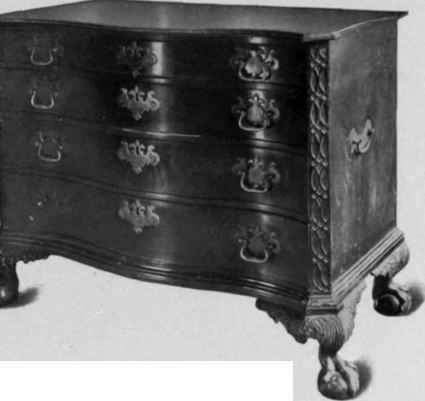
Figure 117. Chest of Drawers, 1760-75.

Figure 118. Chest of Drawers, about 1775.

Figure 129. Chest of Drawers, Bombe-shaped, about 1760.

Figure 130. Block-Front Chest of Drawers, 1750-75. 130.
Figure 129 shows a form of low chest of drawers known as bombe or kettle shape. The front is serpentine and the sides swell at the bottom, the edges of the lower drawers taking the same curve. This form was used by Chippendale on some of his best pieces and is found in this country also on desks. The piece stands on four plain bird's claw and ball feet. It is in the Pendleton Collection, owned by the Rhode Island School of Design.

Figure 131. Block-Front Chest of Drawers, 1750-75.
Figure 130 shows a low chest of drawers with block front, the blocking extending to the top, which is cut in block form. The drawers are flush with a bead on the frame about them and the feet are in straight bracket type. This piece represents the type of low chest of drawers which was developed in New England at the time the type shown in the three preceding figures was developed in the South. The form of the piece shows that it belongs to the northern New England type of block front. This piece is the property of Mr. Dwight M. Prouty.
Figure 131 shows a block-front low chest of drawers from the Pendleton Collection. The blocking is in the second form, the blocks being swelled instead of square or nearly so. (Compare this with figure 130.) The mouldings on the edge of the top are the fillet, cove, and torus. The feet are of the bird's claw and ball bracket type well fashioned. The drawers are flush with a bead on the frame about them.
Figure 132 shows another of the block-front low chests of drawers in the same collection. The form of blocking is the same. The four drawers are graded in height. The piece stands on ogee bracket feet with a scroll finish, which is characteristic of the Rhode Island type. The moulding at the bottom, however, is not in the usual form, being a cove, a fillet, a quarter-round, and a fillet instead of a cyma reversa and two fillets. The drawers are flush with a bead on the frame about them.

Figure 132. Block-Front Chest of Drawers, 1750-75.
By far the largest number of blocked front chests of drawers are without the shell carved at the top of the drawers. Such as are found are of two varieties- those having bird's claw and ball bracket feet and those having the ogee bracket feet. Figure133 shows one of the former type, the property of Mr. H. W. Erving. The shell, it will he seen, is the same as appears on the chest on chest shown in Figure 120. The mouldings under the top consist of a fillet, a cove, and a bead. The corners have square recessed edges filled in with quarter-fluted columns. The drawers, four in number, are flush with a bead moulding on the frame about them. The base moulding are unusual, consisting of a quarter-round, a fillet, a cove, and a fillet.

Figure 133. Block-Front Chest of Drawers, 1760-75.
Figure 134 shows the second type of these chests of drawers which it will be interesting to compare with the preceding one. It is of the pure Rhode Island type, the shell differing materially from that shown in the preceding figure, and there are three drawers instead of four, a characteristic of the type. The edge of the top is cut in a fillet and a cyma recta, and the mouldings below are a fillet, a cove, an astragal, a fillet, and a small cove. The base mouldings are a cyma reversa and a wide fillet as is usual. The legs are ogee brackets with scrolls carved on the inner sides. This chest of drawers is the property of Dr. Frank I. Hammond, of Providence.

Figure 134. Block-Front Chest of Drawers, 1760-75.
Continue to:


My Books

