


Leather Chairs
Description
This section is from the book "Colonial Furniture In America", by Luke Vincent Lockwood. Also available from Amazon: Colonial Furniture In America.
Leather Chairs
The third style, which may be called a modification of the wainscot, is the leather chair, which dates a little later and by some is called Cromwellian. although it appears in the inventories in this country a little earlier than that time. It was really of Italian design, coming to England through Holland during the commonwealth, and very likely reached the Pilgrims, who had come from Holland, earlier than it did England, for we find these chairs first mentioned at Plymouth as early as 1643: "3 leather chairs, 3 small leather chairs £I 10s." We continue to find them mentioned freely until the close of the seventeenth century, as in the inventory of the famous Captain Kidd, at New York, 1692, "two dozen single nailed leather chairs, £1 16s"; and in New York, 1703, "8 leather cheares very old," undoubtedly referring to chairs similar to that shown in Figure 442. The earlier ones had a straight frame without turning with a band of leather stretched across the back and a leather seat, each fastened with large, heavy nails. The later ones had turned frames and were lighter.
Figure 442 shows an interesting specimen of a leather chair belonging to Trinity College, Hartford, Connecticut. The leather in the back is carved while that in the seat is plain. The waving line of the stretcher is suggestive of the carved stretchers of the cane period. This chair originally stood somewhat higher from the floor, but the legs are worn away.
Figure 443 shows two arm-chairs in this early leather style belonging to the Holies Collection. These chairs stand high from the floor in the usual manner, the feet not having worn off. The front stretcher on each is a plain slab of wood, and on the one to the right the surface is ornamented with an applied foliage design which has disappeared from the other.
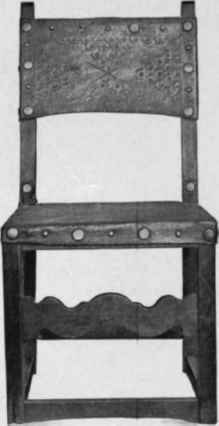
Figure 442. Leather Chair, about 1650.
Wainscot and leather chairs in general stood much higher from the floor than either the turned ones or those appearing later; in fact, the seats are often as high as twenty or twenty-two inches. They were apparently intended to be used with footstools, as were the benches, for we find the following description in "The Gate of Language Unlocked," before referred to:
"When the table is spread with the table cloth, dishes are set upon it and trenchers 'whether they be round or square' and also a salt sellar.
"Out of the bread basket, loaves (shives) of bread are set on the table, or pieces 'morsels'; and then messes of meat.
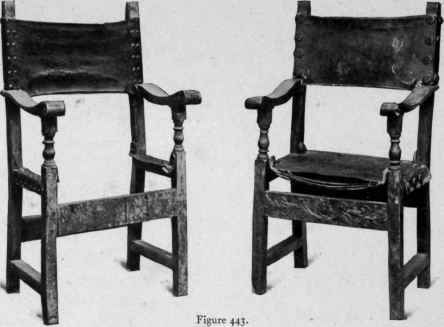
Leather Chairs, about 1640.
"The ghests that are bidden are brought (led) in by the feast-maker into the dining room (parlour) and when they have washed over a bason out of a ewer and have wiped with a towell; they sit down upon benches or stools set in order with cushions having foot stools set under them."
These leather chairs must not be confounded with the Spanish leather chairs, which are of later date and totally different style: Boston, 1653, "8 red leather backe chairs and 2 low leather backe stools"; Salem, 1647, "3 red leather chairs"; Boston, 1700, "6 russia leather chairs"; Philadelphia, 1683, "14 russia leather chairs"; 1686, "6 calfe leather chairs"; New York, 1691, "3 doz. russia leather chairs"; and Yorktown, 1668, "6 turkey leather chairs." These are references, no doubt, to the style of chair shown in Figures 442 and 444.
The York County (Virginia) records after 1660 show that a large number of these chairs were in use, one hundred and three of them being mentioned between the yean [657 and 1670; as many as twenty-eight in one inventory in 1667 are spoken of as old. Their values vary from one to ten shillings each.
A little later form of a leather chair is shown in Figure 444. The front legs and stretcher are knob-turned. The chair is smaller and lower than the earlier form. It belongs to the writer.
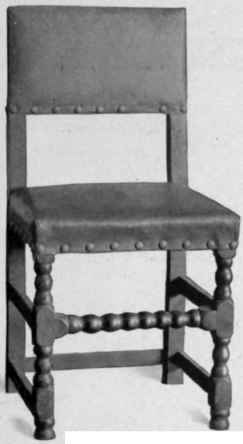
Figure 444. Leather Chair, about 1650.

Figure 445. Turkey-Work Chair, about 1650.
Figure 445 shows a chair quite similar to the foregoing which was originally covered with Turkey work. It differs from the preceding type of leather chairs in that the back is considerably higher and there are two knob turnings on each side below the upholstery. The front legs are knob-turned as is also the front stretcher. This chair is the property of the writer.
In the inventories are mentioned both Turkey carpets and Turkey work. Carpets were the imported rugs, and their usefulness seems to have been appreciated by the Dutch who brought them from the East. The Turkey work was made in imitation of the rugs. It was made on coarse canvas or sacking, on which the pattern was drawn, exactly as the hooked rugs were made except that worsted was used in place of cloth cut in strips. We find Turkey-work chairs mentioned in English inventories as early as 1589, the English having received permission, in 1579, from Amurath III to trade with Turkey. In New York we find, in 1677, "12 old Turkey chairs £1 4s"; Boston, 1669, "12 turkey work chairs £1 7s 4d"; at Yorktown, Virginia, 1674, "6 Turkey worked chairs £2 2s"; at Salem, 1684, "9 turkey work chairs without backs £2 4s"; "4 turkey work chairs with backs £1 12s"; at Philadelphia, 1687, "12 small turkie carpett chairs 2 of them broken £6"; and "6 turkie work chairs I of them broken £1 16s."
Turkey work and leather were very evidently not the only coverings used for these square-framed chairs, as the following inventory entries will show: Salem, 1698, "6 old serge chairs"; New York, 1680, "6 old red cloth chairs"; 1698, "6 chairs with red plush and 6 with green plush"; Philadelphia, 1687, "6 camlett silk fringe low chairs"; 1668, at Yorktown, "6 wrought chairs"; and, as upholstery was not in use for the turned or wainscot chairs, these entries must refer to the square-framed chairs just described.
Very few of these Turkey-work or leather chairs have survived, although through a period of some thirty years they are frequently mentioned in the inventories both in the North and South, and it is not at all uncommon to find a large number, from one to three dozen, in a single inventory. The probable reason is that when the leather or Turkey work was worn out the frames were of little use and were broken up or thrown away. After 1650 chairs became lighter in appearance, the leather chair just described affording the type.
Figure 446 indicates how this effect was secured. The front legs and stretcher resemble quite closely the chair shown in the preceding figure, but the entire frame of the piece is knob-turned. The back is composed of two turned rails and five turned spindles. This chair is in the Bolles Collection.
A very beautiful chair of this period is shown in Figure 447. The form and construction are the same as shown in the preceding figure, but the turning is all spiral-twisted, giving a rhythm of form which is extremely pleasing. It will be seen that even the rails of the seat arc turned in the same manner, and a wooden seat is sunken into the rail. This chair is also in the Bolles Collection.

Figure 446. Knob-Turned Chair, 1650-60.

Figure 447. Spiral-Turned Arm-Chair, 1650-60.
The most notable change in this period was the introduction of cane chairs from Holland. Their graceful and beautifully carved frames were in striking contrast to the turned and wainscot pieces then generally in use.
This style of furniture came into general use in England in the reign of Charles II (1660), and continued until the Dutch style became dominant in the reign of Anne in 1702.
The fact that furniture should be exported from the Low Countries was not strange, for Antwerp seems to have been a great centre for that trade from about 1560 down, and Anderson, in his "History of Commerce," says that in that city were Germans, Danes, Italians, English, and Portuguese, and the commerce included exchanges with all the civilised countries of Europe. Antwerp was exporting household furniture to Genoa, England, and Spain as early as 1560, and, in fact, was one of the most important places in the commercial world.
So far as this country is concerned, these chairs appear in the inventories not earlier than the last quarter of the seventeenth century. We find at Yorktown, 1687, "2 old cained chairs 16s," and in New York, in 1691, "13 cane chairs broken and out of order," which would indicate at least that at that date the style was not new. At Philadelphia, 1686, "8 cane chairs"; 1687, "8 cane chairs"; Boston, 1732, "1 doz. cane chairs"; Salem, 1734, "6 cane chairs."
The style remained in fashion until after 1719, for in that year in the Boston News Letter is mention of "fine cane chairs just imported from London."
The chief characteristics of the cane chair in its purity are that the cresting and front stretcher are carved, and usually there are rare exceptions, in the same design. The seat is high from the floor and the backs are tall and stately. The original caning is always composed of very narrow double strands running vertically and horizontally and a single wider strand running diagonally. The holes for the cane are in a straight line on the upper surface, but are bored diagonally, so that on the reverse side they alternate in two parallel lines. The back legs and stiles of the back, which are in one piece, are raked to an angle where the seat joins the back. The wood is beech or walnut, and occasionally, in English specimens, oak. In the later pieces the cane in the back is sometimes replaced by carved strips, but no American example of the type has come under the writer's observation.
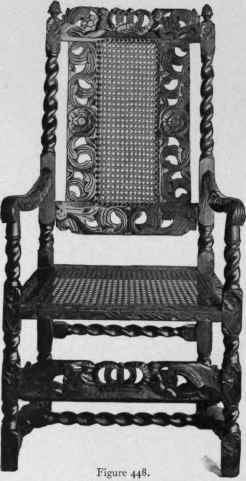
Cane Chair, 1660-80.
It is probable that many of these chairs found in America were imported, for chairs in the same design are found in England, but it is also probable that many of the simpler sort were made here.
There are three well-defined types of the cane chair:
First - Those in which the turned stiles of the back terminate in finials with a carved cresting between, as in Figure 448.
Second. - Those in which the carved cresting extends over the stiles of the back which Set into them, as in Figure 470.
In these two classes there is inserted between the stiles a frame of cane.
Third. - Those in which the stiles of the back are not turned, but moulded, and appear to carry in a continuous line over the top, as in Figure 475.
Each of these types persisted beyond the time when it was in fashion, and the third can be traced into the Dutch period. In order to show clearly the development of each of these types, we will take them up separately and carry them through to the time each either disappeared or was absorbed in a later style.
Continue to:


My Books

