


Bear
Description
This section is from "The American Cyclopaedia", by George Ripley And Charles A. Dana. Also available from Amazon: The New American Cyclopædia. 16 volumes complete..
Bear
Bear (ursus). "The family of bears are classed," says Robert Mudie in his "Gleanings from Nature," "among those carnivorous animals which are plantigrade, or walk upon the soles of their feet. They differ from the more typical carnivora in many respects. In the first place, they do not confine themselves to animal food, but eat succulent vegetables, honey, and other substances which are not animal; in the second place, they do not kill the animals which they eat in what may be called a business-like manner, by attacking them in some vital part, but, on the contrary, hug or tear them to death; and in the third place, those of them that inhabit the cold climates, which are their appropriate places of residence, often hibernate during the winter, or some part of it, which is never done by the characteristic carnivora. There are bears in almost all latitudes, from the equator to the pole; but those which inhabit the warmer latitudes are tame and feeble as compared with the natives of the cooler ones, and therefore we must regard them as being, in their proper home and locality, animals of the colder regions of the globe.
The whole genus has in fact a polar rather than an equatorial character, and may thus be considered as geographically the reverse of the more formidable of "the strictly carnivorous animals - the lion and tiger in the eastern, and the jaguar in the western hemisphere. These are all tropical in their homes, habitually ardent in their temperaments, and, though they can endure hunger for considerable periods, they feed all the year round, and thus have no season of repose. The bears, again, are seasonable animals, retiring during the winter, and coming abroad in the spring. But it is not from the storm that the bears retire; it is from the cold serenity - the almost total cessation of atmospheric as well as of living action - which reigns during the polar winter; the storm is both seedtime and harvest to the bears. During its utmost fury they range the wilds and forests, accompanied by the more powerful owls and hawks, which, like the bears, are equally remarkable for their strength and their impenetrable covering. At those times many of the smaller animals are dashed lifeless to the earth by the storm, or shrouded in the snow, and upon these the bears make an abundant supper - a supper of days, and even of weeks - before they retire to their long rest.
So also, when the storm begins to break, they find a plentiful collection of the carcasses of such animals as have perished in the show, and been concealed from sight and preserved from putrefaction under it." - The polar bear (U. maritimus) is the largest, strongest, most powerful, and, with a single exception, the most ferocious of bears. Its distinguishing characteristics are the great length of its body as compared with its height; the length of the neck; the smallness of the external ears; the large size of the soles of the feet; the fineness and length of the hair; the straightness of the line of the forehead and the nose; the narrowness of its head, and the expansion of its muzzle. It is invariably of a dingy white hue. The size varies considerably. Capt. Lyon mentions one 8 ft. 7 in. long, weighing 1,500 lbs. The domestic habits of these powerful animals are not much understood, and whether they hibernate or not is not very well ascertained, although it is believed that the male at least is not dormant so long as the land bears of the north. The admirable work of Dr. Kane seems to place it in doubt whether either sex absolutely hibernates, as we find she bears with their cubs visiting his winter quarters during the midnight darkness.
The pairing season is understood to be in July and August; and the attachment of the pair is such, that if one is killed the other remains fondling the dead body, and will suffer itself to be killed rather than leave it. The same wonderful affection of the female for her cubs has been noticed, from which neither wounds nor death will divide her; and all the arctic navigators, from Dr. Scoresby to Dr. Kane, have recorded their sympathy with and regret for the poor savage mothers, vainly endeavoring to persuade their dead rubs to arise and accompany them, or to eat the food which they will not themselves touch, although starving. The habits of the polar bear are purely maritime; and although their system of dentition is the same with thai of the other bears, their food, from necessity, is wholly animal. The polar bear is comparatively rare in menageries, as it suffers so much from the heat, even of our winters, and from the want of water, that it is not easily preserved in confinement. - The next bear in all respects to the polar species, and superior to him in ferocity and tenacity of life, is the grisly bear (U. horribilis) of America. This powerful animal, which is to the American fauna what the Bengal tiger is to that of
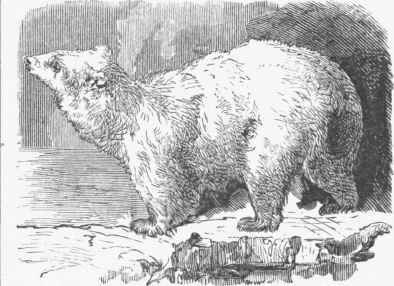
Polar or White Bear (Ursus maritimus).
Hindostan and the lion to that of central Africa, is of comparatively late discovery, having been first distinguished by Lewis and Clarke in their western explorations. Its geographical range is from the great plains west of the Missouri, at the foot of the Rocky mountains, through Upper California to the Pacific ocean. Its characteristics are strongly marked and clear. "The line of its forehead and muzzle is straighter than in any other species; and its claws, especially those of the fore feet, are much more produced and far more crooked, though its general habit is not that of a climber. The snout is black and movable, the central furrow being distinct; the lips are partially extensile; the eyes very small, having no third eyelid, and the irides being of reddish brown. The ears are short and rounded, and the line of the forehead thence to the eyes is a little convex, but it continues straight to the point of the snout. The hair on the face is very short, but on the body generally it is long and very thickly set. The hair in the adult is a mixture of brown, white, and black. The tail is short, and in the living animal completely hidden by the hair.
On the fore paws the claws are rather slender, but long, as well as crooked and sharp at the tips, though the sharpness is rather that of a chisel, by being narrowed at the edges, than a point, This structure gives the tips of them great additional strength, and accounts for the severe gashing wounds which arc inflicted by their stroke. The soles of the hind feet are in great part naked, and the claws on them arc considerably smaller than those on the fore paws, though much more crooked; and their trenchant points form very terrible lacerating instruments when the animal closes with its enemy in hugging. They arc sufficient to tear the abdomen even of a large animal to shreds, while the fore paws are at the same time compressing the thorax to suffocation." The grisly bear is the most savage of his race. If it be not certain that he will voluntarily attack a human being, it is certain that if attacked he will pursue the assailant to the last, nor quit the confiict while life remains. He is also the most tenacious of life of all animals. One shot by Gov. Clarke's party, after receiving ten balls in his body, four of which passed through his lungs and two through his heart, survived above 20 minutes, and swam half a mile, before succumbing to his wounds.
The cave bear (U. spelceus), larger than the grisly bear, lived in the caverns of Europe in the post-tertiary epoch. - The European brown bear (U. arctos) and the American black bear (if. Americanus) are closely allied, and are very similar in habits, although the former is fiercer and more sanguinary, especially as he grows old, when he will, though rarely, attack men, particularly if he have once tasted human blood. They are both excellent climbers, passionately fond of honey, great devourers of roots, green wheat, and in America green maize, and especial enemies to hogs and young calves. The brown bear is distinguished by the prominence of his brow above the eyes, which is abruptly convex, with a depression below them; the black bear, by the regular convexity of its whole facial outline, from the ears to the muzzle. The latter never attacks man except in self-defence, and then only when hard pressed and cornered. The flesh of the black bear is very good, resembling pork with a peculiar wild or perfumed flavor. - The cinnamon bear (U. occidentalis) is generally regarded as a mere variety of the black bear, whose place it takes to the west of the Rocky mountains. It receives its name from the yellowish red color of the fur.
It is not uncommon in California, and often descends from the upper sierras into the valley villages in winter in search of food; though very fond of berries and nuts, it occasionally takes a calf, pig, or sheep; it is savage if attacked or wounded. - The Asiatic or sloth bear ( U. labiatus, so called from its long lips) is a timid, inoffensive creature ordinarily, though it will fight fiercely when wounded, or in defence of its young. It inhabits the high and mountainous regions of India, burrows in the earth, feeds on ants, rice, and honey, and lives in pairs, together with its young, which when alarmed mounts the back of the parent for safety. It is called sloth bear from the edentate character of the jaws, from the early loss of the incisor teeth, and the filling up of the sockets. - The Syrian bear (U. Isabellinus) is interesting chiefly because it is the one often alluded to in the Jewish Scriptures. When young it is grayish brown, becoming nearly white when old; the hair is long, somewhat curled, forming a mane upon the shoulders, and near the skin surrounded by a soft fur.
It is gentle in disposition, a vegetable feeder, and is found now in the mountains of Palestine. - Three or four other species of bears, principally Asiatic, have recently been distin-guisbed, but all of very inferior interest to those above specified, and one at least of extremely doubtful authenticity as a distinct species. This is the Siberian bear ( U. collar is), so nearly identical with the common black bear as to be distinguished from it only by a white or grizzly collar encircling its shoulders and breast, and is probably a mere casual variety. It is said to be peculiar to Siberia. The spectacled bear (U. oniatus) is a native of the Chilian Andes. Its fur is smooth, shining, and black, with the exception of a pair of semicircular marks over the eyes, whence its name, and the fur on its muzzle and its breast, which is of a dirty white color; little or nothing is known of its habits. The Thibetan bear or Isabel bear (U. Tihetanus) is characterized by the shortness of its neck and the straightness of its facial outline. Its color is black, with a white under lip, and a white mark in the shape of a letter Y, the stem lying on the middle of the breast, with arms diverging upward on the shoulders. It is a small-sized, harmless, and purely vegetable-eating animal.
The Malayan sun bear (helarctos Malayanus) is small, jet black, with a lunar white mark on its breast, and a yellowish muzzle. It has a long, slender, protrusive tongue, unlike that of other bears. It is perfectly inoffensive, feeding on honey and the young shoots of the cocoanut trees, of which it makes extreme havoc. When domesticated it becomes exceedingly tame, is sagacious, intelligent, and affectionate, and will not touch animal food. The Bornean bear (II euryspi-lus) differs from the above by having a large orange-colored patch on the chest. It does not exceed four feet in length, and has the long, Blender, protrusive tongue of the species last described, fitting it especially to feed on honey, which, with fruits and vegetables, is its sole food. - There has always existed a doubt as to the existence of any species of bear in Africa. Pliny mentions that in the consulship of M. Piso and M. Messala, 61 B. C, L. Domitius Aheno-barbus exhibited 100 Numidian bears, and as many Ethiopian hunters, in the circus; but at the same time he asserts that there are no bears in Africa. Herodotus, Virgil, Juvenal, and Martial all speak of Libyan bears as well known animals.
Ehrenberg and Forskal both speak of a black plantigrade animal called by the natives kawai or karrae, with a long muzzle, which they both saw and hunted, but in vain. It is, however, a good rule in natural history to adopt no animal on hearsay, or until a specimen is produced. On this view it must be held that there is no African bear until one shall be produced and described; although there is no reason why there should not he. - Bear-baiting with mastitis was formerly a favorite and even royal amusement in England; and the readers of "Kenilworth" will remember the characteristic scene in which Essex is represented as pleading before Elizabeth the cause of the bear warden against the stage players, Raleigh defending the latter, and quoting the passage of Shakespeare personifying the queen as "a fair vestal throned in the west." on which she suffers the bear ward's petition to drop unheeded into the Thames. In the north of Europe the brown bear is hunted in the winter with snow shoes, and shot without the aid of dogs.
In the west and southwest of the United States, the bear is systematically chased with packs of hounds bred for the purpose - a cross generally of the large slow foxhound with the mastiff; and the sport is highly exciting, and by no means devoid of danger, when Bruin turns to bay, and it becomes necessary to go in with the knife, to close quarters, in order to save the lives of the hounds.
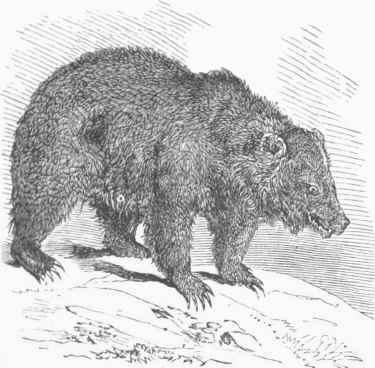
Grisly Bear (Ursus horribilis).
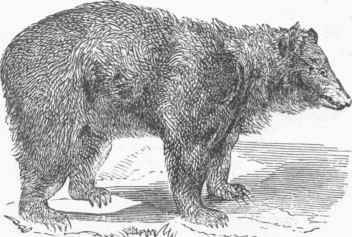
Black Bear (Ursus Americanus).
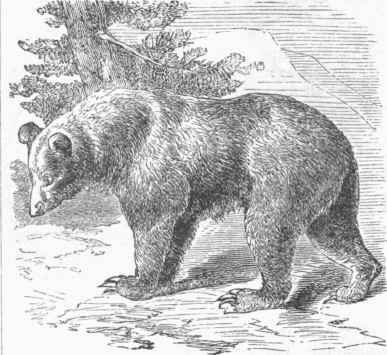
Cinnamon Bear (Ursus occidentalis).
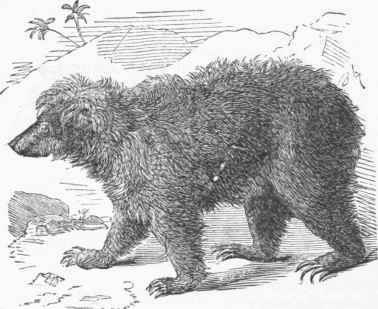
Asiatic or Sloth Bear (Ursus labiatus).

Syrian Bear (Ursus Isabellinus).
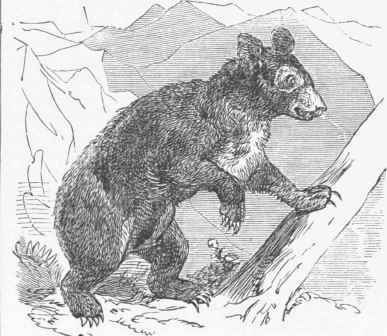
The Spectacled Bear (Ursus ornatus).
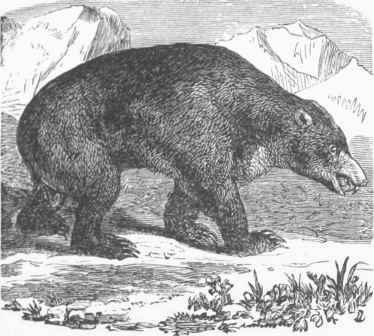
Malayan Sun Bear (Helarctos Malayanus).
Bears #1
Bears, formerly a province of S. W. France, bordering on Spain, now forming the eastern and larger part of the department of Basses-Pyrenees. It is mountainous and well watered, and excellently adapted for raising cattle and horses. The name is derived from its primitive inhabitants, the Beneharni. The bulk of the present population is of Basque descent, still speaking the Basque tongue, and understanding very little French; the people are energetic, industrious, and freedom-loving. Beam Mas a part of ancient Aquitania, and fell into the hands of the Visigoths, and afterward of the Franks. Its first feudal possessor, Centullus, is mentioned in the 9th century, and his descendants ruled it to the close of the 13th century, when it came into possession of the counts of Foix by marriage, and by the female line of this house into the hands of the kings of Navarre, by the last of whom, Henry IV., it was united with France, though the act of annexation was not finally accomplished till 1620.
Continue to:


My Books

