


I. Introduction. Part 6
Description
This section is from the book "Colonial Furniture In America", by Luke Vincent Lockwood. Also available from Amazon: Colonial Furniture In America.
I. Introduction. Part 6
Figure 3 shows one of a pair of settees in Chippendale's Chinese taste with a slight suggestion of the Gothic in the arching under the arms. Although full of Chinese motifs and feeling, an analysis will show that there is hardly a line in the piece which a Chinese workman would have used in furniture. The piece well illustrates Chippendale's ability to adapt and combine without slavishly copying.
Figure 4 shows one of a pair of torcheres or gueridons in pure Gothic-style. The great beauty of this piece is its architectural perfection. It rises arch on arch, each apparently supporting the weight in proper proportion, so that when the stand is reached one has the feeling that it would support any strain.

Figure 3. Chippendale Settee, Chinese taste, 1750-60.
These examples are taken from the famous collection of Mr. Richard A. Canfield for the purpose of illustrating the three important styles used by Chippendale. In the same collection are examples of the same master, where these various styles are mingled.
Of course the large mass of Chippendale furniture is vastly simpler than these pieces, being made for persons of moderate means, and Chippendale's book of designs was used in England, Scotland, Ireland, and America as the basis for much of the so-called Chippendale furniture.
The next cabinet-makers of note were Ince end Mayhew, who also published designs in parts, which were afterward bound. Under date of April 12, 1760, their advertitement was published in the Gentleman's Magazine as follows:
To the PUBLICINCE and MAYHEW return their utmost Thanks for the kind Reception their DESIGNS have met with; and assure them no Pains shall he spared to render them preferable to any like Performance, both for thn Choke of the GENTLEMAN and the Use of the WORKMAN. A Determination to finish them to the utmost Exactness obliges them to be irregular, onasioned through a great Want of Time, and every Design being NEW.
No. XVII. with Four Folio Plates, is published this Day at 1 s. To be had at Webley's, Holborn; Darley'a Cheapside; and of the Authors, CABINETMAKERS and UPHOLSTERERS, Broad-Street, Car-naby Market: Where the Honour of any Commands will be observed with the most reasonable Charges.
N. B. Those who have not yet completed their Sets, are required to do so, as but a few of the first Impression is left.
Ince and Mayhew's designs were similar to Chippendale's, but, on the whole, were not as well proportioned.
During the next ten years many other books were published, one by Decker and several by a Society of Upholsterers and Cabinet-Makers.
About 1765 the public taste began to change from the French, Gothic, and Chinese tastes to the classic. owing very largely to the research, study, and publication of classical ruins and designs by the Brothers Adam, who were the leading architects of the day.
Chippendale felt the effect with others and began to execute orders from the designs made by Adam, and finally abandoned his early style for the classic, much to his detriment.
Under date of June 30, 1767, Chippendale billed to Sir Roland Winn, Bart., of Nostel Abbey, "a large Mahogany Library table of very fine wood with drawers on each side of the bottom part and drawers within on one side and partition in the other, with terms to ditto, carv'd and ornamented with Lions' heads and paws with carv'd ovals in the panels of the doors & the top cover'd with black leather & the whole completely finished in the most elegant taste. £72. 10s."
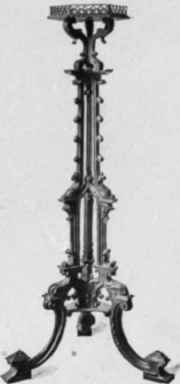
Figure 4. Chippendale Torchere, Gothic taste, 1750-60.
This piece is shown in Figure 5. Were it not for the bill, few persons would believe it could be made by the same person who, some ten years earlier, had made the commode shown in Figure 2, yet Chippendale, in the third edition of his "Director," shows a side-table with term legs quite suggestive of this piece.
The next cabinet-maker of this period was Shearer, who, with other cabinetmakers, published "A Cabinetmakers Book of Prices" in 1788. By this time the style had completely changed, the cabriole leg had been superseded by the tapering straight leg, and there was a general lightness of construction which was entirely new, undoubtedly due to the influence of the Louis XVI style.

Figure 5. Chippendale Library Table, 1767.
Shearer was the first to design a sideboard with serpentine front and inlaid drawers, now commonly called Hepplewhite.
Hepplewhite, the next of the great designers, published a book in 1789. The designs are still more delicate, almost to the point of fragility. The chair backs were usually either oval or shield-shaped, and contrasting woods were employed for ornamentation. Carving was but sparingly used.
The next and last of the great designers was Sheraton. His early style was similar to Hepplewhite's, but his chair backs were generally rectangular, and he often embellished pieces with a fine cameo carving. He ceased to be a cabinetmaker in 1793, and devoted the remainder of his life to writing books of design which had large sales. He died in 1806. His later designs followed the Egyptian clastic style which had come into vogue in France and is known as the Empire style. He had many followers in America, notably Duncan Phyfe, of New York, a cabinet-maker who executed some exceptionally good pieces in this style.
Following Sheraton, the style became massive and heavy, with coarse carving, heavy columns, claw feet, and massive slabs of well-grained mahogany It is known as late Empire.
In America, throughout the eighteenth century, were a large number of cabinetmakers, some of whom advertised as coming from London. The number is so large, and the inventories of their estates show them to have been so prosperous, that it can only be concluded that much of the furniture was made here. On the other hand, such men as Sir William Pepperell, Faneuil, Judge Sewall, and Hancock, of Boston. Franklin, of Philadelphia, Byrd, of Virginia, and others of the wealthier class were sending to England for their furniture and household effects.
Continue to:


My Books

