


V. Desks And Scrutoires. Part 6
Description
This section is from the book "Colonial Furniture In America", by Luke Vincent Lockwood. Also available from Amazon: Colonial Furniture In America.
V. Desks And Scrutoires. Part 6
This distinction hardly seems to us probable, because a low chest of drawers could have been properly described by calling it by that name, as had been the custom in the inventories of the oak period, and as was still occasionally done in this; and, furthermore, the word table could hardly be applied to such a piece.
It is undoubtedly true that when the expression first appeared it referred to some new style in furniture, and we believe, from a study of old dictionaries, as well as the inventories and the pieces still extant belonging to those times, that the word was always used in connection with writing in some way.
The word bureau appears to have had two meanings, either a piece on which to write or a chest of drawers of some sort. In the expression "bureau-desk" the word seems to have been used in its second meaning, otherwise it would not be a qualifying word and would be redundant. The furniture best answering this description would be the slant-top desks with the chest of drawers below, which was a new style. The other expression, "bureau-table" or "bureau-chamber-table," would seem to use the word in its first sense. The expressions "table" and "chamber-table," as used in the inventories we have seen, refer to what are commonly called low-boys; so if the word bureau was there used to denote a piece to write upon, we should have a low-boy plus a desk, such pieces as are shown in Figures 246 and 247; and as such pieces came into existence at about the time this expression first appears in the inventories, we believe them to have been there described.
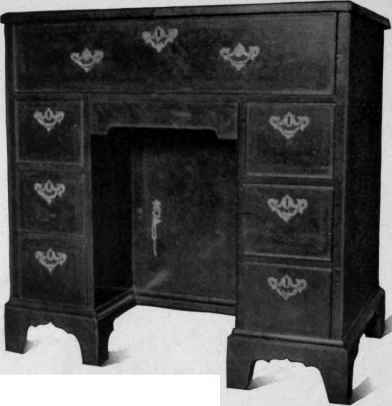
Figure 253. Knee-Hole Desk, about 1725.
The word bureau does not seem to have been used to any extent in its modern meaning until the last quarter of the eighteenth century, and we believe it was then so called because of the desk appearing in the upper drawer of such pieces; the desk drawer later was dropped, but the name remained.
Chippendale shows designs for ladies' secretaries, which he calls bureaus; and he, Hepplewhite, and Sheraton call chests of drawers commodes, so it is hardly likely that the word hureau could at that time have heen very commonly used to denote a simple chest of drawers. The word secretaire is the same word as secretary, .1 corruption of escritoire.
It will therefore be seen that after about the first twenty years of the eighteenth century there were four words used interchangeably to denote a piece of furniture for writing purposes, viz., desk, scrutoire, escritoire, and bureau.
Another early form of desk and dressing-table is shown in Figure 253. It is in knee-hole form; that is, the centre portion is recessed to allow a person to sit at the desk. The front of the top drawer falls on a quadrant and forms a surface upon which to write, and within are pigeon-holes and drawers. On each side of the centre are three drawers, and just above the recessed portion is a shallow drawer. A cupboard is built in the recessed portion. This piece stands on straight bracket feet. The fronts of the drawers are made of walnut veneer with herring-hone edges in early fashion, and the handles are in the early open-work willow pattern, the same as appears in Figure 244. This type of desk is also found with a baize top upon which to write. This piece is very similar to the dressing-table shown in Figure 113, which was the model for the knee-hole dressing-tables such as are shown in Figures 121 and 122, but which are of a considerably later date. This desk is the property of Messrs. Cooper and Griffith, of New York.
As time went on more space was wanted in the drawer portion of the scrutoire than could be obtained from the low-boy type; consequently such pieces as that shown in Figure 254 came into fashion. The table part consists of a narrow frame on short, bandy legs terminating in Dutch feet. In the desk section are four drawers. It is 371/2 inches high, 271/2 inches wide, and 16 inches deep, and its diminutive proportions make it graceful. The use of this low frame with bandy legs seems to have been popular principally in Connecticut.
An interesting slant-top scrutoire with cabinet top, the property of Mr. George Dudley Seymour, of New Haven, is shown in Figure 255. It is made in three parts; first the frame with short cabriole leg terminating in bird's claw and ball feet, then the desk part with four drawers below, and above this is the cabinet. The top is scrolled and the mouldings consist of the usual quarter-round, fillet, cove, astragal, fillet, and small cove. Below the scroll top is a bevelled panel, the upper surface following the outline of the top, and at the centre is carved the sun pattern. On either side of the doors is a fluted pilaster, and in each door is a bevelled panel with a domed top. Elaborate H hinges are on the doors. The interior of the desk part has four pigeon-holes on each side of the centre and two drawers, on each of which is carved the rising-sun pattern. This scrutoire is made of cherry.

Slant-Top Scrutoire, 1740-50.
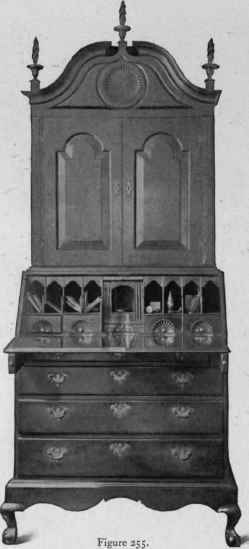
Slant-Top Scrutoire with cabinet top and bird's claw and ball feet, 1725-50.
Figure 256 shows a scrutoire with a rather good interior consisting of eight pigeon-holes with gracefully cut partitions. The drawers arc all curved, four below the pigeon-holes and one at each end below, while at the centre is a long open space to hold a ledger. At the centre are also two narrow vertical drawers for paper, and two drawers, the upper one cut with a shell. Below the desk part are four drawers with overlapping edges, and the feet arc of the Dutch bandy-legged type with a heavy shoe. This desk is the property of Mr. Francis H. Bigelow, of Cambridge.
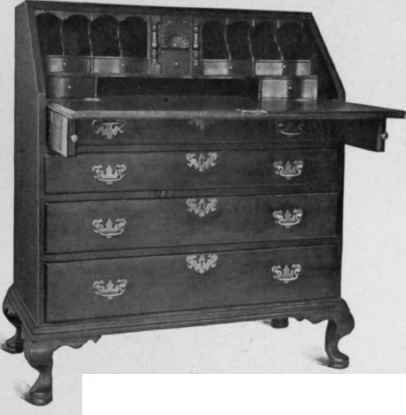
Figure 256. Slant-Top Scrutoire, 1740-50.
Continue to:


My Books

