


V. Desks And Scrutoires. Part 5
Description
This section is from the book "Colonial Furniture In America", by Luke Vincent Lockwood. Also available from Amazon: Colonial Furniture In America.
V. Desks And Scrutoires. Part 5
There is no drawer in the table part and the skirt is cut in a serrated edge. The legs are turned, ending in flat balls, and resemble inverted tenpins. The desk section has one drawer below the lid, and the interior is arranged exactly like that in the ball-foot scrutoires (Figure 239), with the slide opening into the top drawer instead of into a well. The fronts of the little drawers on the inside are cut in double ogee curves. This piece is the property of the writer.
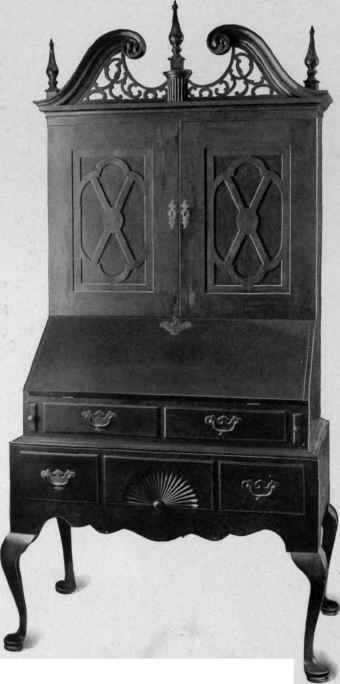
Figure 250. Cabriole-Legged Scrutoire with cabinet top, 1725-40.
An unusual scrutoire of this type with a cabinet top is shown in Figure 250, the property of Mr. H. W. Erving. The table section has three drawers side by side and the centre one is carved in the rising-sun pattern. The legs are cabriole, terminating in large Dutch feet. The desk part is made in one piece with a cabinet top, which is an unusual form of construction. The natural way would seem to have been to make the piece in three parts, consisting of the base, the desk, and the cabinet top. Below the lid are two drawers. There are two doors in the cabinet part with fret designs planted on the panel. The cornice is in scroll form with foliated rosettes, and the space beneath the scrolls is filled in with a fret of C scrolls. At each end and at the centre are turned pointed finials, the centre one resting on a circular fluted acroterium. The cornice is composed of the following mouldings: a fillet, a cyma recta, a narrow fillet, a wide fillet, a narrow fillet, a cove, an astragal, and a fillet. This piece is of cherry and is supposed to have been made at Windsor, Connecticut.
Scrutoires of this type with cabinet tops are very rare in this country, and this one is probably the best example that has been found.
Another unusual scrutoire of the same type is shown in Figure 251, the property of Miss C. M. Traver, of New York. The table part is low with short cabriole legs and Dutch feet. In this part are two square drawers with a full-sun pattern carved on the surfaces, and a narrow drawer. In the desk part are three long drawers and three small ones side by side, the centre one having carved upon it the same full-sun pattern. The interior is plain, with a long drawer and four small ones below and no pigeon-holes. Above the desk part is imposed another section, consisting of two drawers, upon which is carved the rising-sun pattern placed vertically, and above are two drawers side by side. This piece is so tall that it must have been intended to be used by a person standing, and was probably made for some special purpose. The wood is maple.
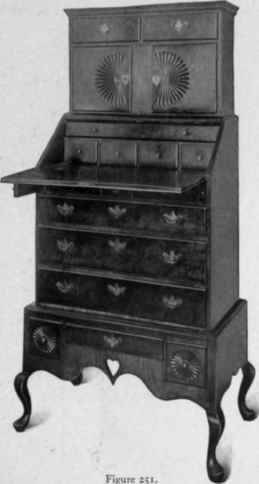
Cabriole-Legged Scrutoire, 1725-40.
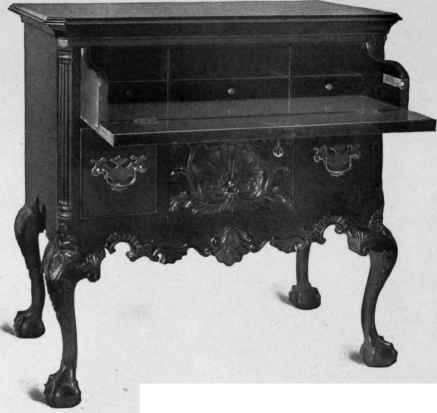
Figure 252. Dressing-Table with desk drawer, 1760-75.
Still another form of the so-called low-boy scrutoire is shown in Figure 252. When closed it appears to be a regular dressing-table of the Philadelphia type (Figure no), but the front of the top drawer falls, disclosing a desk. The top is finished with a cove, a fillet, and a quarter-round, and below is a deep cornice composed of a fillet and a large cove. The corners have square recessed edges and quarter-reeded columns are inserted. On the base of the frame and extending onto the knees are carved flowers and leaves and on the knees are carved two flowers with a long spray of acanthus leaves extending well down the legs. The feet are of the bird's claw and ball type. The skirt is beautifully cut and carved in C scrolls with leaves, with a shell at the centre. On the centre lower drawer is carved a shell and streamer so familiar on the Philadelphia pieces. This piece, so far as the writer knows, is unique, and is in the Pendleton Collection, owned by the Rhode Island School of Design.
After the first twenty years of the eighteenth century the marked distinction before noted in the prices given for desks and scrutoires disappears, and thereafter the inventories almost indiscriminately use the terms to denote the same kind of piece at the same price. Thus, at Salem, in 1734, we find "1 desk £5, 10s."; the high valuation showing that the old distinction was no longer made. And, later still, the word scrutoire seems to disappear entirely, and writing pieces of every sort are called desks.
It was also about this time that the word bureau first came into use. The word is of French origin. Some assert that it comes from a word denoting a writing piece of any kind, while others claim that the name was derived from the word burnt, or bureau, a coarse russet cloth of mediaeval times with which such pieces were covered. This latter derivation is probably the correct one, the first being a secondary meaning, for in Cotgrave's French and English dictionary, published in 1611, the following appears: "Bureau, a thick and course cloth of a browne russett or dark mingles colour; also the table thats within a Court of audit or of audience (belike, because tis usually covered with a carpet of that cloth)."
The word is.used by Swift in its modern spelling with its early meaning in the following much-quoted stanza:
" For not a desk with silver nails Nor bureau of expense Nor standish well Japann'd avails To writing of good sense."
This word is compounded in two ways in the inventories, bureau-desk and bureau-table or -chamber-table. Dr. Lyon, in his splendid work on Colonial Furniture, thinks the former referred to a scrutoire, while the latter referred to a low chest of drawers, or bureau in the modern sense, and cites such entries as: at Boston, in 1721, "a burow desk £3 10s"; in 1725, "1 buroe £5"; in 1739, "1 buro table"; and in 1749, "In the front chamber 1 buro table with drawers £15" - all of these valuations, of course, being in inflated currency.
Continue to:


My Books

