


V. Desks And Scrutoires. Part 7
Description
This section is from the book "Colonial Furniture In America", by Luke Vincent Lockwood. Also available from Amazon: Colonial Furniture In America.
V. Desks And Scrutoires. Part 7
Figure 257 shows a scrutoire in which the drawers in the desk part are cut in ogee curves and the decoration is obtained by carving and burning the design into the wood. It was found in central Pennsylvania. The door at the centre conceals a series of little drawers, and under the frame of these drawers is a spring which, upon being pressed, releases the whole centre and discloses a secret drawer back of the two carved columns. The lid is supported by two square drawers instead of two pulls.
In many of the scrutoires the maker exercised great ingenuity in contriving a scries of secret drawers and receptacles in which deeds, wills, and other valuable papers could be kept. These secret places were sometimes arranged back of the centre compartment. The whole centre would draw out on being released by pressure of a hidden spring, which was sometimes concealed above a little drawer at the top which must first be removed; sometimes the spring would be concealed at the bottom or on the side, always ingeniously hidden from the uninitiated. This centre, being drawn out, discloses either a series of small shallow drawers, a shelf, or two narrow upright drawers on either side of the centre. This is the commonest place to find secret compartments, but if they are not in the places mentioned a narrow shelf may be found between the top drawer and the bottom of the scrutoire part, to which an entrance can be obtained by means of a sliding panel in the bottom of the scrutoire part, often securely fastened by a spring hidden in various ways. Again, there is occasionally a hollow place at the back of the slides which holds the lid.
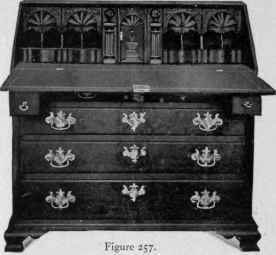
Slant-Top Scrutoire, third quarter eighteenth century.
Figure 258 shows a scrutoire with an unusually good interior. There are two tiers of three carved drawers on each side of the centre. On the upper tier are carved rosettes and on the lower ones shells. Above are three pigeon-holes on each side and above that are three drawers. On each side of the door is a fluted pilaster which is the front of a paper drawer. The door front contains a panel with the edges cut in ogee and simple curves on which a vase with prune blossoms and leaves is beautifully carved. There are four plain drawers below, and the piece stands on bird's claw and ball bracket feet in front, with the knees carved in an acanthus-leaf and scroll design. The rear legs are in the ogee bracket type. This scrutoire is the property of Mr. C. R. Morson, of Brooklyn.
Figure 259 shows a scrutoire belonging to Mr. H. W. Erving. A rope moulding and a shell is carved on the lid, and on the centre of the lower drawer is carved a similar shell, and a rope moulding is repeated on the skirt, both front and sides. The corners are chamfered and fluted, the feet are bird's claw and ball bracket feet with carved knees, and the balls are ornamented with small indentations.
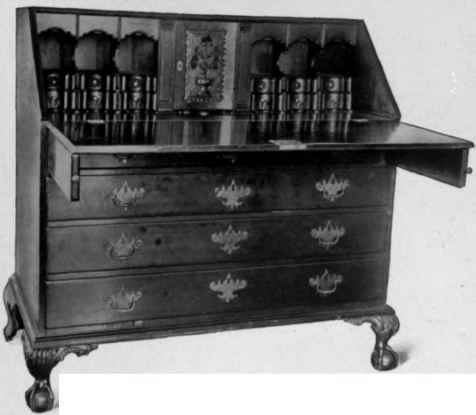
Figure 258. Slant-Top Scrutoire, third quarter eighteenth century.
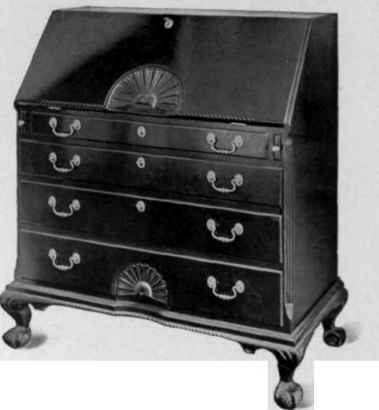
Figure 259. Slant-Top Scrutoire, third quarter eighteenth century.
A form of writing-desk which strongly resembles the modern office desk is shown in Figure 260. This form was used in France as early as the Louis XIV period. It did not become at all common in England until Chippendale's time. Chippendale shows several designs of this form in his "Director," and a late one executed by him is shown in Figure 5. In this country the model was not popular. The one here shown is English and the cabinet work is of exceptional quality. It will be seen that the bases are bombe-shaped, the sides of the drawers being cut on the curve of the frame. The top is covered with a tooled leather. The mouldings on the edges of the top are carved in a dainty acanthus-leaf design and the stiles are all carved in acanthus scrolls. The feet are of the ogee bracket type, the handles are in Chippendale style, and on the ends are mounts of cast brass in imitation of French ormolu work. The proportions, simplicity, and refinement of this writing-table make it one of the best examples known. It is the property of Mr. Richard A. Canfield.
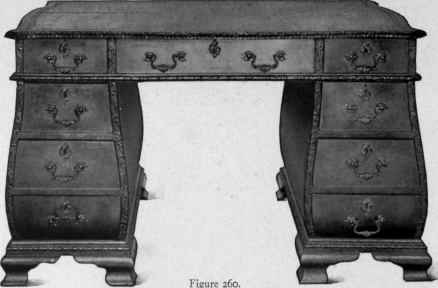
Knee-Hole Writing-Table, 1750-60.
In no piece of furniture probably did the block-front type reach such perfection as in the scrutoire.
In studying the block-front type the reader will do well to compare the desks here shown with the block-front chests of drawers (Chapter III), where will be found a discussion of the style.
Figure 261 shows a typical block-front scrutoire. The blocking is raised and depressed beyond the plane of the drawer. This is the common method. This piece stands on four bird's claw and ball feet, and the blocking extends through the moulding onto the brackets of the legs. The brasses are original and are of the type usually found on these pieces. This piece is the property of Mr. Albert H. Pitkin, of Hartford.
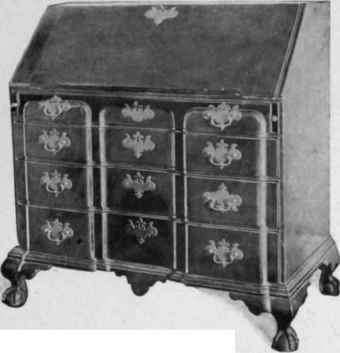
Figure 261. Block-Front, Slant-Top Scrutoirc, third quarter eighteenth century.
Figure 262 shows another block-front scrutoire with the same style of blocking as is shown in the preceding figure, and there is the same moulding on the frame about the drawers. The feet, however, are unusual, being animals' claw and ball bracket feet with carved knees. The mouldings at the base of most of the block-front pieces, other than the Rhode Island type, generally consist of a cove, a fillet, and a quarter-round, with a wide fillet below, as in this piece. The interior of this desk is good; the blocking idea is carried out by the hollowed fronts of the outer drawers and the single door, above each of which is carved the rising-sun pattern. The handles, of course, originally were similar to those shown in the preceding figure. This scrutoire was the property of the late William G. Boardman, of Hartford.
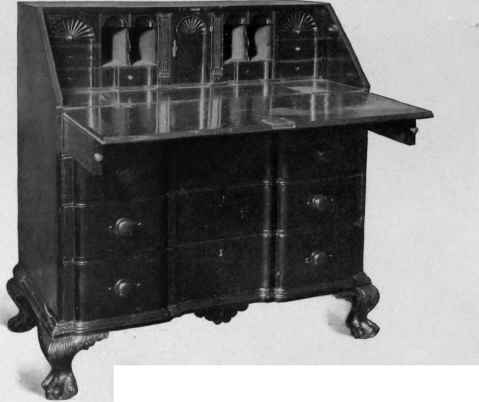
Figure 262. Block-Front, Slant-Top Scrutoire, third quarter eighteenth century.
Continue to:


My Books

