


VI. Looking-Glasses. Part 7
Description
This section is from the book "Colonial Furniture In America", by Luke Vincent Lockwood. Also available from Amazon: Colonial Furniture In America.
VI. Looking-Glasses. Part 7
We now come to the lata example of the cut-work looking-glasses of which Figure 325 was a prototype. It will he seen that the upper edges of the tooking-glassea in Figure 343 are curved in the same manner as in that figure. The cutwork scroll tops are enriched with applied gilded and curved scrolls. On the first one is a small pediment top the inner surface of which is finished with rosettes and pendent leaves, and at the centre is a pheasant with wings overt. On the other one are acanthus scrolls on either side with a similar bird at the centre. Both looking-glasses have on either side the carved pendent leaves and flowers, gilded. These looking-glasses are in the Bolles Collection, owned by the Metropolitan Museum of Art.
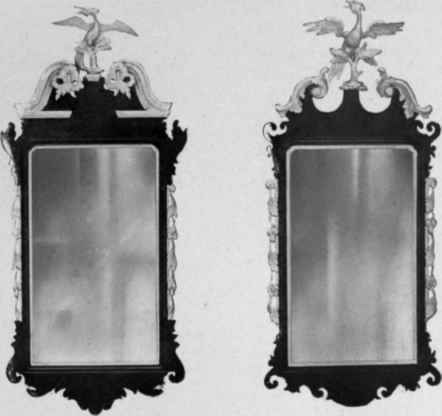
Figure 343. Two Looking-Glasses with mahogany and gilt frames, 1770-80.
Figure 344 shows another example of this same type of looking-glass, the property of the writer. On either side of the top are scrolls, the inner ends finished with rosettes and pendent flowers, and at the centre is a pheasant with wings overt. Below the pheasant is an applied oval with a pearl edge beading and on the sides are the usual pendent leaves and fruits.
Another form of this same style of looking-glass is shown in Figure 345 and is the property of the Tiffany Studios of New York. The cresting is of the usual cut-work type, but on the surfaces are scratched leaf designs instead of plain surfaces as in those heretofore shown. At the centre is cut a circle and within the circle is a pheasant with wings overt. At the base is applied a carved shell.
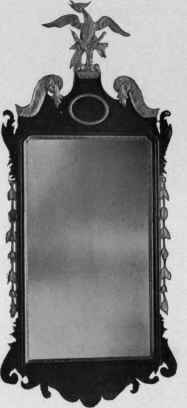
Figure 344. Looking-GIass with mahogany and gilt frame, 1780-90.
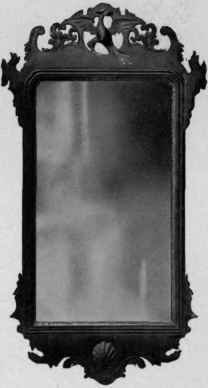
Figure 345. Looking-Glass with mahogany and gilt frame, 1780-90.
A still later example of this same style of looking-glass is shown in Figure 346 and is in the Bolles Collection. The glass in this case is rectangular without the curved upper corners. In the centre of the cresting is a circular opening within which is inserted a pheasant with wings overt, and below are inlaid swags of flowers caught in three places with rosettes.
Figure 347 shows another cut-work looking-glass which is the property of Mr. H. W. Erving. The scrolls at the top are cut in a waving edge, and at the centre is an urn with carved wood flowers and leaves supported on wire stems. \t the centre of the cresting is a leaf design which is repeated at the base. On the sides arc pendent leaves, flowers, and fruit. The inner edge of the frame is cut in a similar cyma scroll design as is shown on Figure 342. On the back of this looking-glass is pasted the advertisement of the maker, which reads as follows: "Thomas Aldersey, looking glass maker in London."
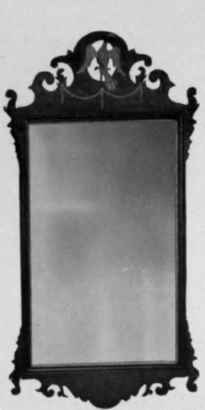
Figure 346. Looking-Glass with mahogany inlaid and gilt frame, about 1790.
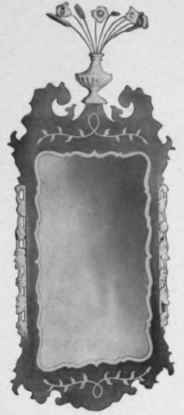
Figure 347. Looking-Glass with mahogany and gilt frame, 1780-90.
A late form of a pediment-top looking-glass is shown in Figure 348. At either side of the centre of the top is a scroll, the inner edge finished with a simple rosette, and at the centre is an urn in which are flowers and leaves made of composition fastened on wires. The surfaces of the frame are veneered mahogany, and below the urn at the top is an inlaid medallion. On the sides are pendent leaves and flowers made of composition and hung on wires. About the frame, which is square, is a border of inlay.
Another form of small looking-glass is shown in Figure 349. At the centre of the top are leaves and flowers on an arch which is supported by two capitals, between which are swags of flowers and leaves extending from the top of the columns down over the sides. At the bottom are likewise swags of leaves caught up at the ends and the centre, and at the centre are also ribbon effects. This looking-glass is the property of Mrs. Brown, of Salem.
Figure 350 shows another looking-glass of the same general type. At the centre is an urn within which are flowers and leaves and from which depend scrolls with acanthus leaves which twist and terminate in flames. The outer and inner edges of the frame are carved and at the base are swags of leaves caught up at the ends and centre. This looking-glass is the property of the writer.
After about 1760 advertisements are frequently found of sconces, but very few have been found in this country. It is probable that they were so fragile that they have become broken.
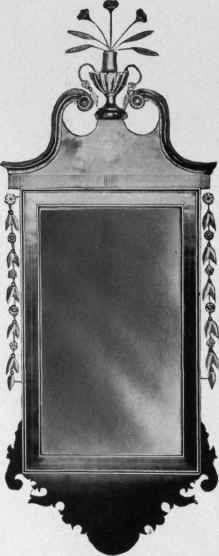
Figure 348. Looking-Glass with mahogany and gilt frame, 1790-1800.
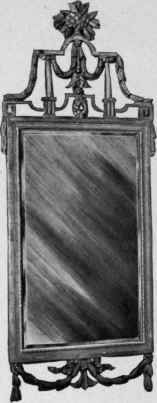
Figure 349. Looking-Glass with carved and gilded frame, about 1780.
Figure 351 shows a sconce at the top of which is a bow knot, and below is an eagle with flowers and grasses. The eagle stands on a base from the bottom of which spring scrolll which hold the two candle-stieks, and below are ribbom terminating in two tassels. Bran chains extend from the top and from the eagle's mouth down to the candles and the rosettes, and from the rosettes arc two chains terminating in bells Figure 352 shows another sconce at the top of which is carved a bow knot, and below is an eagle with a chain and ball suspended from its mouth. Below arc a torch and a quiver with arrows crossed. There are two candle-sticks with pendent cut-glass drops, and the base is finished with a bow knot and ribbon ending in a tassel. These sconces are the property of Mr. Marsden J. Perry, of Providence.
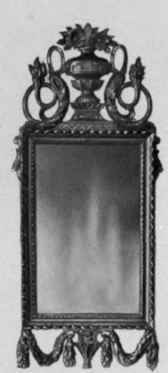
Figure 350. Looking-Glass with carved and gilded frame, about 1780.
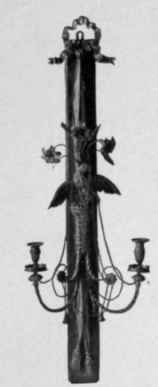
Figure 351. Sconce, 1790-1800.
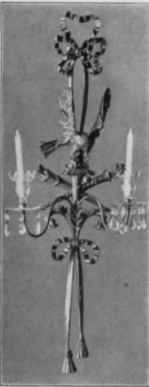
Figure 351. Sconce, 1790-1800.
Continue to:


My Books

