


Cart
Description
This section is from "The Domestic Encyclopaedia Vol1", by A. F. M. Willich. Amazon: The Domestic Encyclopaedia.
Cart
Cart, a land carriage, with two wheels, drawn either by horses or oxen, for conveying heavy goods, etc. generally at short distances.
In rural economy, the proper construction, and adaptation of carts to different soils and situations, are objects of the first consequence to every reflecting farmer. Nevertheless, it is surprizing, that little attention has been paid to this important subject, previous to the late improvements in agriculture ; the flourishing seta of which, in Britain, commenced about the middle of last century, or the year 1/54, when that patriotic Society for the Encouragement of Arts, Manufactures, and Commerce, was instituted at London., Since that memorable period, numberless in-ventions have been introduced into rural economy, and the names of Lord Romney, Mess. Shipley, MORE, and many other illustrious promoters of true national wealth, will ever be remembered by a grateful posterity. One of the most active members of this respectable institution is Mr. Arthur Young, of whose public spirit, and indefatigable labours, we have before us the most ample and satisfactory proofs. His "An-nals of Agriculture, "though con-ducted on a plan too diffuse for ordinary readers, is a work replete with practical facts; and, on the whole, the best illustration of British husbandry. In the 18th volume of these Annals, we meet with an elaborate paper, entitled "The Farmer's Cart;" by the editor; from which we shall extract the following particulars: Mr. Young first observes, that the most general farmer's carriage in England, is a waggon, drawn by four horses, in which is conveyed com, hay, wood, etc. but not dung or earth, which are usually moved by carts, or tumbrils, drawn by three, or four horses: - carriers almost universally employ broad-wheelcd waggons, drawn by eight horses.
In Scotland, waggons were formerly used, but afterwards changed for large carts, and more lately for small ones, drawn by one horse.
In Ireland, the most common vehicle at present is the one-horse car, with low wheels beneath the body of the machine; which has universally superseded the use of English carts and waggons, from a conviction of their inferiority. Nothing, says Mr. Young, exceeds the amazing expedition with which corn and hay fields are cleared in that country, by means of this useful, though inelegant implement. In consequence of such a decisive encomium, as well as the very favourable account given of this machine by the late Mr. Barewell, of Dishley, Leicestershire, in the "Communications to the Board of Agriculture, "we have been induced to present our readers with the following cut, and description, of an Improved Irish Cart.

The advantages of this vehicle, which was preferably employed, and strongly recommended, by the feast mentioned agriculturist, consist in the facility with which it is laden, on account of its lowness; and, when gate-ways and roads are narrow, much room is gained by the wheels being fixed under the body of the cart. In such situations, therefore, it is well calculated for carrying manure, especially on meadow or ploughed land ; and, for that purpose, its wheels ought to have a flat bearing, and to be at least six inches in breadth. Another peculiarity in the construction of this cart is, that its wheels are necessarily cylindrical ; and that the facility of draught arising from this unobserved circumstance, was probably imputed to some other part of the machinery. But, though contrary to the generally received opinion, Mr. Alexander Cummings (in his Observations on the Effect which Carriage-wheels with Rims of different shapes have on the Roads, printed in the Communications to the Board of Agriculture), has satisfactorily demonstrated, and it is likewise evinced by experience, that the resistance to the cylindrical wheel is not increased, but diminished, by increasing the breadth and, the flat bearing of its rim. The knowledge of this fact is of very great importance to the farmer, as well as to the waggoner ; for, by availing himself of this simple improvement, he may be enabled, in almost all seasons, to drive his broad-wheeled carts, etc. on his meadow or ploughed ground, when no narrow wheel can be employed. - Hence it would be superfluous to enumerate the farther advantages of this implement; yet, when the width of gate-ways and the breadth of roads will admit of the wheels being placed at the sides of the cart, without confining the width of its body, it will probably be more advantageous to have them at the sides, than under the cart.
One of the greatest advocates for one-horse carts, is Lord Robert Seymour , whose excellent paper on this subject, datedTaliaris, 5th. September, 1796 (inserted in the 27th volume of the Annals of Agriculture), deserves the thanks of all British farmers. This patriotic nobleman strongly recommends the cart which he. employs on his estates, as a most useful implement of husbandry. Convinced of its superior excellence, in many situations, we have thought proper to annex an accurate engraving of this cart, for the elucidation of which, we shall extract the following particulars from his Lordship's letter, addressed to the editor of the last-mentioned work :
The advantages of single-horse carts are universally admitted, wherever they have been attentively compared with carriages of any other description. By his own observation, Lord Seymour is led to conclude, that a horse acting singly will do half as much more work as in conjunction with another, so that two horses will, separately, perform the work of three conjunctively. This difference, he believes, arises partly from the single horse being so near the load he draws, and partly from the point or line of draught being so much below his breast; as the wheels of single-horse carts are usually made very low. When a horse draws in conjunction with another, he is generally embarrassed by some difference of rate - the horse behind, or before him, being quicker or slower than himself: whereas a single horse has only his load to contend with, and is not inconve-nienced by the greater or lesser height of his fellow. Nor is there any necessity for employing additional drivers; as horses, once in the habit of going singly, will follow each other as uniformly, and steadily, as they do when harnessed together : hence, on the most frequented roads in Ireland, one man conducts three, four, or rive single-horse carts, without any inconvenience to the passenger.

Dimensions of the body of the cart employed by Lord Robert Seymour : - Two feet eleven inches across the bottom; three feet nine inches, inside length; one foot high; sloping top, nine inches.
Iron wheels, - 'Two feet eight inches high; rim, three inches and a half wide, and from three-quarters to an inch thick; spoke, three inches and a quarter at each end, worked off to two inches at its centre.
In the introduction to the letter above alluded to, his Lordship ob-serves, that the price of iron cast into wheels is 16s. perewt.; and the weight of each wheel is about three-quarters of a hundred. - Two in-conveniencies, however, arise from the use of low cast-iron wheels ; namely, 1. That such iron is very liable to break upon concussion; and 2. That the course of a wheel of so small a diameter, occasions a very quick consumption of grease. The first of these objections is, in a great measure, removed by the facility with which the rim of the wheel may be repaired by the application of wrought iron ; the latter being joined to the former by a rivet, the wheel acquires a degree of elasticity, and thus becomes, perhaps, stronger than it was when new. In order to furnish a regular supply of grease.-, Lord Robert has introduced four grooves or cavities in the boxes, increasing a little towards their centres : and with a view to defend the axle-tree, which consists of wrought iron, against the harder body of the box, he ordered the extremity of it to be steeled.
Mr. Arthur Young, in the 18th volume of his Annals of Agriculture, before quoted, states the following dimensions of a single-horse cart, which he, by the test of experience, has found to be the most advantageous :
Buck. - .Length, 5 feet 1 inch.
Breadth, 3 feet 7 inches.
Depth, 2 feet. Cubical feet, 35 and a fraction.
On his farm cf 350 acres, in Suffolk, Air. Young employs only rive such carts; and observes, that he would not add more than one to the number, even though he should increase his business to 4 or 500 acres: hay, corn in the straw, faggot-wood, billets-, dung, clay, marl, lime, bricks, etc. are all conveyed by them ; carrying out 9, and even 10 coombs of wheat in sacks, and they are never drawn by more than one horse or ox.— No farm of the same extent, in an arable country, has less than three waggons, three tumbrils, and a light cart : the exact price of these different implement, in the year 1792, amounted to l09l. ; while the building of six carts, upon Mr. Young's plan, costs only 63l. : thus he saves about 40 per cent, in annual repairs. Beside this great reduction of expence, another circumstance cumstance deserves particular no-tice - As these carts had for many years been the object of ridicule, Mr. Young offered a bet to one of his prejudiced neighbours, that he should load a waggon, till five horses could not stir with it; and Mr. Young engaged tocarry away that load with ease, in his carts, with four of the same horses ; but the confidence, which his antagonist possessed in waggons, would not allow him to accept the offer.
The infinite benefit, concludes Mr. Young, of which these carts would be to the roads, if their use • should become general, may be easily conceived. In all the examinations before Committees of the House of Commons, as well as in most of the treatises published on the subject, it has been admitted that no police or management can keep the roads in repair, while such vast weights are permitted to be drawn in a single carriage. Par-liament has been made so sensible of this fact, that repeated acts have been passed, by which the weight of waggons was limited, and a certain breadth of the wheels enjoined. Experience, however, has proved, that both are insufficient, and that the only method of effecting a favourable change, would be to prohibit numerous teams. Let every man cany whatever weight he pleases in a one-horse cart, and pay a light toll ; let the load of a two-horse cart be limited, and the toll increased; farther lessening the weight, and raising the toll, when four horses are employed; and thus advancing the turnpike expences for every additional horse, till it amounts nearly to a prohibition. If such a plan were to be adopted, we should soon see all our roads in an improved state.
Rollers have, indeed, been greatly indulged both in weight and toll; but this was a preposterous measure, for a roller will crush a pebble to dust, as well as a wheel, and the badness of roads must be attributed to the materials being reduced to powder, almost as soon as laid on, and either blown away in dust, or carried off in mud. Having followed some of Sharp's waggons, and observed the effect, Mr. Young is persuaded, that the roller is more detrimental to the road than nine-inch wheels. In such an inquiry, facts only can decide the question : the Irish roads are made at an expence beyond comparison less than the English, and were, at the time he visited that country, greatly superior to those in England. This difference, in his opinion, must be attributed entirely to the use of one-horse carts, as he has explained in his "Tour of Ireland." "Many hundred thousands a year would be saved in England, if these carts were so favoured in road-acts, as to ensure a great decrease of waggons." On the whole, he ventures to recommend the use of one-horse carts to his brother farmers, with that confidence which ought to arise solely from numerous and varied experiments.
Having concluded the subject of single-horse carts, we shall only observe, for the information of those who employ teams with two-wheeled carriages, that several useful implements have lately been invented, for the more effectual stopping of such carts, in descending steep hills, and likewise for taking off the increased weight thrown on the shaft horse's back in all descents. A description of these excellent contrivances, illustrated by the necessary Cuts, we shall communicate under the re-spective heads of Locking-pole, and Wheel-drag.
In London and Westminster, carts are not permitted to carry more than twelve sacks of meal, 750 bricks, one chaldron of coats, etc. on pain of forfeiting one of the horses (stat. 6 Geo. I. c. 6). - By the laws of the city, carmen are forbidden to ride either on their carts or horses : they are to lead or drive them on foot through the streets, under the penalty of 10s. (stat. 1 Geo. I. c. 57).
By 39 Geo. III. c. 93, there is a duty of ll. 4s. a year to be paid on all carts or carriages with less than four wheels, to be drawn by one horse, without any other than a tilted covering, and without any lining, springs, or ornament whatever, except a paint of a dark colour, with the words, "a taxed cart, " and also the owner's name, written upon it; and the price of such cart shall not exceed 12l.
Rolling-carts are very useful machines for carrying manure on low-lands during wet seasons. According to an account given by Mr. Richard Moyle, and inserted in the 11th volume of the "Travsatlions of the Society for the Encouragement of the Arts, etc."such a cart consists of three circular pieces of strong elm, two feet in diameter, and each eighteen inches long, through which a strong iron axis is passed, so as to protrude a few inches on each end beyond the rollers ; after all, allowing an inch between each piece, for the conveniency of turning round. On the projecting part of the axis, a fixed frame is placed, for supporting the body of the cart which, according to the nature of the soil, may be loaded to any degree, and employed simply, as a roller, or for carrying manure, etc. on land where common wheels cannot be admitted.
By means of these rolling carts, the surface of the land is to be frequently compressed, in order to consolidate the Soil more perfectly, so that the earthy particles may embrace the roots of the grasses, and retain their proper moisture ; on which the luxuriancy of such soils in a great measure depends.
Cart. - In the 2d volume of u Communications to the Board of Agriculture, " we meet with a description of a Drag-Cart, and an ingenious method of regulating the centre of gravity of the load; by-Lord Somerville. This memoir is illustrated with plates, from one of which we have selected the following figure, representing a perspective view of a cart designed to be drawn by two strong oxen, with a pole, yoke, and bows; such carriage being calculated to convey 45 cwt.
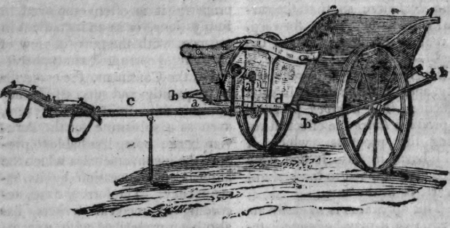
In the front of the body of this cart, is represented the manner in which the centre of gravity of the load is adjusted; in order to prevent it from pressing too much on the animals, when descending a hill: the front of the cart is elevated by means of a toothed rack screwed on it, and worked by a pinion, and the handle a ; being immediately connected with the pole c. - By the aid of this pinion and rack, the front of the carriage is raised in a greater or less degree, according to the declivity 3 so that the weight of the load bears more on the axle, and less on the necks of the cattle.
On the side of this cart is delineated the position, in which the friction-drag is applied, and is made to press in a greater or less degree, according to the steepness of the descent. - b, b, is the friction-bar; one end being connected with the tail of the cart, by means of a small chain 5 and the other being fastened to the front by a toothed rack b, d, that catches on a staple in such front; so that the friction-bar may be made to aft more or less powerfully on the side of the wheel, at the discretion of the driver:- the notches, or teeth, on this rack should be set as closely together, as circumstances will permit.
The friction-bar, in the figure above given, is stated by Lord S, to be placed lower on the wheel
D than it was originally designed, with a view to divide the pressure and friction more equally on the opposite side of the wheel: so that the action on each is diminish-ed; and the risk of over-heating and destroying the friction bars rendered less, than if the whole pressure were applied in one point, on the top of the wheel. The advantages arising from the drag here described, are as follow :
1. The pressure and degree of friction may, with great expedition, be adjusted to the steepness of the declivity; so that the carriage will neither press forward, nor require much exertion in the draught.
2. The friction is, with great propriety, applied to the wheel in such a direction, that a pressure will produce twice the effect in retarding the progress, which it would have, in case it had been immediately applied to the body of the cart, or to the axis.
3. This apparatus is so easily ar-. ranged, that it may be immediately adjusted, without stopping the carriage, or exposing the driver to danger.
4. Lord S.'s useful contrivance will be of still greater utility when applied to loth the hind wheels of waggons : for, by this expedient, the resistance may not only be always adapted to the steepness of the descent, so as effectually to prevent both the tearing up high roads, and the unnecessary exertion of cattle, when drawing locked carriages down hills ; but also the frequent accidents to which drivers are exposed, will be completely obviated; and that time, which is now spent in locking and unlocking waggon-wheels, will in future be saved.
Continue to:


My Books

