


VI. Looking-Glasses. Part 9
Description
This section is from the book "Colonial Furniture In America", by Luke Vincent Lockwood. Also available from Amazon: Colonial Furniture In America.
VI. Looking-Glasses. Part 9
Figure 360 shows another of these looking-glasses which is the property of Mr. Marsden J. Perry, of Providence. At the centre is a figure probably intended to represent Ceres, and above her head is a bow knot and flowers and leaves. On either side of the figure are cornucopias filled with fruits and flowers which extend partially down the sides. Below the looking-glass frame are two doves standing on a quiver with arrows. The edges of the frame are carved in a guilloche pattern and the inner edge is finished with a pearl bead moulding.
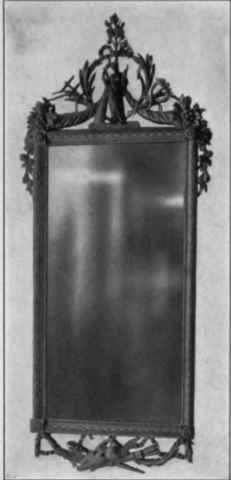
Figure 360. Looking-Glass with carved and gilt frame, 1785-95.
Another of these looking-glasses is shown in Figure 361 and is the property of Mr. Erving. At the centre is a basket filled with fruits and a sheaf of wheat.
On either side are farming implements - a rake, a pitch-fork, a flail, and a scythe - and around each are swags of leaves and flowers which extend down over the sides. At the base are ribbons and drapery. On the edges of the frame are carved pendent leaves with rosettes at the corner, and the inner surface is finished with the reel and bead moulding.
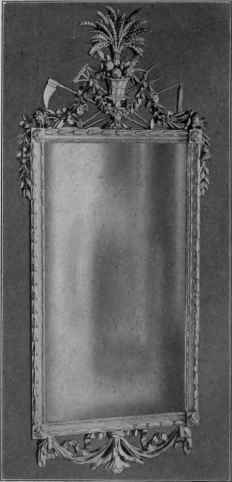
Figure 361. Looking-Glass with carved and gilt frame, 178S-95-.
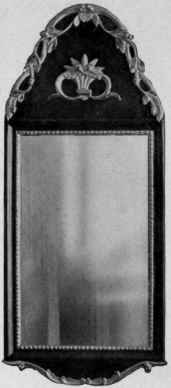
Figure 362. Looking-Glass with mahogany and gilt frame, 1785-95.
Another form of small looking-glass popular at this time is shown in Figure 362. It will be seen that it is practically a revival of the earlier cut-work looking-glass shown in Figure 328. The cresting is tall and is edged with scrolls, oak leaves, and acorns. At the centre is a basket with scrolls, and acorns and leaves within. The lower edge is finished in a scroll design. All of the carving is gilded.
The inner edge of the frame is finished with a pearl bead moulding. This looking-glass is the property of the writer.
A more elaborate looking-glass of the same general character is shown in Figure 363, the property of Mr. H. W. Erving. On the top is applied an arch upon which is a bow knot with pendent leaves and fruit. Below this are scrolls which support at the centre a basket containing leaves and fruits. At the base are C scrolls and a vase containing fruit and leaves.
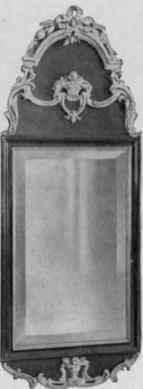
Figure 363. Looking-Glass with mahogany and gilt frame, 1785-95.
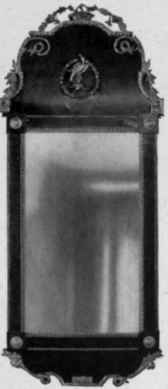
Figure 364. Looking-Cilass with mahogany and gilt frame, 1785-95.
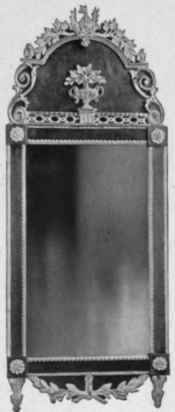
Figure 365. Luoking-Glass with mahogany and gilt frame, 1785-95.
Figure 364 shows another looking-glass of the same character, the property of Mr. George M. Curtis, of Mcriden. An egg-and-dart moulding outlines the arch-shaped top, above which is a basket from which are streamers of leaves and flowers, and scrolls extend down the sides of the cresting. At the centre is applied a pheasant surrounded by a wreath. On the outer edges of the frame is a reel and bead moulding and on the inner edge a pearl bead moulding is carved. At the Cornell are blocks within which are inserted rosettes. At the base are scrolls terminating in cornucopias with fruit and leaves.
A very elaborate looking-glass of this type is shown in Figure 365 and is the property of Mr. Norman F. Allen, of Hartford. At the top is the same arched moulding, above which are scrolls of flowers and leaves and at the centre a vase. The arch is supported by scrolls, and across the base of the cresting is a fret railing and at the centre is an urn with leaves and flowers. The corners of the frame are blocked and have rosettes planted on them, and on the outer edge of the frame is a reel and bead moulding and on the inner side a pearl edge moulding. At the base are feet with leaves carved on them and a festoon of leaves and flowers.
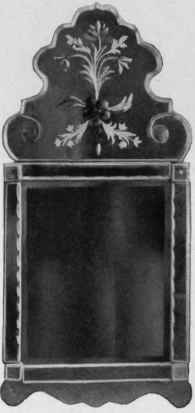
Figure 366. Looking-Glass with glass frame, 1780-90.
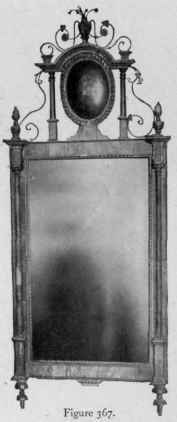
Looking-Glass with marble and gilt frame, 1780-90.
An interesting looking-glass which is suggestive of this type is shown in Figure 366 and is the property of Mr. Frederick E. Haight, of Brooklyn. The cresting is of glass with bevelled edges, on the surface of which are cut sprays of flowers and leaves. Squares of glass are placed at the corners, and the outer edges of the frame are of glass as is also the curved base. This looking-glass came from the West Indies in the last quarter of the eighteenth century.
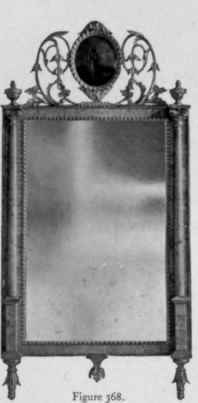
A form of looking-glass a number of which have been found, all coming from the seaport towns, is shown in Figure 367 and is the property of Mr. George S.
Palmer, of New London. The frame is made entirely of coloured marble. On the sides are engaged columns at the tops of which are carved and gilded finials, and at the base are feet. At the centre of the top is an arch supported on columns on top of which is an urn with flowers and scrolls of wire thinly coated with plaster. Beneath the arch is an oval framing a small picture. Such pieces as these have commonly been called "bilboa" looking-glasses and are supposed to have been imported from Portugal by persons engaged in foreign trade.
Looking-Glass with marble and gilt frame, 1780-90.
Continue to:


My Books

