


Reviews (9)
Description
This section is from "The Horticulturist, And Journal Of Rural Art And Rural Taste", by P. Barry, A. J. Downing, J. Jay Smith, Peter B. Mead, F. W. Woodward, Henry T. Williams. Also available from Amazon: Horticulturist and Journal of Rural Art and Rural Taste.
Reviews (9)
TRANSACTIONs OF THE NEW-YORK STATE AGRICULTURAL SOCIETY, with an abstract of the Proceedings of the County Agricultural Societies. Vol. X. 1851. The annual volume of Transactions of the New York State Agricultural Society lies before us, a goodly octavo of over 700 pages. We find it more than usually filled with interesting facts, valuable reports, and able speeches, on the topics that belong to the culture of the soil.
First of all, in importance and completeness, we place Mr. Delafirld's, (the late President,) " general view and Agricultural Survey of the County of Seneca." We do not remember to have seen any where, in the annals of American husbandry, so perspicuous, comprehensive, and valuable a report, embracing all that relates to the local history, ge ography, scientific facts, and practical agriculture of a district of country, as this survey of Mr. Delafirlo's. Though intended to Apply directly to only a small portion of the broad farm-lands of the State of New-York, a good part of it may be read with the greatest advantage by every intelligent farmer in the northern states. Mr. Delafield is a practical farmer himself, in our best farming district, and it needs but a little such leaven as such minds are made of, to create a new moving spirit in the hitherto inert and cold massrof those who hold the plow handles. We consider the latter half of this report as a most valuable book of reference for all intelligent fanners.
The Prize Essay of Mr. Thomas, on " Agricultural Dynamics," which might hare been ceiled the natural philosophy of the farm, we should like to see printed, bound, and hung . up in every work-shop, tool-room, and farmer's book-shelf, in the country. Without containing one word that is new, it gives the reason, and explains the action of mechanical powers, and the forces of nature generally, with illustrations so directly drawn from the farmer's daily routine, that it gives a direct meaning and value to every point, rarely found in text books devoted to the subject.
With every years' volume of these Transactions, we notice with satisfaction, the increase of interest about agricultural education. Almost every speech made at the county societies last year, alluded distinctly to its importance, and several able addresses before the state and the local societies, take the strongest ground on this topic. Nothing seems wanting now, but some concert of action between the different county societies, for the purpose of pressing the subject on the attention of the legislature, in order to secure a practical form-school, endowed by the state. The law-makers will never take any decided action in the matter till the farmers besiege the capital of the state with flails in hand, and lay their strong hands on the members who feed them with fine compliments, but lay their petitions on the table.
One of the most valuable features - perhaps the most valuable, in these Transactions of the Stale Society, is the account given under affidavit, by those cultivating the "premium forms," of their management, and routine of cultivation. The true test of ability is success, all the world over, and the best possible mode of finding out what can be realised by farming, in any district of country, is to look carefully into the practical results - the cost and profit of the crops on farms that are so managed as to pay well.
A capital example of this kind is the second premium farm, of last year's competition - that of Mr. Daniel D. T. More, of Watervliet, near Albany. Mr. M. bought, as it ap-pears, five years ago, a farm of one hundred and eighty-five acres, a sandy loam, worn down by having been leased to "skinners," for fifty years running. The buildings were all decayed, and had to be either pulled down or destroyed by Mr. M. on his taking possession.
This form was let, before Mobs bought, for $100 a year, and even this was complained of as too high a rent. The tenant sold all he could raise upon it, for $400 a year. Mr. Mobs, nevertheless, bought it, "against the advice of all his friends," paid all the money that he had or could raise upon the purchase money, and had to pay more as interest than the former occupant paid as rent.
"The land was so much exhausted," says Mr. M. in his statement, "that for two years I could only raise white beans." Not a very promising prospect surely. Nevertheless, be undertook a system of deep plowing, and bringing his land into condition sgain by plowing under green clover, using plaster to promote the growth of the clover, at the rate of about 250 pounds to the acre.
Mr. More, as fast as he brought his land into heart, adopted a rotation of crops, and applying manure as follows: "Plow under clover, plant corn, follow with potatoes, and then rye, with a top dressing of manure, not so much for the benefit of the rye, as for the clover sad future crops. I am satisfied," he adds, "that my land has improved rapidly from this mode, in feet at such a rate, that I shall not be able to follow it, so far as the rye crop is concerned".
Now it appears that Mr. More has made this old worn out form, that would not pay a rent of 9100, and whose annual product was $400, show for the year 1851, a total receipt account of $4,852.51 - which, against a total expense account, (of farm and family,) of $2,174.85, leaves a clear net profit for one year, of 82,678.16. And during the five years he has been about this course of improvement, he has erected anew and substantial dwelling house, form buildings, and fences; paid all the interest and part of the principal, besides the last year's profits.
If any body after this, says there is nothing to be learned in fanning - that intelligence and system applied to agriculture, will not, even under the most unfavorable circumstances, produce the same favorable results as when applied to any other practical business; if any body says that the " worn out" lands of the Atlantic states need any thing but a master, i. e., a man who finds out and respects nature's laws, not ignores and despises them, we turn him over to such men as Mr. More. His success is a better appeal to the state to educate the farmers generally by a practical school, than all the speeches that will be made on the subject in the legislature, at three dollars a day, from now till the millennium. Oh, generation of skinners - ignorant earth-robbers and land-pirates, when will you give place to cultivators who look deeper in the furrow than the horses who drag the plough through it!
Reviews #1
Cottage Residences: or a series of Designs for Rural Cottages and Cottage Villas and their Gardens and Grounds; adapted to North America, By A. J. Downing.
Illustrated by numerous engavings. Fourth edition, revised, enlarged and improved.
New-York: John Wiley, 18 Park Place, 1852. It is neither fitting nor necessary, that we should say anything as to the merits of this volume. The circulation of several extra large editions, and the results all over the country in the shape of numberless cottages and villas, erected from the designs it contains, are, perhaps, sufficient proof that it has both found favor in the eyes of the public, and has exerted a considerable share of influence in the formation of the popular taste for rural architecture.
The present edition, just issued from the press, will be found to contain several new designs for cottages, lodges, etc., with considerable additional matter, and the original text entirely revised throughout.
The most important addition, however, is a chapter entitled, " Further hints on the Gardens and Grounds of Cottage Residences." In this chapter we have given general directions, accompanied with plans, for the laying out of plots of ground, from the smallest parterre of flowers, to the largest area in which a cottage may usually be supposed to be placed. The different styles of flower gardens - the flower garden consisting of beds and masses or turf - the geometrical flower garden - the Elizabethan flower garden - the English flower garden and shrubbery - the labyrinth of shrubs - and various French and German plans for cottage gardens and grounds, are explained and illustrated in a way that we trust will be found of practical value.
This part of the work is, we think, particularly needed by ladies, who, for the most part, take in hand the laying out of the ornamental grounds of their cottage homes; and, in doing so, are frequently at a loss for hints and sketches, which, if not precisely adapted to their own grounds, might at least suggest to their own minds, such variations as would exactly answer the desired purpose.
We give, as a specimen of this part of the work, the following extract and plan, which may be in season to interest some of our readers now busy with the arrangement of their ornamental grounds.
" In presenting all these various modes of arranging flower gardens, we must be allowed to say that the modern taste of discarding any set flower garden, and, instead of it, arranging the beds of choice perpetual blooming plants, in and around a small lawn, in graceful and harmonious forms, is by far the most satisfactory in the majority of cases. It is especially so in all small places, where the ornamental grounds are too limited to Ill-low of separate scenes. In such cases, the grouping of flowers round a lawn, having only one or two colors in a bed, heightens the beauty of the lawn itself, while the flowers are enjoyed, perhaps, more than in any other way.
" Fig. 102 is a design of our own, of this kind, which has been carried out and found extremely pretty and satisfactory. In this, A. is the dwelling-house; B. the conservatory, (a detached building one side of the lawn;) C. the lawn; D. flowerbeds; E. vase, fountain, sun-dial, or rustic basket filled with flowers. Round the whole runs a boundary belt, F. of trees and shrubs - shutting out all that portion of the grounds not strictly ornamental. In practice, it is found that small circular beds, about three feet in diameter, grouped in twos and threes, (like those on the left of D.) are more convenient and effective than the irregular beds; partly because a three feet circle is large enough for a mass of a single color, in a small garden, and partly because a circular bed, like a tree, always looks well, either alone, or grouped with other circles* It is also adapted to any position, which an irregular bed is not.
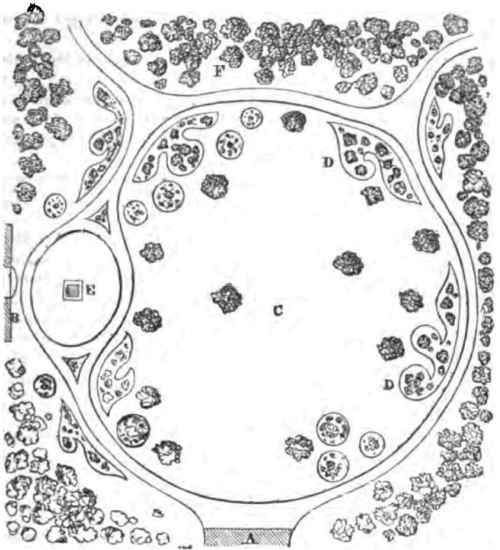
Fig. 10s.
"In order to give the lawn C, a more picturesque character) we hare introduced a few single specimens of trees, such as grow with beautiful forms when standing alone. "We may mention, as peculiarly adapted to such sites, the Chinese Magnolia, (M, conapicua, and M. soulangiana,) very hardy and beautiful; the Weeping Ash, Weeping Beech, Pur pie Beech, and Weeping Silver Lime, all striking in habit and foliage; the Ash Leaved Maple, or Negundo, for its lively green foliage; the Virgilia of Kentucky, with snowy white blossoms; the Virginia Fringe Tree, ect. As evergreens, to plant them singly we may enumerate the Deodar Cedar, the Norway Spruce, the Himmalayan Spruce, the Irish Yew, and the Silver Fir. A lawn and flower garden combined, and planted in this way, would have a tasteful and beautiful effect in any situation, or in connection with a residence in any style," p. 204
Continue to:


My Books

