


VI. Looking-Glasses. Part 11
Description
This section is from the book "Colonial Furniture In America", by Luke Vincent Lockwood. Also available from Amazon: Colonial Furniture In America.
VI. Looking-Glasses. Part 11
Figure 377 shows a very handsome pier looking-glass, the property of Mr. Dwight Blaney, of Boston. The cornice is composed of a series of reedings bound together with straps, and on the cove moulding below are vertical leaves. On the frieze is an ornament composed of a series of scrolls suggestive of the Vitruvian scroll, and at the centre of each is a rosette. Above the columns are lions' heads. The columns are long and slender, with fluted surface, and the capitals are of the composite order. Above the looking-glass are three panels of painted glass each representing a female figure. The centre panel represents a woman looking at a tomb around which are willow trees. On the tomb is the name "Werter." This central panel is signed "J. Phillips, 1798." Below these painted panels, on either side between the columns, are long, narrow glasses and a large central glass, and below are two small rectangular glasses and a long, narrow one.
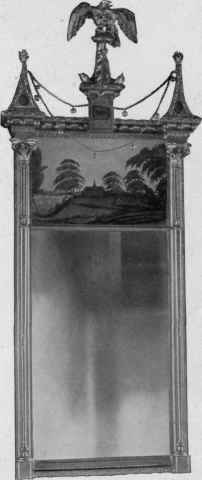
Figure 378. Pier Looking-Glass, about 1800.
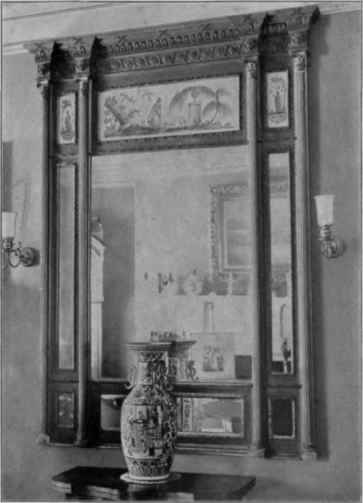
Figure 377. Pier Looking-Glass, 1798.
Figure 378 shows another looking-glass of this period, the property of Mrs. Annie B. Swan, of Providence. At the two corners are pointed Gothic finials and at the centre an eagle. Pendent balls are attached to the cornice and chains with balls are swung between the two finials. In the upper section is a landscape on glass representing a building with trees about it and a river with some ships.
There are long, slender columns on either side finished with capitals of the composite order.
During this period circular girandoles with concave or convex glass were very popular. They were made in all sizes, and some were perfectly plain with a moulded edge and others were highly ornamented with leaves, grapes, or flowers, with eagles or other birds in composition and gilded.
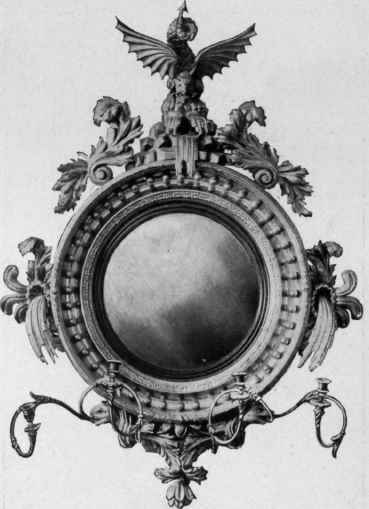
Figure 379. Girandole, about 1800.
Figure 379 shows a girandole, one of a pair owned by Mrs. Charles Clarence Torr, of Philadelphia. The surface of the frame is hollow and within are set a series of balls. At the top is a dragon, with tail in the air, standing upon rocks with dripping-water effects, on either side of which are acanthus-leaf scrolls. At the sides are acanthus rosettes with dripping-water effect, and at the base are dragons' heads and acanthus leaves with two branches, each intended to hold two candles.
This rock-and-water effect, which was in imitation of the Chippendale school, was revived in the early nineteenth century, hut the latter work was very ninth coarser than that of the Chippendale school.
Figure 380 shows another circular girandole having four lights with glass pendants. At the centre of the top are two dolphin-, with tails crossed, lying on rocks, and on either side are acanthus-leaf scrolls. Below are acanthus-leaf scrolls with a pendent flower. The moulding about the looking-glass is a half-round, and at the top, bottom, and two sides are cabochons with scrolls and flowers. The glass is convex. This girandole is one of a pair, the property of Mr. R. H. Maynard, of Boston.
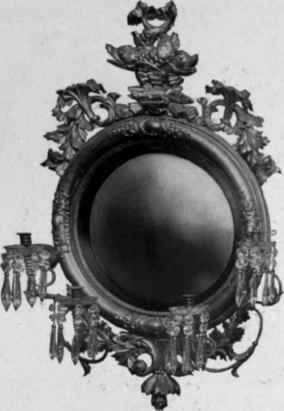
Figure 380. Girandole, about 1800.
A very beautiful oval looking-glass, but not a girandole, is shown in Figure 381, the property of the Tiffany Studios, of New York. It is composed of two cornucopias fastened together at the base by a ribbon and pendent leaves with grapes. From the mouths of the cornucopias extend heads of wheat over the top, making the upper side of the looking-glass. At the centre of the top is a large eagle.
Figure 382 shows a very good early Empire looking-glass in the Bolles Collection. The mouldings are a quarter-round and a fillet on which is a pearl bead moulding, a cove, a fillet, and a small cyma reversa carved in leaf pattern. At the two ends of the top are well-shaped urns with flames and at the centre a large urn with a pineapple at the top, and festoons of leaves and flowers connect the urns. On the centre acroterium is a basket with fruits and flowers. The glass is divided into two sections, the upper one containing a painting representing Liberty. On either side of the frame is carved an acanthus leaf, and on either side of the looking-glass are fluted columns and on the capitals are carved acanthus leaves. At the base of the columns are carved rosettes.
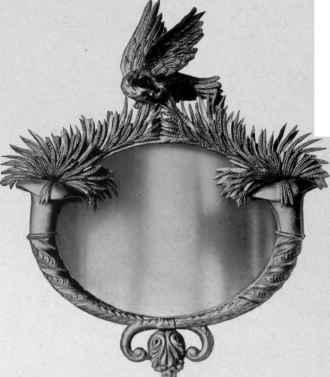
Figure 381. Looking-Glass with gilded frame, 1790-1800.
At the time of the War of 1812 it became the fashion to make looking-glasses with a painting representing scenes from the war. Figure 383 shows such a looking-glass on which is depicted the Macedonian fight. The looking-glass is in the usual Empire style with pendent balls, and on either side the moulding is hollowed and a narrow spiral-turned column is inserted. This looking-glass is in the Bolles Collection.
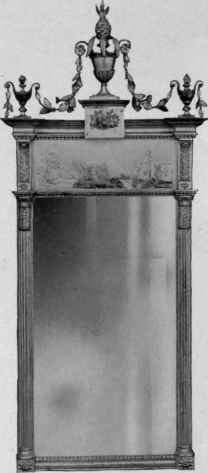
Figure 382. Looking-Glass with gilded frame, 1790-1800.
Figure 384 shows another looking-glass of about the same period. The same pendent balls are under the cornice, and on the upper section in relief is an angel dying and festoons of leaves and flowers. The columns are clustered and extend the whole length of the sides, and the centre one is hollowed, within which is inserted a pearl bead moulding. This looking-glass is in the Holies Collection.
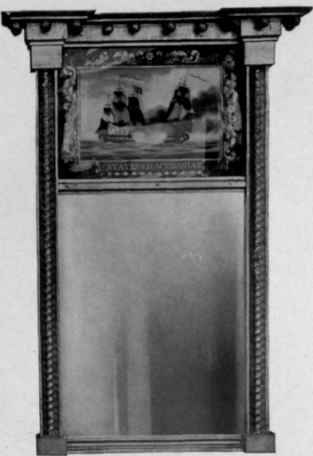
Figure 383. Looking-Glass, Empire style, 1812-20.
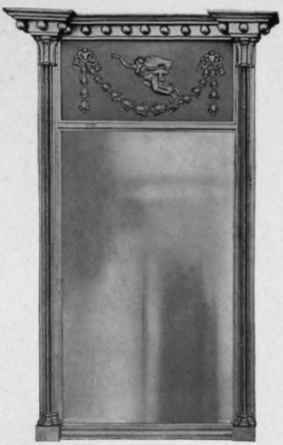
Figure 384. Looking-Glass, Empire style, 1810-20.
Continue to:


My Books

