


Visits To Country Places, No. 3. About New York. The North River. Continued
Description
This section is from "The Horticulturist, And Journal Of Rural Art And Rural Taste", by P. Barry, A. J. Downing, J. Jay Smith, Peter B. Mead, F. W. Woodward, Henry T. Williams. Also available from Amazon: Horticulturist and Journal of Rural Art and Rural Taste.
Visits To Country Places, No. 3. About New York. The North River. Continued
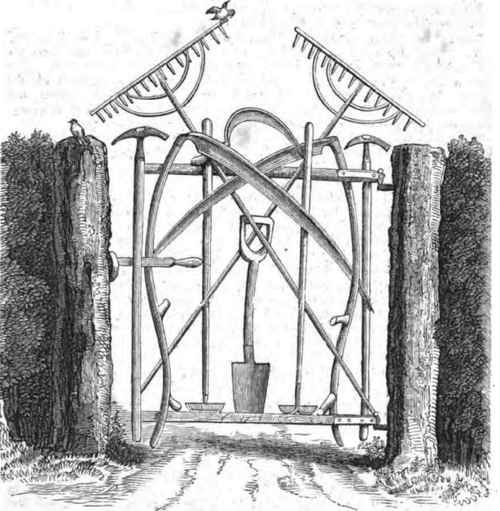
Ornamental Garden Gate at Wodenethe, the residence of H. W. Sargent, Esq.
A curious effect is produced by the mingling of variegated and particolored, trees, such as the variegated or silver~striped chestnut, the silver and variegated elm, the silver variegated thorn, the golden-blotched maple, and a very curious ash, the aucuba folia, with leaves as marked as the Japan gold-dust tree. These, mixed with the purple beech, the copper beech, the purple elm, purple berberis, and purple filbert, the darker colors presenting themselves first, and gradually blending off into the brightest, produce a very curious effect. The evergreens predominate, and make both the winter and the summer scene delightful.
The Pinus excel sa, or the Bhotan pine, has attained here the height of twelve feet, and fully justifies Mr. Downing's description, "that affectedly pretty" pine.
Pinus ponderosa, twelve feet, though only six years from the seed. This is a very striking and rampant grower, though too loose in its habit to be very handsome.
Picea ptnsape, six feet.
Picea cephalonica, eight, and very handsome.
Nordmaniana, from the Crimea, three feet, and the finest of the piceas.
Cedars of Lebanon, eight to fifteen feet.
Among the carious evergreens, Thuja filiformis (weeping arbor vitae), six feet high, weeping juniper, both beautiful, a very handsome golden-striped yew, six feet, a golden-striped cedar, a novelty in England, where it originated, and a silver-striped Balsam fir; but the two finest of Mr. Sargent's evergreens are the Torreya Taxifolia, the original tree sent to Mr. Downing by Dr. Torrey, and from which all the English Torreyas are descended) and the Abies Morinda, twenty-five feet high, and perhaps the finest specimen in this country.
The gardens are models of neatness and success. There are 2000 feet of espaliers for trained fruit-trees; peach houses, graperies, and forcing houses ail in the neatest order. , Two thousand pounds of grapes were raised here in one season, the average crop being 1000 pounds.*
We were amused by the mode of opening the lodge-gate, which is accomplished in the following manner: The lodge is set upon a Ha-ha or terraced wall adjoining the gate; through this wall a chain passes from the gate to the living room, and there secured to a small windlass, which, on the arrival of a carriage, is instantly wound up, thus opening the gate at any hour of the day or night without exposing the lodge-keeper even to sight; when open, it is held so until the carriage passes, when it shuts of its own weight, being hung out of plumb.
In short, Wodenethe is a cabinet picture; in landscape effects perfect. Though the place is not large, advantage is taken of its situation to appropriate the surrounding scenery. Newburgh, on the opposite side of the river, lies at your feet through an opening of the new Italian balcone; the river, with its moving panorama of steam-vessels, Ac, through others, and all the effects of a large and magnificent park are obtained through superb vistas. Every luxury, a fine library of new and old books, a family of education to enjoy it, botanical riches, and never-ceasing amusements, which " books, friends, a garden, and perhaps his pen" afford, the hospitable owner never lacks congenial occupation, and, of course, happiness.
Depend upon it, there is no success can attend those who sit down in idleness to enjoy their money. Man is never happy without a pursuit, and when his means will allow it, he should seek an intellectual one; such is horticulture and arboriculture. When we find a gentleman well read on these subjects, we feel sure he is in a state of progress, that his time never hangs heavy on his hands, and that he has something to show for his intelligence. We are free to confess that we deem this class to be the happiest Americans we know: - "All, wherever in the scale.
Have - be they high or low, or rich or poor, Inherit they a sheep-hook or a sceptre - Much to be grateful for; but most has he Born in that middle sphere, that temperate zone, Where knowledge lights his lamp".
* There are several interesting points about Mr. Sargent's management of his grounds and graperies. In excavating for the house, the earth was made into an irregular mound; on this a rustic summer-house of great beauty has been erected, and the whole is overrun with Bignonias, Wistarias, Cobeas, etc., etc. In the grapery, where the border extends inside, mushrooms are successfully grown; they are picked every morning through the slats used for walking on, thus forming a successful and economical "mushroomery".
A thorough inspection of the best country life in America will convince the unprejudiced that we have among us a class of thoroughbred gentlemen, who reside oh their acres from the enjoyment they derive from it. They are not drinkers, as of old, for want of occupation, nor gamblers to get rid of their time, but intellectual, literary, or scientific. They enjoy society when they are in it because their reading qualifies them for it, but they are at no loss when their places and their books are alone accessible. Such a class is already among as, formed of individualized men, with rational pursuits and healthy frames, ready to do good service at home, and when abroad creditable specimens of high-minded Americans. They have something better to do than the European mere gentleman, whose chief boast is thai he is a sportsman, for they find more useful and congenial occupation in superintending their gardens, and farms, and their cattle; their planting is a never-failing resource; fruit in and out of season you are sure to find in plenty; they are as familiar with Loudon and Downing as the shopkeeper with his Ledger or Herald, with this advantage, that white thoroughly posted on foreign and home politics, they understand something besides; they are familiar with the physiology of botany, and can tell you the composition of their soils.
Who, of our readers at least, would hesitate which class to prefer?
We could stop to descant more largely on Wodenethe, but other places have claims to our attention; we Leave it with regret, and yet with satisfaction at the thought of America's rearing more specimens like it, and educated men to usefully employ the time that is given them.
Mr. Sargent's appropriation of scenery is completed by his having a good neighbor in Charles M. Wolcott, Esq., whose place, Roseneathe, adjoins, and is only separated by ornamental plantations and iron fences; these are so contrived as to appear to give the surrounding grounds to both parties, which, in fact, they do, for the walks lead through gates always unlocked, and each family is free to the possessions of the other. Mr. Wolcott has also adorned his beautiful spot with rare and fine trees, masses of evergreen shrubs, his Rhododendrons, Azaleas, and Mahonias, Ac. Ac, being perhaps as successful as any we have seen in this country, and his lawns, with their beautiful views of river and mountain scenery, are kept in excellent condition. His graperies, greenhouses, and gardens are on an extensive scale, and the whole, including the house and grounds, is supplied with water by a steam-engine of simple construction placed in a building attached to the propagating house, and which at the same time heats his greenhouse, and forces water to his reservoir.
We know of no two adjoining places in better keeping than these, and could wish that some spots we wot of in various parts of the country could and would take example here; and "pattern accordingly." Repose and leisure are turned to good account; life is added to amazingly by such elegance and neatness. The "happy valley" seemed to us no longer a dream for those who, unlike the artist, would be contented not to add waxen wings to their earthly bodies, and seek impracticable and useless flights. In the comparatively small space of, we believe, only sixteen acres, Mr. Wolcott comprises every attribute of a country place, several lawns, each one a distinct feature from the other, an English flower garden, a most successful vegetable garden, greenhouse, grapery, . a forcing-house, the most charming views, and no apparent boundary but the river and mountains.
The So-Called "Bleeding Of Trees". Inducing Their Earlier Production Of Fruit
Considered As A Means Of Inducing Their Earlier Production Of Fruit. By Herr Yon Winterfeld.
This bleeding of trees consists in the division of the bark parallel to the longitudinal fibres of the stem, and downwards throughout its entire length. This operation is to be undertaken in the spring, or in the commencement of summer. The bark at the tree is to be divided, with a sharp knife, entirely through, down to the young wood, taking care, however, not to wound this latter; and these slits are to be made parallel to each other, and at greater or less intervals around the entire circumference of the trunk, extending downwards to the surface of the ground. By this means the growth of the wood is much encouraged, from the fact that the external bark of trees being dead, the growth of parts is restrained, and the growth of wood and consequent increase of the stem arrested till nature shall have overcome the hindrance offered by the external layer of bark, bursting it, as may be seen in all old fruit trees.
The following are the observations of the above-mentioned Herr Von W.: -
1. "Bleeding" is an effectual method to induce bearing within from two to three years on the part of trees which, from their age or nature, should have already borne, but have been prevented, either from excess or deficiency of growth.
2. The ordinary bearing time of trees is hastened by this method; that is, the time required ordinarily for the ripening of the fruit is shortened. In this, care must be taken not to expect impossibilities.
3; Those trees having little sap and a hard bark, must have these slits made close together, as near as one to every half inch of the circumference; those of a contrary description requiring only about four incisions for their entire circumference.
4. The most favorable time for this operation is in the early spring,' as soon as the leaves have unfolded, and from this time until summer. It may be performed, however, even in the latter end of fall, when the leaves are beginning to drop off. It is better that this should not be done from the middle of June to the middle of July, in order to avoid the injury that may be inflicted by insects, that seek to deposit their eggs in the fresh wound. '
5. The incision must completely divide the bark without injuring the wood, although a slight deviation from this rule will not do much injury in either case.
6. Trees already in bearing are rendered, by this operation, more fruitful.
7. Stone-fruited trees are not injured by this operation, as no effusion of gum follows. - Translated from the Gattenflora Monatschrift, Von E, Regie, Erlangen, Feb. 1856.
Continue to:


My Books

