


Graining. Part 5
Description
This section is from the book "Cyclopedia Of Painting", by George D. Armstrong. Also available from Amazon: Cyclopedia of Painting.
Graining. Part 5
Very dark or antique oak has a neutral ground, in which the red and yellow are subservient to the umber or black tones. The graining color may be Vandyke brown or ivory black and burnt umber in oil; blue-black or ivory black is used for the overgraining. An overgraining of Vandyke alone is rich, but transparent black tones are more characteristic of real antique color. A little Vandyke toning here and there is an improvement.

The use of the graining brushes shown in Fig 28 are given in the accompanying list:
A - Badger Blender, set in wood.
B - Camel-Hair Cutter, square.
C - English Bristle Oval Grainer.
D - Thin Bristle Mottler.
E - Bristle Oak Grainer.
H - Bristle Marbler.
J - Angular Bristle Cutter.
K - Bristle Snake Grainer.
L - Bristle Blender, set in wood, style A.
M - Knotted Bristle Grainer.
S - Bristle Pipe Over Grainer.
In oak there are markings of little black lines, varying in length from 1/8 to 5/8 inches, and in width from 1-32 inch to a point. These require to be imitated, and nearly every grainer has his own dodges and ways of working, which are to him the best. These dark markings do not appear all over the natural woods, but only in places. They may be produced during the overgraining by drawing a coarse comb down the whole length of the lines, finishing it afterwards with a fine steel one, leaving long, unbroken lines. The fine steel comb carried down with a sharp, wavy motion of the. hand breaks up the line. The badger gives the rest. A special comb is made, much like a hairdresser's comb, in which the teeth are cut in such a manner as to cause the hair to divide with a sharp edge at the point. This pressed on an overgraining brush will divide the hairs, and form up the streaks of color into thin lines.
Another method of producing the little lines in oak graining is to use an oak combing roller. The rollers are used as a mechanical means of printing fine lines or irregular lengths on veined work, producing an excellent imitation of the natural grain. The roller has to be fed with a brush containing the color while rolling the work. The color used is a little blue-black and Vandyke mixed with stale beer.
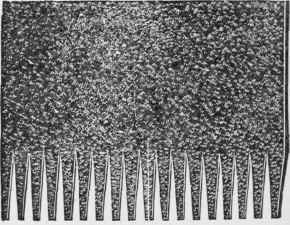
Fig. 29. Graining Comb.
After the combing is done and the paint dry, but before varnishing, a little black paint is mixed on the palette. A short, stiff, hog-hair brush is dabbed vertically upon this. so as to take up color on its end only. The brush is then held in the operator's left hand in front of the graining, with the handle about parallel with the face of the work and a few inches from it. By taking a chip of wood and drawing back the hairs with it so that they will spring forward again suddenly, a number of splashes or small dots of black are sprinkled over the work. On drawing a small badger brush downwards over the dots, they are drawn out into the lines noticed. A great deal of oak graining is done without these lines appearing in it at all.
Shading or glazing, which involves the use of oil paint, alters the tone or color of either new or old oak graining-Very thin color is spread over those parts which require to be deepened and enriched. A drying mixture is stained to the required color, the addition of megilp not being necessary. In matching old graining, the oil-glazing process assists in getting the mellowness which, independent of the graining, the aging of varnish imparts. The student who has mastered the foregoing instructions will find no difficulty in glazing certain portions of new work, in converting light to medium oak or the latter to dark oak. Occasionally the glazing principle is reversed, inasmuch as a panel is rubbed in, figured with lights and half-lights, but not combed; when dry, the oil color is again spread, and then combed with gutta-percha or cork combs. The grain which crosses the lights is wiped out, and the work is then overgrained and varnished. This method is too tedious for ordinary purposes, but the student will benefit by studying this process, with which far more natural effects can be obtained than with the usual methods.

Fig. 30. Graining Comb.
In glazing over water color, allow the under work to dry, then apply a coat of turpentine and gold size mixed. Glazing is frequently executed in oil, in which case it is easy to wipe out the lights with a rag. When the glazing is done in water color, the lights are wiped out with a damp wash-leather, a sponge being sometimes used to get certain desired effects. Vandyke brown, because of its richness of tone and transparency, is the color generally used for glazing. It is toned with burnt sienna for a warm tone, and with blue-black for a cold tone.
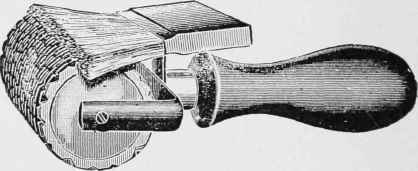
Fig. 31. Double Line Check Graining Roller.
For oak graining a wainscot in oil, make up the color for the ground from white-lead tinted with small quantities of yellow ochre and burnt sienna to match the lightest portion of the grain. If the oak is gray in tone, a touch of blue will secure the desired tint. To every 2 pounds of white-lead add 1 ounce of driers. When the work is dry, and before applying the graining color, rub it over with stale beer to which a morsel of whiting has been added. For combing, take raw sienna with burnt umber or Vandyke brown, according to the depth of color required. These colors can be procured very finely ground in oil. Mix up the colors with half oil and half turps, and add 1/2 ounce of driers to each pound of color as a megilp to enable the color to stand the combing. The overgraining color should be ground in water. Mix it up with equal quantities of beer and water. The work should be so managed that the overgraining will not contrast with the under work, but will darken it. A slight coat of turpentine, with which is mixed a small quantity of japanners' gold size, added after the work is dry, will bind down the overgrain and allow of the work being finally glazed with Vandyke brown mixed with oil.
Continue to:


My Books

