


Artichoke
Description
This section is from the book "The Steward's Handbook And Guide To Party Catering", by Jessup Whitehead. Also available from Amazon: Larousse Gastronomique.
Artichoke
There are two different vegetables called artichokes, and neither of them being in general use with us there is a good deal of mystification about the directions given for using them. One, the artichoke straight, is a sort of thistle, the green immature flower, with a little eatable material about the base; the other, the Jerusalem artichoke, is the root of a small sort of sunflower; it is like a misshapen potato. The directions given for cooking one look foolish when applied to the other. There are so many better vegetables that neither kind of artichoke is much thought of; the Jerusalem artichoke had its day before the potato came into general use. It is claimed now that it contains more nutriment than the potato, will grow anywhere and can remain in the ground all winter without injury. This root artichoke grows wild in the western prairie states. How the two dissimilar vegetables came to be called by the same name nobody now knows, but the term Jerusalem does not mean what it purports to; it is a corruption oiffira-sola - an Italian word meaning sunflower.
Still this mistaken name has led to a soup made of a puree of Jerusalem artichokes - like potato soup-being known everywhere as Palestine soup, in reference to Jerusalem city being in Palestine.
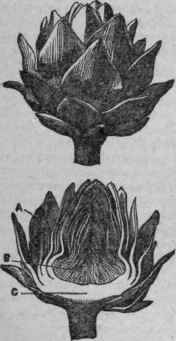
This, the thistle or globe-artichoke, is cultivated extensively for market over the water and to a small extent in the United States. It is also dried and exported. When to be cooked, the dried artichoke is steeped in water. It is the white part that is eatable; the center, called the choke, is cut out when the vegetable is half cooked, when it can be removed easily.
Stuffed Artichokes
The leaves and bottoms pared off, choke removed, cavity filled with stuffing, baked, served with a sauce or as a garnish to a dish of meat.
Artichokes A La Barigoule
The cavity filled with a fine herbs mince of mushrooms, parsley, shallots and minced pork in espa-gnole thickened, baked with a slice of pork over each stuffed artichoke, served without the pork, sauce over.
Artichokes A La Lyonnaise
Trimmed and pared down to the fleshy part, cut in quarters, cored, parboiled, simmered tender in seasoned broth; served with onion sauce, brown.
Artichokes Au Naturel
A Parisian authority contends that the only way to serve artichokes well is to steep them in cold water 2 hours, boil 1 hour, eat by pulling off each leaf with the fingers and dipping the eatable base in melted butter.
Artichauts A La Gouffe
Fried in batter, same as egg plant.
Artichauts Farcies A L'Italienne
Parboiled, insides removed, stuffed with bread, onion and grated cheese, cooked in little stock in a covered pan, served with brown Italian sauce.
Artichauts A L'Italienne
Quartered, cooked in wine and stock, served with white Italian sauce.
Artichoke Salad
(1)-The bottoms chopped small, mixed with heart lettuce also chopped; seasoned with oil vinegar, pepper and salt. (2)-Artichokes previously pared and quartered and steeped in water, containing lemon juice, are eaten as salad alone, with the usual seasonings.
Artichauts A La Hollandaise
Plain boiled and served with Hollandaise sauce to dip in.
Artichauts A La Bonne Femme
The same served with white sauce.
Artichauts A L'Essence De Jambon
Stuffed, braised and served, covered with a puree of ham.
Italian Gobbo
The growing leaves of the globe artichoke are doubled back, tied and covered with earth and white lumps form on the stalks, which are called gobbo; this species of salad is eaten raw with salt.
Artichoke, Jerusalem
The French name for it is Topinambeur, the old name of potatoes. This tuber is apt to turn dark in cooking as salsify does. To prevent that it is thrown into water containing vinegar as soon as pared, and not allowed to remain on the fire after it is done. A very general use of it in the southern states where the plant may be found growing in garden corners without attention is as a pickle; it is put up the same way as cucumbers, only scalded, not cooked soft.
Topin-Ambours A L'Italienne
Cut in shapes, stewed in stock, served with sauce.
Topinambours Au Gratin
Jerusalem artichokes boiled, mashed and baked with grated cheese on top.
Topinambours A La Soyer
Shaped like pears, boiled in water with onions, butter and salt; served with butter sauce poured over.
Artichoke Fritters
Same way as parsnip or salsify fritters, by mashing, mixing with egg and dropping spoonfuls in hot lard.
Fried Artichokes
Done same way as fried egg plant.
Artichoke Soup ("Palestine Soup")
Made with 12 ounces Jerusalem artichokes to each quart of chicken stock; turnips, celery and leeks added; all vegetables passed through a seive, and cream and yolk of eggs added - it is a cream puree of artichokes.
Continue to:


My Books

