


Dublin
Description
This section is from "The American Cyclopaedia", by George Ripley And Charles A. Dana. Also available from Amazon: The New American Cyclopædia. 16 volumes complete..
Dublin
I. An E. county of Ireland, in the province of Leinster, bordering on the Irish sea and the counties Meath, Kildare, and Wicklow; area, exclusive of Dublin city, 348 sq. m., of which 306 are arable; pop. in 1871, including the city, 405,625. It has a coast line, including windings, of 70 m., comprising the natural harbors of Dublin bay, Killiney, Malahide, Rogerstown, and Lough Shinney, with harbors constructed by art at Kingstown, Howth, and Balbriggan. The only river of importance is the Liffey. The county is generally level, but on the southern boundary rises a range of hills, culminating in the peak of Kippore at a height of 2,473 ft. Near these extend the Dublin mountains, the central group of which is 1,000 to 1,200 ft. high; toward the north are picturesque valleys and cultivated heights, and on the coast are many bold promontories. The geological formation is mostly mountain limestone, bounded S. by a ridge of granite. The soil is shallow, and in general not well adapted to agriculture, but careful drainage and manuring have rendered much of it productive. The principal crops are wheat, oats, barley, rye, potatoes, and turnips. Grazing and the fisheries form important branches of industry.
Lead and copper are mined to a small extent at Ballycorus. The manufactures are limited to stockings, cotton, and a few other fabrics. The principal towns, besides the city of Dublin, are Kingstown and Rathmines. II. The capital of the county and of Ireland, a municipal and parliamentary borough and seaport, situated at the head of Dublin bay, on both sides of the Liffey, in lat, 53° 23' N., Ion. 6° 20' W., 292 m. W. N. W. of London and 63 m. W. of Holyhead; pop. in 1871, with the suburbs, 295,841; without the suburbs, 245,722. The Liffey is navigable to the centre of the city, which is divided into two nearly equal portions. Its entrance is obstructed by a sand bar, on which at low ebbs there is not more than 9 ft. of water, although in spring tides it has 24 ft. At the mouth of this river in Dublin bay lies the harbor, formed by two breakwaters, one projecting E. into the bay S. of the river, the other running out from the shore beyond Clontarf, N. E. of the city, and nearly meeting the former at an angle of 40°. The area thus enclosed at high water spring tides is 3,030 acres, and by systematic dredging the channel has been so deepened as to admit vessels of 1,400 tons. The wharves and docks connected with the custom house are extensive.
There is a lighthouse at the end of the S. breakwater and in other parts of the bay are two other lights. A harbor of refuge has been constructed at Kingstown. The entrances at the port in 1871 were 7,286 vessels, tonnage 1,299,644; clearances, 3,745 vessels, tonnage 992,126. The trade of Dublin is chiefly with the midland districts, which it supplies with tea, coffee, sugar, tobacco, timber, deals, wines, and other foreign products, and with the English markets, to which it exports cattle and agricultural produce. With the United States its commerce is small, and confined mostly to timber. It has but few manufactures, and those of trifling value. Iron casting, cabinet making, and manufactures of the minor articles of jewelry and apparel are thriving, but afford employment to a very small part of the population. The manufacture of silk poplins was introduced by Huguenot refugees, and still flourishes to some extent. The well known Dublin porter is an important item in the trade of the city. The number of hogsheads exported in 1855 was 87,905; in 1862, 150,077; in 1871, 281,301. The quantity of distilled liquors exported in 1869 was 2,196 butts and puncheons, 4,520 hogsheads, 1,193 casks, and 3,268 quarter casks: - The modern part of Dublin is regularly built, without much architectural display, but with an appearance of substantiality and comfort.
The lower part is occupied by filthy streets of wretched tenements, inhabited by people as poor as their dwellings. In hardly any other city are wealth and poverty in such close and marked contrast. But the general aspect to strangers who follow the main thoroughfares is very favorable. The S. W. quarter is occupied by the poor, the N. W. by the middle classes, the S. E. and N. E. being the residence of the wealthy. The thickly populated part of the city has an extent of about 1 3/4 m. in each direction, but with the remainder it covers a space of 2 1/2 by 2 m. It is paved, lighted with gas, and supplied with water by works completed in 1868. Nine bridges, of which two are of iron, span the river, and an avenue called the Circular road, 9 m. long, encompasses the city. The public buildings are noted for their elegance. The bank of Ireland, in College green, was formerly used as the Irish parliament house. It is nearly semicircular with a fine Ionic colonnade. The chamber of lords remains as when last used. Immediately opposite the bank is Trinity college, an imposing Corinthian structure.
It was founded under authority of Pope John XXII., closed in the time of Henry VIII., and reopened by Elizabeth, who incorporated it in 1592 as the college of the holy and undivided Trinity. It contains a small museum, and an extensive library, rich in ancient MSS. Trinity college has a large faculty and about 1,300 students. Roman Catholics were for the first time admitted to scholarships in 1856. The queen's university, incorporated in 1850, with power to confer degrees on students of the queen's colleges of Belfast, Cork, and Gal-way, holds the meetings of its senate at Dublin castle. The Roman Catholic university in Stephen's green was founded in 1854. Among the other literary and scientific institutions are the colleges of physicians and of surgeons, apothecaries' hall, and medical societies; the royal Dublin society, having museums of natural history and of agriculture, a botanic garden, a gallery of statues, a library numbering over 30,000 volumes, a school of art, and free lectures; the royal Hibernian society of art, with an annual exhibition of paintings; the royal Irish academy of science, literature, and antiquities; the royal college of science, opened in November, 1868; the archaeological society, society of engineers, mechanics' institute, statistical, geological, and zoological societies, numerous other associations and reading societies, upward of 200 charity schools, and several libraries.
An agricultural college at Leop-ardstown, near Dublin, has a farm of 200 acres. An act of parliament was passed, Aug. 10, 1854, to provide for the establishment of a " national gallery of paintings, sculpture, and the fine arts," for the care of a public library, and the erection of a public museum; and the building was begun in 1859, and opened in 1864. It forms a northern wing to the premises of the royal Dublin society, its gallery end facing Merrion square, and the corresponding southern wing being devoted to the new museum. Although entitled the national gallery, it is also intended as a testimonial in commemoration of Mr. William Dargan's exertions in behalf of the great Dublin industrial exhibition of 1853. The cost of construction was £26,739. Thirty newspapers and periodicals were published in Dublin in 1873, among which were eight dailies. The castle, the residence of the viceroy, stands on an elevation, but is not an imposing edifice. The Four Courts are a pile of building of Corinthian architecture, with a frontage on the Liffey of 500 ft., and occupied by the courts of queen's bench, chancery, exchequer, and common pleas. The custom house is of the Doric order, and is surmounted by a cupola 125 ft. high.
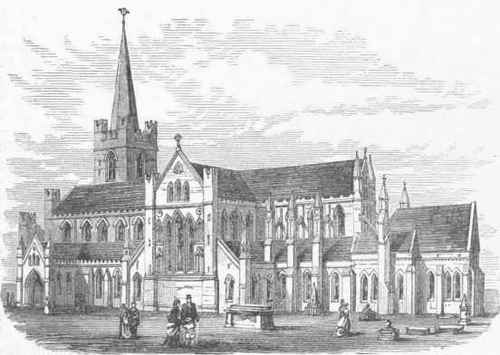
Other noticeable structures are the general post office, with an Ionic front, of considerable elegance; the city hall and exchange; the magnificent freemasons1 hall, erected in 1868; commercial buildings, in which is the chamber of commerce; the queen's inns, linen hall, the weavers' hall, corn exchange, conciliation hall, the theatre, several barracks for constabulary and troops; Stephen's hospital for 300 patients; the Meath, city of Dublin, Sir Richard Dun's, and Richmond surgical hospitals, and royal hospital, designed by Sir Christopher Wren, St. Patrick's Cathedral for disabled soldiers; and St. Patrick's hospital, erected from a legacy left by Dean Swift. The county jail stands W. of the suburbs, at Kil-mainham. Within the city are the Newgate, city and four courts, and marshalsea prisons, the bridewell or house of correction, Smith-field penitentiary, penitentiary for females, and house of industry. Dublin is the seat of a Protestant and a Roman Catholic archbishop, and has two ancient cathedrals of the Anglican church, those of St. Patrick and of the Holy Trinity, and a modern Catholic cathedral.
St. Patrick's cathedral was thoroughly restored in 1865, at a cost of £150,000, which was defrayed by Sir B. L. Guinness. The Anglican church has 20 parish churches and 20 non-parochial places of worship; the Roman Catholics have 9 parochial places of worship, 6 friaries, a Jesuits' church, 3 monasteries, and 8 convents; the other places of worship are : Presbyterian, 6; Unitarian, 2; Independent, 3; Primitive Wesleyan, 2; Wesleyan Methodist, 8; Friends', 2; Baptist, Moravian, Catholic Apostolic Church, Welsh Presbyterian, and Jewish, each 1. Among the chief streets and public places of Dublin are Grafton street, passing into College green, in which is an equestrian statue of William III., and connecting by Carlisle bridge with Sackville street, containing a column to the memory of Nelson; Dame street, containing many of the finest shops; St. Stephen's green, a square one mile in circumference, tastefully planted, and having a statue of George II.; College park, Fitzwilliam, Rutland, and Mountjoy squares. The celebrated Phoenix park comprises an area of 1,752 acres. A granite obelisk has been erected to Wellington on the left of the entrance. There is a statue of Thomas Moore, erected in 1857; and a colossal statue of Daniel O'Connell has been placed in the city hall.
Among the public testimonials more recently erected in Dublin are: a fountain with a bust of the eminent surgeon Sir Philip Crampton, erected in 1862, at the end of College street; a full-length statue of Oliver Gold-mith, in front of Trinity college, by Foley, in 1863; statues of the earl of Eg-linton, on the N. side of Stephen's green, in 1866; of Edmund Burke, by Foley, in 1868; of Smith O'Brien, by Farrell, in 1870; and of Prince Albert, by Foley, in 1872. Glasnevin is a pleasant suburb, containing the botanic garden of the royal Dublin society, and was the favorite residence of Addison, Steele, Swift, and Sheridan; and Glasnevin cemetery contains the tombs of O'Connell, "Tom Steele," and Curran. The Royal and Grand canals flank the city N. and S., and four railways give communication with Galway, Cork, Belfast, etc. Steam packets ply regularly to Holyhead, Liverpool, London, Bristol, Cork, Glasgow, etc. The environs of Dublin are remarkably beautiful. The bay, one of the finest in the United Kingdom, is 7 m. wide at its entrance, between Howth head on the north and Kingstown on the south, and extends inland about the same distance, with a somewhat increased width.
The civic government is by the municipal reform act vested in a corporation consisting of a lord mayor chosen annually from among the aldermen or town councillors, 15 aldermen, and 45 councillors, there being one alderman and three councillors from each of the 15 municipal wards. The corporate income amounted in 1871 to £196,175, the expenditure to £192,577, and the debt to £782, 609. The city sends two members to parliament, and Trinity college two. - Dublin claims a high antiquity. Curious Celtic remains were found in 1856 within the town walls of ancient Dublin. It is the Eblana of Ptolemy; Irish Dubh-linn (black pool); Danish Dyflin and Dyvelin. About the middle of the 9th century it was taken by the Danes. The records of the next three centuries are little else than a succession of bloody battles. In 1170 it was taken by the English under Strongbow, who died and is buried there. In 1205 the castle was built; in 1190, 1283, 1301, and 1304, the city was burned; in 1405 the citizens made a descent on Wales for Henry IV. During the first half of the 16th century it was troubled by the Kildare family, one of whom, Lord Thomas Fitzgerald, among other exploits, murdered the archbishop.
During Richard Cromwell's feeble protectorate the city was seized by the cavaliers, recovered by the parliamentarians, and again captured by the partisans of the king. In 1798 a conspiracy to seize the city and castle was frustrated by the arrest of Lord Edward Fitzgerald and others. In 1803 occurred Emmet's insurrection.
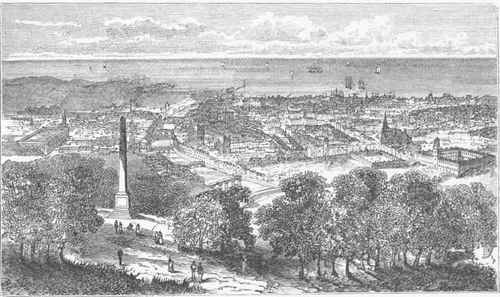
View of Dublin from Phoenix Park.
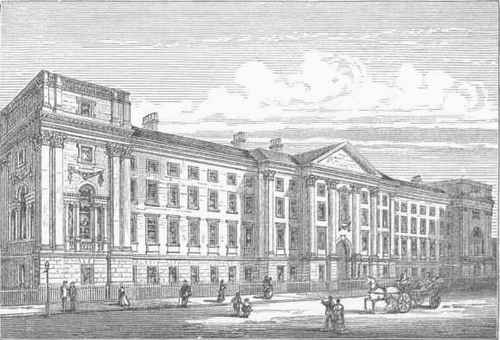
Trinity College.
Continue to:


My Books

